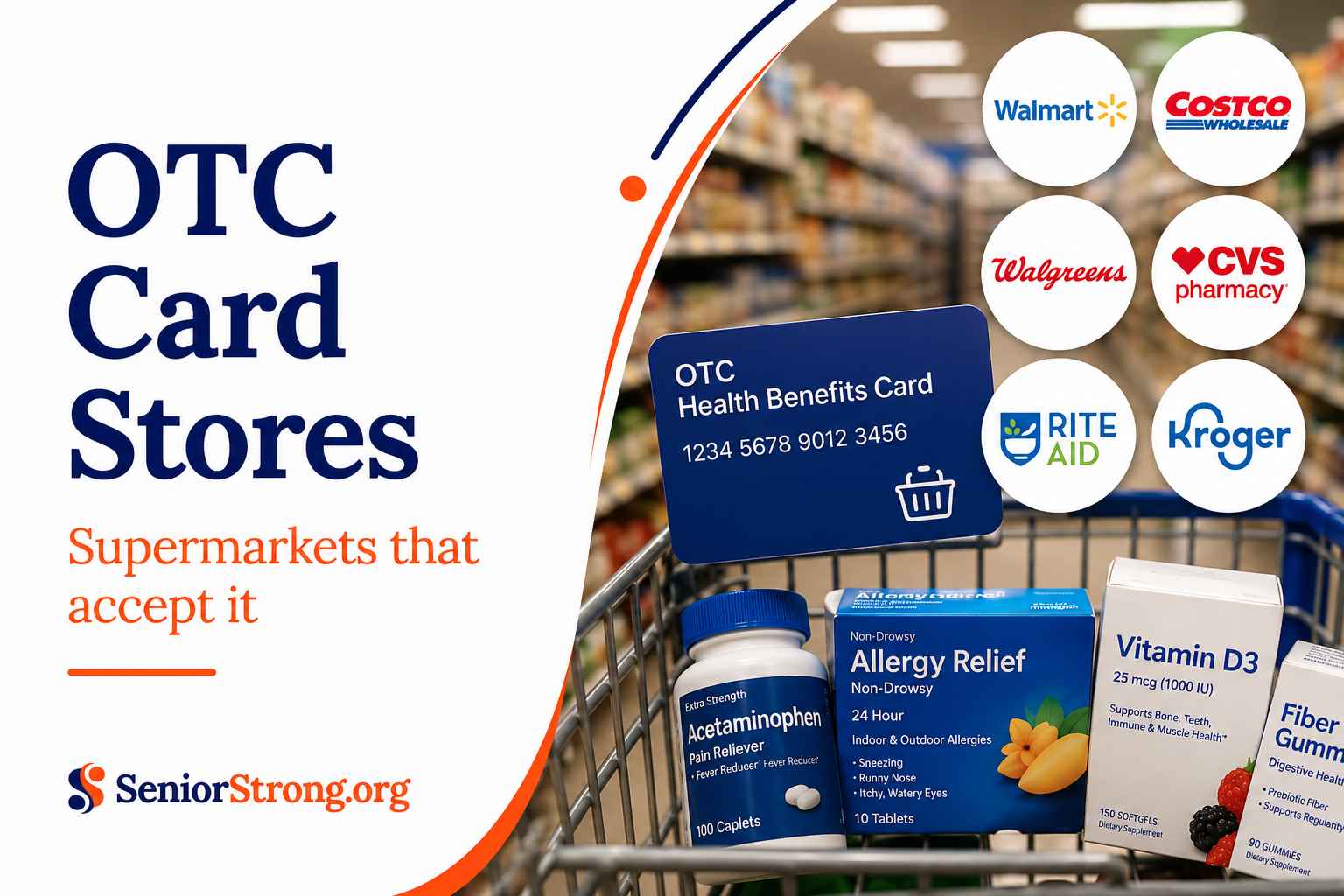
Walmart, Kroger, Costco, Publix, Safeway, Albertsons, Stop & Shop, ShopRite, Meijer, and Food Lion are among the major supermarkets that accept OTC card benefits in 2026, along with pharmacies like CVS and Walgreens, discount chains like Dollar General and Family Dollar, and online platforms including Amazon and Instacart. According to Kaiser Family Foundation data summarized by eHealth, about 79% of MedicareA federal health insurance program for people who are 65 or older, certain younger people with disab... Advantage enrollees in 2025 were in plans offering over-the-counter benefits, which is why knowing where to use the card has become a high-value question for millions of seniors and the family members helping them shop.
This guide covers which supermarkets accept OTC card payments in 2026, how to confirm acceptance before you check out, what you can and cannot buy with the card, and the most common reasons a card gets declined at the register. For background on the broader benefit, see our overview of the top benefits of Medicare Advantage plans for seniors.
OTC card acceptance has expanded well beyond traditional pharmacies. In 2026, the largest national and regional supermarket chains process OTC card payments for eligible health items at their regular registers, and several have integrated their point-of-sale systems to automatically separate eligible items at checkout.
Major chains widely listed by insurers and the OTC Network as participating retailers include Walmart, Kroger, Costco, Publix, Albertsons, Safeway, Vons, Stop & Shop, ShopRite, Price Rite, Meijer, Giant Eagle, Food Lion, The Giant Company, Sedano’s, and Save A Lot. The Kroger family of stores covers a wider footprint than the Kroger banner alone, with Fred Meyer, Fry’s, Ralphs, King Soopers, QFC, Smith’s, Pick’n Save, Mariano’s, Dillons, and Food 4 Less all part of the same network. The Albertsons family similarly includes Vons, Jewel-Osco, Shaw’s, Acme, Tom Thumb, Randalls, Pavilions, Star Market, Haggen, and Carrs.
One of the newest additions to the OTC supermarket landscape is Wakefern Food Corp, which announced in September 2025 that its ShopRite, Price Rite, and other stores would begin accepting OTC benefit cards from InComm Healthcare, NationsBenefits, and S3 Health Benefit. According to the company’s press release, members of participating health plans can now shop in-store at Wakefern banners knowing they can use their OTC benefit cards to purchase qualified products, including medications, vitamins, first aid supplies, personal care products, and certain healthy foods.
What still matters most: your specific plan defines which of these stores you can use. A card from one Medicare Advantage planA type of Medicare health plan offered by a private company that contracts with Medicare to provide ... may work at Kroger but not at Costco. A card from a different plan may reverse that. The retailer’s signage and the OTC Network logo are useful indicators, but the real source of truth is your plan’s catalog, mobile app, or member portal.
The following table summarizes where major retailers accept OTC cards, what’s typically supported in-store and online, and points worth knowing before you shop. Acceptance still depends on your individual Medicare Advantage plan, so use this as a starting point rather than a guarantee.
| Retailer | In-Store | Online | Notes |
|---|---|---|---|
| Walmart | Yes | Yes (walmart.com) | Wide acceptance for OTC items and approved groceries under D-SNP food allowances |
| Kroger | Yes | Limited | Auto-sorts eligible items at checkout; some accepted cards are in-store only |
| Costco | Yes | Some plans | Accepted at all registers, including pharmacy; Costco membership required |
| Publix | Yes | No | Participating locations; verify with your specific plan |
| Albertsons / Safeway | Yes | Via Instacart | Includes Vons, Jewel-Osco, Acme, Tom Thumb, Pavilions, Star Market, and Randalls |
| Stop & Shop | Yes | Yes | Strong support in the Northeast for both OTC and OTC Plus cards |
| ShopRite / Price Rite | Yes | No | Wakefern began accepting OTC cards in September 2025 |
| Meijer | Yes | Some plans | Common in Priority Health and other Midwest carrier networks |
| CVS Pharmacy | Yes | Yes | Look for blue OTC tags; not accepted at CVS-in-Target or CVS-in-Schnucks locations |
| Walgreens | Yes | Yes (walgreens.com) | Dedicated OTC benefits shopping page online |
| Dollar General | Yes | No | Wide rural footprint; useful for seniors without nearby supermarkets |
| Amazon | N/A | Yes (Amazon Health) | Link your OTC card to your Amazon Health profile to filter eligible products |
| Instacart | N/A | Yes | Connects to 1,400+ retailer brands including ALDI, Sprouts, and Wegmans |
The safest way to avoid a declined transaction is to confirm acceptance before you go to the store, then double-check at checkout. Follow these seven steps to make sure your card willA legal document that states how a person's property should be managed and distributed after death. work at the supermarket you plan to visit.
OTC card coverage is restricted to non-prescription health and wellness items in most plans, with limited exceptions for grocery allowances offered by Dual-Eligible Special Needs Plans (D-SNPs) and certain chronic-condition plans. Knowing the difference between an OTC card, a flex card, and an OTC Plus card is the first step in figuring out what you can actually put on the register.
Over-the-Counter (OTC) Card: A prepaid debit card issued by some Medicare Advantage and MedicaidA state and federal program that provides health coverage to eligible low-income adults, children, p... managed care plans that holds a monthly, quarterly, or annual allowance for approved health items.
OTC Network: A national payment network that processes OTC card transactions at participating retailers. Most of the major supermarkets and pharmacies in this guide use this network.
D-SNP (Dual-Eligible Special Needs Plan): A Medicare Advantage plan for people who qualify for both Medicare and Medicaid. These plans more often include a healthy food or grocery allowance in addition to standard OTC coverage.
OTC Plus Card: A card variant offered by some health plans, including Healthfirst and EmblemHealth, that allows healthy food purchases at participating supermarkets in addition to standard OTC items.
Medicare Flex Card: A broader prepaid card from some Medicare Advantage plans that may cover dental, vision, hearing, and other expenses on top of OTC items.
D-SNP enrollees on certain plans (Healthfirst OTC Plus, Devoted Health Food & Home, Humana Healthy Foods, and others) may also buy fresh fruits, vegetables, dairy, meats, eggs, rice, pasta, beans, and other approved foods at participating supermarkets. Devoted Health, for example, lists Walmart, Kroger, Dollar General, Publix, Food Lion, Safeway, The Giant Company, Giant Eagle, Albertsons, and Sedano’s as participating food retailers in 2026.
Pharmacies are still the most reliable place to use an OTC card. CVS, Walgreens, and Rite Aid all process OTC benefit cards at the register, and CVS displays blue tags on shelves to identify items widely covered across plans. Two CVS-specific exceptions are worth knowing: CVS locations inside Target stores and CVS locations inside Schnucks supermarkets cannot process OTC benefits at the in-store register, according to CVS. To use your card in person, visit a stand-alone CVS Pharmacy.
For seniors in rural areas without a nearby supermarket or pharmacy chain, discount retailers fill the gap. Dollar General and Family Dollar both participate in OTC card networks for many plans, which matters because Dollar General now operates more than 20,000 stores across the country, expanding card access in rural communities where pharmacy options are limited. EmblemHealth, for example, explicitly lists Dollar General, Family Dollar, and Save A Lot as in-network OTC retailers for its Essential Plan.
Many independent pharmacies also process OTC card payments, either through integrated point-of-sale systems or specialized handheld terminals from networks like OTC Health Solutions and the OTC Network. If you have a relationship with a local independent pharmacy and prefer to use it, ask the pharmacist directly whether they accept your specific OTC card network. Smaller pharmacies often have closer relationships with longtime customers and can flag eligible items before you check out.
For seniors with mobility challenges, transportation barriers, or simply a preference for delivery, online OTC shopping is now broadly available. The two largest platforms are Amazon and Instacart, with most major plans also offering their own direct online portals.
Amazon Health OTC Benefits lets eligible Medicare Advantage members link an OTC card to their Amazon Health profile and shop a filtered catalog of approved items. The site automatically shows which products are eligible against the linked card, which removes much of the guesswork at checkout.
Instacart partners with the OTC Network to enable card payments across more than 1,400 retailer brands, including Albertsons, ALDI, Costco, CVS, Kroger, Publix, Sam’s Club, Sprouts, Wegmans, and many regional chains. Members add their OTC Network card to their Instacart account, then see an OTC Network label next to eligible items as they shop. Orders need to be at least $10 to qualify for delivery.
Some plans also offer direct online portals. Healthfirst lets members shop at walmart.com and instacart.com or through ConveyHFOTC for no-cost delivery. EmblemHealth offers Amazon-delivered OTC orders for eligible members. Priority Health, Devoted Health, Humana, UnitedHealthcare, and others maintain plan-specific shopping sites with current product catalogs and order-by-phone options for members who prefer not to shop online.
For family caregivers managing OTC shopping on behalf of a parent, online ordering is often the most efficient route. You can log into the parent’s plan portal, place the order under their card, and have it shipped directly to their home, all without a store visit. This is especially useful in winter, during a recovery period after surgery, or when a parent is no longer driving. A short conversation with the parent about what they need, followed by a 10-minute online order at the start of each benefit cycle, can save real money over the course of a year.
A declined transaction at the supermarket is stressful, especially in a busy line. The good news: most declines come from one of six predictable reasons, and each has a straightforward fix.
Caitlin Donovan, senior director at the National Patient Advocate Foundation, has emphasized in CVS materials that using the Medicare Advantage OTC benefit is crucial because so many beneficiaries leave dollars on the table by not understanding their allowance or how to spend it. Knowing the most common decline reasons in advance is the simplest defense against losing those dollars.
According to data summarized by Chapter, an estimated 70% of OTC benefits go unused each year, which equates to about $5 billion in unspent allowance dollars across all OTC recipients. That is a striking number in a population that often manages out-of-pocket health costs on a fixed income.
Three patterns explain most of the unused balance. First, seniors and caregivers often do not realize the benefit is included in their plan. A Humana, Aetna, UnitedHealthcare, or WellCare Medicare Advantage plan may include an OTC allowance that the enrollee was never explicitly told about during enrollment. Second, the use-it-or-lose-it structure surprises people. Allowances typically reset monthly or quarterly, and unused balances rarely roll over, so a senior who plans to save up for a bigger purchase often loses the funds when the next cycle starts. Third, confusion about which supermarket or store accepts the card leaves the card sitting in a drawer.
In our experience at SeniorStrong, the simplest fix is the most overlooked. Set a calendar reminder for the last week of each benefit cycle, take a quick look at your balance, and stock up on items you regularly use. Bandages, multivitamins, toothpaste, denture cleaner, and pain relievers do not expire quickly. Buying them with allowance dollars you would otherwise lose is the cleanest way to convert a use-it-or-lose-it benefit into real savings.
For caregivers, this is also a practical kindness to a parent. A 15-minute online order at the end of each month, charged to a parent’s OTC card and shipped to their home, can save the family several hundred dollars over the course of a year without requiring the parent to make a trip to the store. It also opens the door to a useful conversation about what items the parent is actually using and whether their current plan’s benefits fit their real needs.
As of 2026, OTC cards are easier to use than they were a few years ago, but they are still not universal store gift cards. Walmart, Kroger, Costco, Albertsons, Safeway, ShopRite, Price Rite, CVS, Walgreens, Dollar General, Amazon, and Instacart all support OTC or benefit-card shopping in some form, but your exact access depends on your Medicare Advantage plan, benefit administrator, ZIP code, and eligible-item list. Before you shop, check your plan’s retailer locator, confirm your balance, and keep a backup payment method ready for items your card does not cover.
To make the most of your benefits, set a reminder near the end of each monthly or quarterly cycle and use your remaining allowance on everyday health items like pain relievers, toothpaste, vitamins, bandages, denture care, and incontinence supplies. For a retailer-specific breakdown, read our guide on whether Target accepts OTC cards and how its rules compare with major supermarkets.
In most plans, no. Standard OTC cards only cover non-prescription health and wellness items at supermarkets. However, Dual-Eligible Special Needs Plans (D-SNPs) and some chronic-condition plans offer separate grocery or food allowances that cover fresh produce, dairy, meats, and other healthy foods at participating supermarkets like Walmart, Kroger, Publix, and Food Lion.
Some do, some do not. Kroger, Walmart, and other major chains with integrated point-of-sale systems often auto-sort eligible items, charging only the approved products to the OTC card and prompting for a second payment method for the rest. Smaller stores and independent supermarkets may require you to ring up eligible items separately.
An OTC card has a fixed allowance restricted to non-prescription health items at participating retailers. A Medicare flex card is broader, offered by some Medicare Advantage plans, and can also cover dental, vision, hearing, or even certain grocery and utility expenses, depending on the plan. Flex card eligibility rules vary widely by plan, so check your specific plan documents.
Yes. You can check your balance through your plan’s mobile app, by logging into your member portal, by using the OTC Network app or MyBenefitsCenter.com, or by calling the customer service number on the back of the card. Checking before each shopping trip is the easiest way to avoid a declined transaction at the register.
Yes, both draw from the same allowance. Whether you shop at Walmart in person, on Walmart.com, through Amazon Health, through Instacart, or through your plan’s online portal, eligible items are charged against the same monthly or quarterly OTC balance.
CVS confirms that CVS Pharmacy locations inside Target stores and Schnucks supermarkets cannot process OTC benefits at the register. To use your CVS Flex Benefits card in person, visit a stand-alone CVS Pharmacy location. The same restriction does not apply to CVS online ordering.
Target accepts FSA and HSA cards for eligible medical expenses, and Medicare Advantage OTC card acceptance varies by plan and location. For a deeper breakdown, see our companion guide on whether Target accepts OTC cards and how Target’s acceptance compares with major supermarkets.