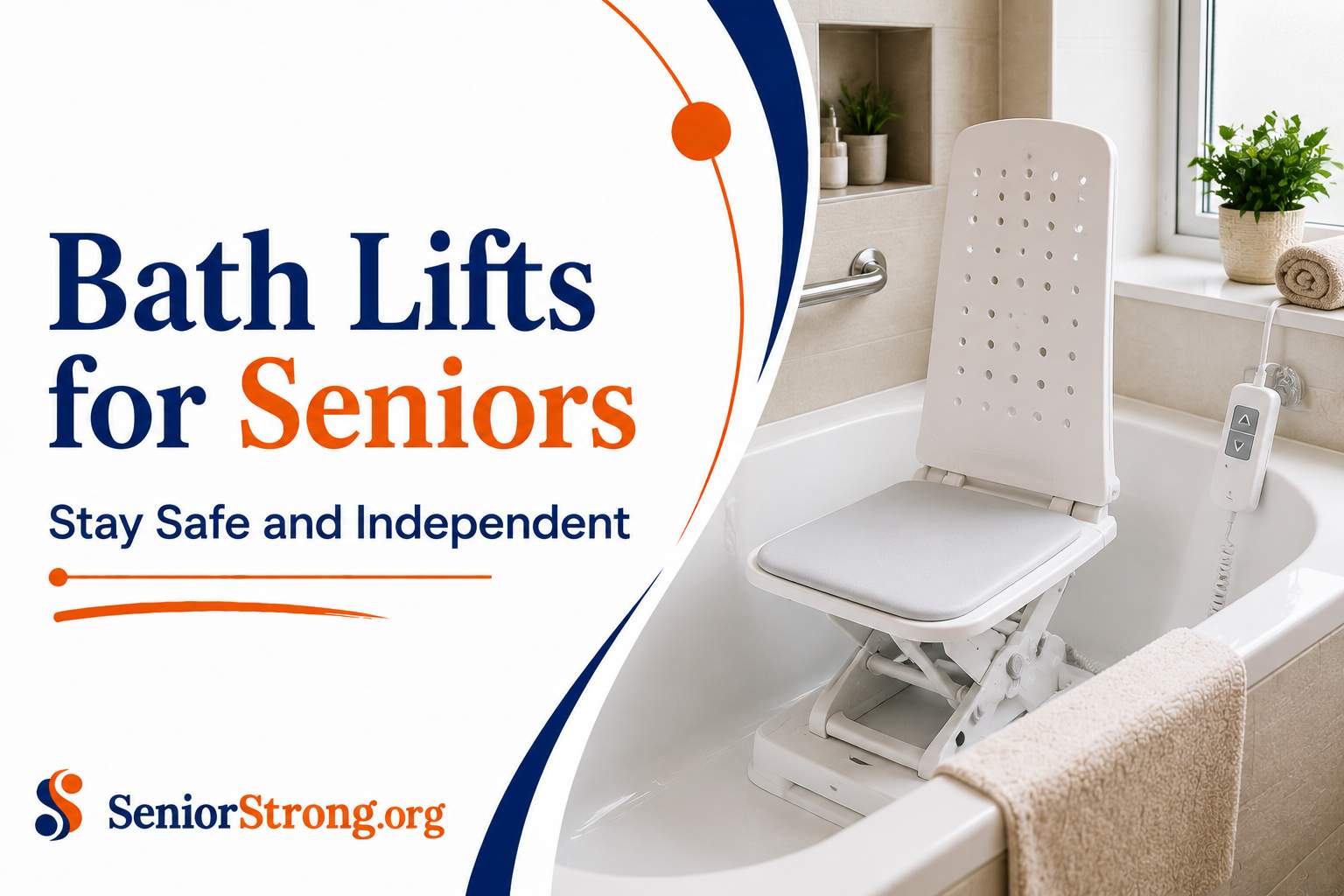
A bath lift for the elderly is a battery-powered seat that lowers a person into the bathtub and raises them back out, so they can bathe without climbing over the tub wall or lowering themselves to the bottom. It gives seniors with limited strength, balance, or mobility a way to keep bathing on their own.
This matters because the bathroom is one of the riskiest rooms in the house. More than one in four adults aged 65 and older fall each year, and falls send about 3 million older Americans to the emergency room annually, according to the CDC. A bath lift removes the two hardest moments of a bath: getting down to the water and getting back up.
Below, you willA legal document that states how a person's property should be managed and distributed after death. learn the four main types of bath liftsMechanical seats that help individuals move in and out of a bathtub safely and with ease., how to pick the right one, what each type costs, whether MedicareA federal health insurance program for people who are 65 or older, certain younger people with disab... helps, and how to use one safely.
A bath lift is a powered seat that sits inside your existing bathtub and uses a waterproof handset to lower you into the water and lift you back to the rim. It does the physical work that knees, hips, and arms struggle with, so a senior can bathe seated and unassisted instead of risking a slip getting in or out.
A bath lift is a good match for an older adult who still enjoys a real bath but no longer feels steady stepping over the tub wall or pushing back up from the bottom. It also helps people recovering from hip or knee surgery, those with arthritisAn inflammation of the joints that causes pain and stiffness and is more common in older adults. or Parkinson's disease, and anyone whose balance has changed enough that bathing has started to feel unsafe.
For families, a bath lift often answers a quieter worry. A parent who has stopped bathing as often, or who waits until someone else is home, may be avoiding the tub because it scares them. A lift can bring back the independence and privacy that make bathing feel normal again, without a full bathroom remodel.
Bathrooms combine wet surfaces, hard fixtures, and movements that test balance, which makes them the single most dangerous room for older adults. The numbers are blunt: more than 14 million adults 65 and older report a fall each year, and falls are the leading cause of injury in this age group.
The bathroom carries an outsized share of that risk. UCLA Health reports that an estimated 80% of falls in the home happen in the bathroom, where getting in and out of the tub, on and off the toilet, and drying off all demand strength and steadiness at once.
The consequences are serious and rising. The National Safety Council reports that 43,020 adults 65 and older died from preventable falls in 2024, and that fall-related emergency department visits among older adults rose 38% over the past decade. The CDC estimates that about 37% of seniors who fall suffer an injury needing medical care or limiting their activity for at least a day.
There is a psychological cost too. After one fall, many seniors develop a fear of falling and start doing less, which weakens muscles and raises the odds of the next fall. A single bad bathroom fall can shrink a person's whole routine. A bath lift breaks that cycle by making the riskiest part of the day predictable and controlled.
Bath lifts fall into four groups, each built for a different level of mobility and caregiverAn individual who provides care to someone who needs help with daily tasks and activities due to chr... involvement. Chair-style lifts suit most seniors who can transfer on their own; transfer and mobile systems are built for people who need hands-on help. The table below shows how they line up.
| Type | How it works | Best for | Typical price |
|---|---|---|---|
| Chair-style | A battery-powered seat suctioned to the tub floor lowers and raises the user with a waterproof remote. Many recline. | Independent seniors who can shift onto a seat but cannot safely lower to the tub floor. | $150 to $1,000+ |
| Mobile system | A wheeled lift rolls to the tub and positions the user, shifting the lifting effort off the caregiver. | Users who transfer from a wheelchair and need hands-on assistance. | $1,000+ |
| Inflatable cushion | An air compressor inflates and deflates a cushion to gently raise and lower the bather. Folds flat for storage. | Seniors who travel, rent, or share a bathroom and want no installation. | $300 to $900 |
| Sliding or swivel transfer bench | A seat bridges the tub wall so the user slides or swivels across instead of lifting their legs over the edge. | People who cannot lift their legs over the tub threshold. | $1,000+ |
Chair-style lifts are the most common recommendation because they balance safety, comfort, and price. Battery life is strong on quality models: many deliver 7 to 12 lifts per charge, and some advanced units last two to three weeks of normal use before needing a recharge.
The right bath lift depends on the user's body and the tub's dimensions, not on the longest feature list. Measure first, then match the model to the person. Work through these six factors in order before you buy.
A bath lift is only as safe as the routine around it. Follow the same six steps every time, whether the senior bathes alone or with help, to keep each bath stable from start to finish.
Bath lifts cost far less than a tub replacement. Prices run from about $150 for a basic seat to more than $1,000 for a premium powered system, which makes them one of the most affordable bathroom safety upgrades available. The table shows what each tier buys.
| Price tier | Range | What you get |
|---|---|---|
| Basic | $150 to $500 | A simple, functional powered seat with minimal extras. Suitable for users who mainly need help getting down and back up. |
| Mid-range | $500 to $1,000 | Adjustable height, a reclining backrest, and added support features for greater comfort and stability. |
| Premium | $1,000+ | Advanced motorized mechanisms and heavier-duty support, built for users who need extensive assistance or wheelchair transfers. |
Now the question families ask most: does insurance help? As of 2026, Original Medicare (Parts A and B) generally does not cover bath lifts or walk-in tubs, because it classifies them as convenience or comfort items rather than durable medical equipment. A doctor’s prescription generally does not change the coverage decision; such approvals are rare and arrive as reimbursement after purchase, not before. Some Medicare Advantage plans may offer separate home-safety, supplemental, or over-the-counter benefits, but coverage varies by plan.
Other paths are more reliable, and this is where it pays to check every option:
For a sense of how bath lifts compare on cost with a permanent fixture, the National Council on Aging notes that walk-in tubs run from roughly $3,500 to $20,000 installed, while a bath lift typically costs a few hundred dollars and needs no construction.
A bath lift is not the only way to make bathing safer, and it is not always the best fit. The right choice depends on whether the senior wants real baths, how much they can spend, and whether they are willing to remodel. Here is how the three most common options compare.
| Option | Best for | Cost | Tradeoff |
|---|---|---|---|
| Bath lift | Seniors who love a soak but cannot get down to or up from the tub floor. | $150 to $1,000+ | Keeps full baths and needs no install, but takes up the tub and has a weight limit. |
| Walk-in tubA bathtub designed with a door to avoid the need to step over the tub edge, reducing the risk of fal... | Those wanting a permanent, low-threshold tub with built-in seating and grab bars. | $3,500 to $20,000 | Safest permanent fixture, but expensive and requires installation and a fill-and-drain wait. |
| Shower chair | Seniors who prefer showers or need the simplest, cheapest seated option. | $25 to $180 | Very affordable and portable, but offers no help lowering into a tub. |
If the person in your care prefers showers, a shower or bath chair may solve the problem for a fraction of the price. If they want real baths and independence without a remodel, a bath lift is usually the strongest middle option.
Many seniors resist a bath lift at first because it feels like a sign of decline. The device that most protects a parent is often the one they most want to refuse. The way you raise it matters as much as the product you choose.
Lead with independence, not safety. A bath lift means bathing alone again, with the door closed, on their own schedule. Framed that way, it reads as freedom rather than surrender. Bring the parent into the decision by comparing two or three models together instead of presenting one as already chosen.
It also helps to time the conversation away from a crisis. Raising it calmly, before a fall forces the issue, gives a parent room to think it over without feeling cornered. If the talk stalls, a short trial with a rented or inflatable lift can let them feel the benefit before committing to a purchase.
In our product evaluations, the difference between a good bath lift and a frustrating one rarely shows up on the spec sheet. It shows up the third week of use. We pay closest attention to three things that owners report after the novelty wears off.
First, suction reliability on the specific tub. A lift that holds firmly on a smooth acrylic tub can creep on a textured non-slip floor, which is a safety problem, not a comfort one. We flag any model whose base struggles on common tub surfaces. Second, handset durability, because a waterproof remote that fails leaves a senior stuck at the bottom of the tub. Third, recharge habits: the units people abandon are usually the ones with awkward charging, not weak motors.
Our consistent advice to families is to match the lift to the tub and the person before chasing premium features. A $300 model that fits the tub and the user's strength will serve better than a $900 model that does not seat securely. That is the same standard we apply across every product we review: real conditions over marketing claims.
A bath lift for the elderly solves a specific, high-stakes problem: it removes the fall risk from getting into and out of the tub while keeping a senior's independence intact. For a few hundred dollars and no remodel, it addresses the room where most home falls happen.
As of 2026, the smartest approach is to measure the tub, match the model to the user's weight and mobility, and check Medicaid, Medicare Advantage, and VA options before paying full price. Insurance rarely covers a bath lift outright, but the right funding path can lower the cost.
For added peace of mind at home, review Senior Strong’s guide to the best medical alert systems for the elderly to find a device that can help summon assistance quickly in an emergency.
Original Medicare usually does not cover bath lifts, because it treats them as convenience items rather than durable medical equipment. Rare exceptions exist with documented medical necessity. Medicaid waivers, VA HISA grants, and some Medicare Advantage plans are more reliable funding paths.
Most standard bath lifts support between 300 and 375 pounds. Always check the exact weight capacity printed for the specific model and confirm it exceeds the user's weight with a comfortable margin. Never exceed the stated limit, since it affects stability and safety.
Yes. Most chair-style and inflatable bath lifts require no permanent installation. You place the seat in the tub, press the suction cups onto a clean, dry, smooth surface, and confirm it holds before use. This is a major advantage over walk-in tubs, which need professional installation.
Most quality bath lifts deliver 7 to 12 lifts per full charge, and some advanced models run two to three weeks of normal use before recharging. A safe lift includes a low-power lockout that will not lower the seat unless there is enough charge to raise it again.
Bath lifts are designed for solo use, which is part of their appeal. A senior living alone should pair the lift with grab bars, keep a phone or medical alert device within reach, and follow a consistent transfer routine. For higher-risk users, a caregiver check-in adds an extra layer of safety.