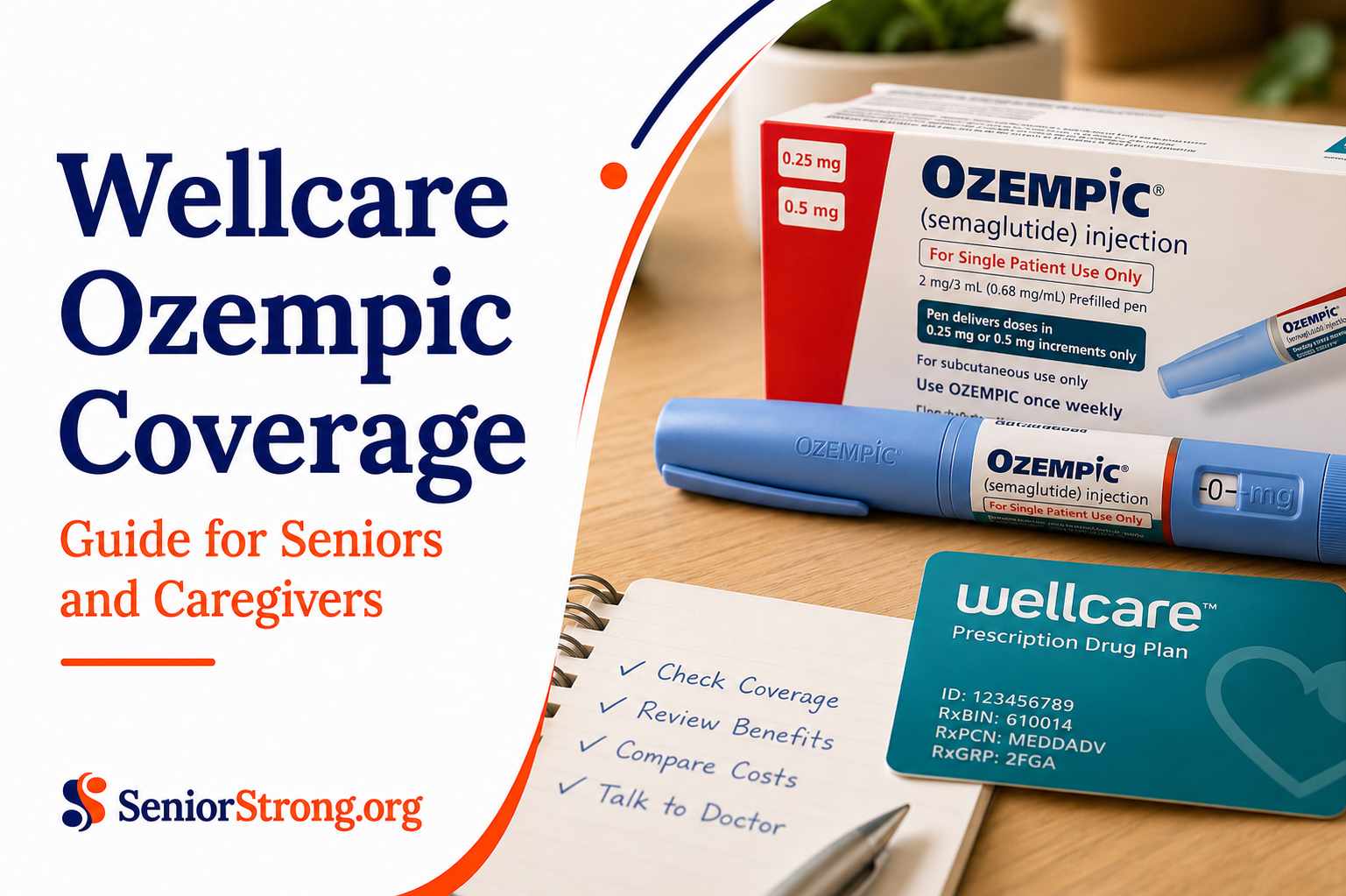
Yes, Wellcare Medicare Part DA program that helps cover the cost of prescription drugs, available to anyone who has Medicare. and Medicare Advantage prescription plans cover Ozempic, but only when it is prescribed for an FDA-approved indication like Type 2 diabetesA chronic condition that affects the way the body processes blood sugar (glucose), requiring ongoing..., and only after prior authorization is approved. Wellcare does not cover Ozempic for weight loss. Coverage also depends on your specific plan's formulary, step therapy rules, and quantity limits. In 2026, Medicare Part D caps your annual out-of-pocket drug costs at $2,100, which gives covered Ozempic users real financial protection once they hit that amount.
This guide walks both seniors and their family caregivers through what Wellcare covers, the prior authorization process, what Ozempic costs under Part D, and how the new MedicareA federal health insurance program for people who are 65 or older, certain younger people with disab... GLP-1 Bridge program changes the picture.
Yes, Wellcare Medicare Part D and Medicare Advantage plans with drug coverage may cover Ozempic when it is prescribed for an FDA-approved use. According to Wellcare's official 2026 GLP-1 policy, the plan covers Ozempic, Rybelsus, Trulicity, Victoza, and Mounjaro when they are used for blood sugar control in patients with Type 2 diabetes. Coverage is tied to the diagnosis on the prescription, not the medication itself.
Ozempic, the brand name for semaglutide, has three FDA-approved indications that can support Wellcare coverage. Each one requires documented clinical evidence in the prior authorization request. A doctor cannot simply write a prescription and expect the plan to approve it without supporting records.
What Wellcare does not cover: Ozempic, prescribed only for weight loss, prediabetes, insulin resistance, or any off-label use, willA legal document that states how a person's property should be managed and distributed after death. be denied. Federal law specifically excludes drugs used for weight loss from Medicare Part D coverage, and Wellcare follows that rule across every plan it offers. If a senior or caregiverAn individual who provides care to someone who needs help with daily tasks and activities due to chr... is being told otherwise by a pharmacy or third-party seller, that is a red flag.
Wellcare requires prior authorization (PA) for Ozempic on every Medicare plan it offers. The PA process is the plan's way of confirming that the prescription matches an approved diagnosis, that less expensive alternatives have been tried where appropriate, and that the medication is medically necessary for this specific patient. The standard review time is 5 to 7 business days, with expedited review available for urgent medical needs.
The PA decision is made by Wellcare's pharmacy review team based on documentation submitted by your prescriber. The full process has six steps that determine whether Ozempic will be filled at your pharmacy or denied.
Quantity limits matter. Even after approval, Wellcare typically authorizes one 3 mL Ozempic pen per month. Requests for a higher dose or shorter refill window require additional clinical justification, which means a second round of documentation if the dose changes.
If your Wellcare plan covers Ozempic, your out-of-pocket cost depends on which phase of the Part D benefit you are in. The 2026 standard benefit has three stages, and CMS confirmed the annual out-of-pocket cap is $2,100, up from $2,000 in 2025. Once that cap is reached, you pay nothing for covered Part D drugs for the rest of the year.
If Wellcare denies your prior authorization, you become responsible for the full retail price. The list price for one Ozempic pen is approximately $935 per month, which means a yearly cost of more than $11,000 if paid in full out of pocket. That gap, between covered and not covered, is the single largest financial decision the prior authorization process creates.
| Coverage Stage | What You Pay | What Counts Toward $2,100 Cap |
|---|---|---|
| Deductible phase | Up to $615 (full plan deductible) before coverage kicks in | Yes, deductible payments count |
| Initial coverage phase | 25% coinsurance or fixed copay, depending on plan | Yes, copays and coinsurance count |
| Catastrophic phase | $0 for the rest of the calendar year | The cap is already reached |
| Without coverage (denied PA) | Approximately $935 per month list price | No, out-of-pocket spending on non-covered drugs does not count |
A note on premiums. The $2,100 cap does not include your Wellcare monthly premium. Premiums are paid separately and do not count toward the out-of-pocket maximumThe most a consumer would have to pay for covered medical expenses in a policy period, after which t.... Some Wellcare Part D plans offer $0 premiums in many states; others charge a modest monthly amount. Review your plan's annual notice of change every September before open enrollment to confirm the 2026 numbers for your specific plan.
No, the Medicare GLP-1 Bridge does not cover Ozempic. The GLP-1 Bridge is a CMS demonstration program that begins July 1, 2026, and runs through December 31, 2027. It provides eligible Medicare Part D beneficiaries with three weight-loss GLP-1 medications for a flat $50 monthly copay. Ozempic is not one of them.
The Bridge specifically covers Wegovy (semaglutide injection and tablets), Zepbound KwikPen (tirzepatide), and Foundayo when prescribed for weight reduction in adults who meet the clinical criteria. According to the CMS announcement, eligibility requires a body mass index of 27 or higher, along with at least one weight-related health condition such as heart diseaseA broad term for a range of diseases affecting the heart and blood vessels, often related to atheros... or prediabetes.
Ozempic is FDA-approved for Type 2 diabetes, not for weight loss. The Bridge program was designed by CMS to fill a specific gap, which is the long-standing Part D exclusion on drugs used for weight management. Ozempic, prescribed for diabetes, is already eligible for Part D coverage under existing rules, so it does not need to flow through the Bridge.
One important caveat. The $50 Bridge copay does not count toward the $2,100 Part D out-of-pocket cap, and it does not apply to people receiving the Low Income Subsidy (Extra Help). If you have Extra Help and your doctor wants you on a GLP-1 for weight loss, the Bridge may actually be more expensive than your normal Extra Help copay structure would be. Talk to your prescriber and your Wellcare plan before assuming the Bridge is the cheaper option.
A denial is not the end of the process. Wellcare and every other Medicare Part D plan must provide a written denial that includes the reason for the decision and the steps you can take to appeal. The most common reasons for denial are missing documentation, no record of step therapy, or a diagnosis that does not match the formulary criteria. All three of these can be addressed.
If costs are the barrier rather than coverage itself, several patient assistance options can help. Novo Nordisk operates a manufacturer assistance program reachable at 1-866-310-7549. The Extra Help (Low Income Subsidy) program from Social Security helps Medicare beneficiaries with limited income pay Part D premiums and copays. For a deeper look at programs that lower prescription costs, see our breakdown of the best prescription plans for seniors.
Medicare prescription drug coverage uses specific terminology that can change the outcome of a conversation with a plan or prescriber. Both seniors and caregivers benefit from knowing what these terms mean before any phone call, especially during prior authorization or appeal.
In our work with families researching Medicare drug coverage decisions, two patterns come up over and over with Ozempic. The first is that seniors with a clear Type 2 diabetes diagnosis and a documented step-therapy history with Metformin almost always get approved. The second is that the denials almost always trace back to missing paperwork, not to ineligibility. A senior with diabetes who has tried Metformin is, in most cases, going to be covered if the prescriber submits the right records.
Juliette Cubanski, deputy director of the Program on Medicare Policy at KFF, has noted publicly that even with new affordability programs in place, the practical experience of getting GLP-1 coverage often comes down to coordination between the patient, the prescriber, and the plan. As she told NPR earlier this month, even a $50 copay can be "a lot of money for somebody who's living on a $750-a-month Social Security check."
Practical advice for the caregiver. If you are helping a parent through this process, ask the prescribing doctor's office to fax or email you a copy of the prior authorization request before it goes to Wellcare. Confirm the diagnosis code is on it, confirm the A1C lab result is attached, and confirm step therapy is documented. Most denials we see for Type 2 diabetes patients are paperwork issues, not medical issues, and they get reversed on appeal when the missing piece is added.
As of 2026, Wellcare may cover Ozempic when it is listed on your specific plan’s formulary and prescribed for an FDA-approved use such as Type 2 diabetes, cardiovascular risk reduction in Type 2 diabetes, or chronic kidney disease risk reduction in Type 2 diabetes. Coverage is not automatic. Your prescriber may need to submit documentation showing the diagnosis, relevant labs, treatment history, and why Ozempic is medically necessary under your plan’s rules.
For weight loss alone, Wellcare and other Medicare Part D plans still do not cover Ozempic. The Medicare GLP-1 Bridge may help some eligible beneficiaries access certain weight-loss GLP-1 drugs at a $50 monthly copay, but Ozempic is not included in that program.
Before filling an expensive prescription, check your Wellcare formulary, ask whether prior authorization or step therapy applies, and confirm how your costs count toward the 2026 Part D out-of-pocket cap. For help comparing drug coverage before your next plan decision, read our guide to comparing the seven prescription coverage options every senior should know.
No. Wellcare follows the Medicare Part D rule that excludes drugs used for weight loss from coverage. Even if a doctor prescribes Ozempic off-label for weight management, Wellcare will deny the claim. The new Medicare GLP-1 Bridge launching July 1, 2026, covers Wegovy, Zepbound KwikPen, and Foundayo for weight loss at a $50 copay, but Ozempic is not in that program.
Standard prior authorization decisions are returned within 5 to 7 business days. Expedited reviews, used when delay would seriously jeopardize the patient's health, are returned within 72 hours. If your prescriber submits incomplete documentation, the clock starts over once additional information is received, which is the most common reason approvals take longer than expected.
No. Federal rules prohibit combining Medicare prescription benefits with manufacturer coupons or third-party discount cards like GoodRx. If Wellcare covers your Ozempic, you must use the Medicare benefit. If Wellcare denies coverage, you can pay cash and use GoodRx separately, but those out-of-pocket payments will not count toward your $2,100 Part D cap.
Extra Help is a Social Security program that significantly lowers Part D premiums, deductibles, and copays for Medicare beneficiaries with limited income. In 2026, you may qualify if your annual income is below roughly $23,475 (single) or $31,725 (married). With Extra Help, your Ozempic copay drops to a few dollars per fill, assuming Wellcare approves the prior authorization.
Possibly. Not every Wellcare plan has the same formulary or the same step therapy rules. If you have been denied on one plan and another Wellcare plan (or a different carrier) lists Ozempic with friendlier criteria, switching during the Medicare open enrollment window (October 15 through December 7) can change the coverage outcome for the following year. Use Medicare.gov's plan finder to compare formularies against your prescription list before switching.
As of 2026, Novo Nordisk markets a reformulated oral semaglutide tablet under the Ozempic brand name (sometimes called R2). This is different from the original injectable Ozempic and from Rybelsus, the older oral semaglutide tablet. Wellcare's coverage of the oral version follows the same rules as the injectable: covered for Type 2 diabetes with prior authorization, not covered for weight loss.