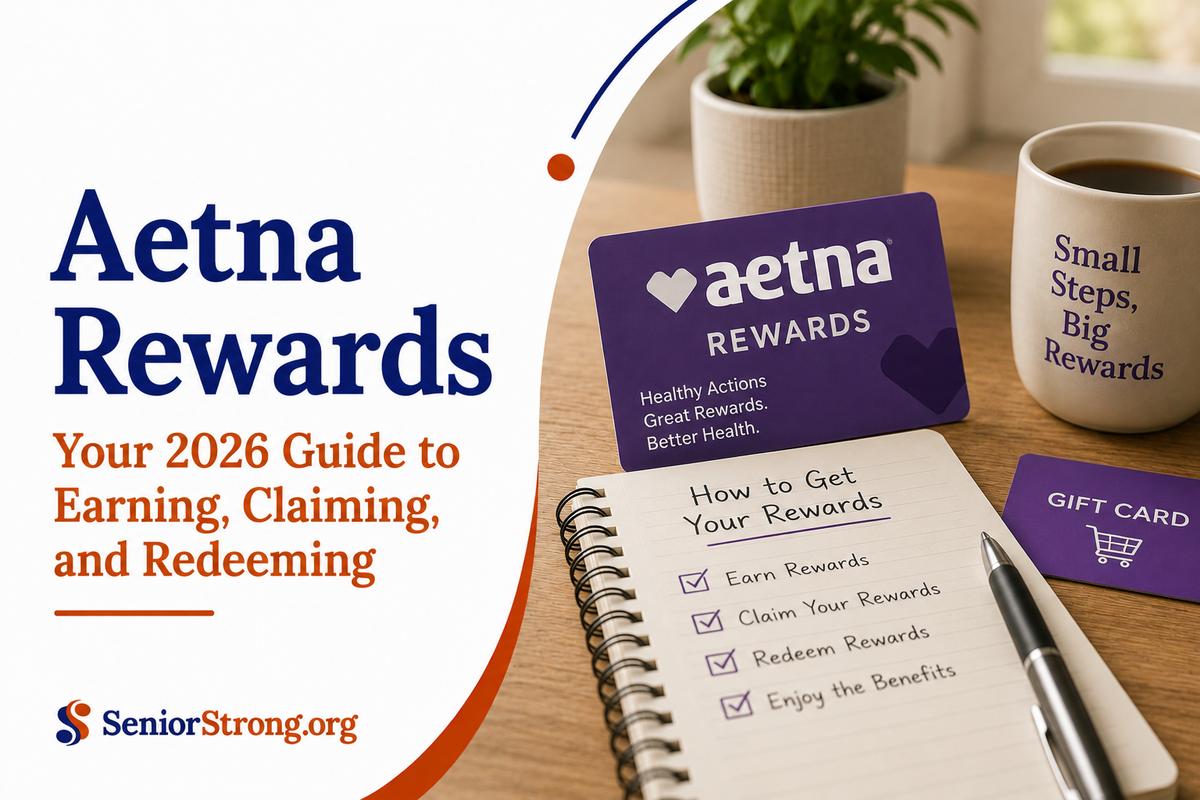
To get your Aetna rewards, you complete the preventive health activities your specific plan lists, report each one through your plan's rewards portal or by phone, then redeem the approved reward as a gift card or a prepaid benefits card. The activities, dollar amounts, and deadlines depend on which Aetna plan you have. So when people ask how to get my Aetna rewards, the honest first answer is: it depends on your plan. Rewards like these are common in this market. MedicareA federal health insurance program for people who are 65 or older, certain younger people with disab... Advantage plans covered more than 34 million people, about 54% of eligible Medicare beneficiaries in 2025, according to KFF, and many use rewards to encourage checkups and screenings.
This guide shows you which Aetna program you have, what each activity pays, how to claim and redeem, and what to do when a reward never arrives.
Aetna rewards are incentives you earn for completing healthy actions, such as an annual wellness visit, a health assessment, or a preventive screening. Aetna pays these rewards as gift cards, points, prepaid benefit cards, or credits applied to your medical costs. The program you qualify for is tied to the type of Aetna plan you carry, not to a single company-wide offer.
Aetna is part of CVS Health and offers coverage across four broad categories: Medicare Advantage, Medicaid (branded Aetna Better Health), federal employee plans, and employer-sponsored commercial plans. Each category runs its own rewards structure with its own activities and values. A senior on a Medicare Advantage planA type of Medicare health plan offered by a private company that contracts with Medicare to provide ... and an adult daughter on her employer's Aetna plan can both earn rewards, but through entirely different programs.
Rewards are widespread because plans use them to drive preventive care. Nearly all Medicare beneficiaries live in an area with at least one Medicare Advantage plan offering extra benefits beyond Original Medicare, per KFF data for 2026.
One honest caveat up front: a rewards program is a nice bonus, not a reason to pick a plan. Coverage of your doctors, your prescriptions, and your out-of-pocket limit matters far more than a $50 gift card. Treat rewards as money you leave on the table if you skip them, not as the deciding factor in your coverage.
Use the table below to match your plan type to its rewards program. If you are not sure which plan you have, your member ID card and your Aetna member website both name your plan. The values shown are typical 2026 figures and vary by plan and state.
| Program | Who it covers | Example activities | Reward type and value |
|---|---|---|---|
| Aetna Healthy Rewards | Medicare Advantage (MA and MAPD) members | Annual wellness visit, health risk assessment, in-home health visit, screenings | Gift cards, $25 to $100 per activity, up to $400 a year in 2026 |
| Aetna Better Care Rewards | Aetna Better Health (Medicaid) members | Annual checkups, prenatal and postpartum care, immunizations, screenings | Points or a prepaid card, often 500 points = $50, set by your state |
| Wellness Incentive Credits | Federal employees on the Aetna Value Plan (FEHB) | Routine physical, flu shot, biometric screening | $50 credit per activity, up to $250 self or $500 family, applied to your costs |
| Aetna Informed Rewards | Select employer-sponsored commercial members | Choosing a lower-cost, high-quality facility for a test or procedure | Cash-style reward, typically $25 to $75 per eligible service |
| Aetna Health Your Way | Select commercial and employer group members | Online health assessment, wellness journeys, fitness tracking | Gift cards and wellness incentives through the MyActiveHealth portal |
Most seniors reading this guide fall under Aetna Healthy Rewards, the Medicare Advantage program. The steps below focus there, then note where other programs differ.
Every Aetna rewards program follows the same six steps: confirm your benefit, complete an activity, report it, wait for verification, choose your reward, and use it. Here is the full process for a Medicare Advantage member, with notes for other plans.
Medicaid members on Aetna Better Health often follow a similar flow but may earn points instead of direct gift cards, and some states ask you to call Member Services to confirm your mailing address before a card ships. Federal employees on the Value Plan skip gift cards entirely: their credits apply straight to deductibles and coinsurance.
Most Aetna Healthy Rewards activities center on preventive care you should be getting anyway, and in 2026 each completed activity is worth $25 to $100, with an annual cap near $400. Exact amounts are set by your plan, so treat these as representative rather than guaranteed.
Medicaid programs reward a different mix. In Illinois, for example, Aetna Better Health members can earn $25 for an annual visit, up to $100 for prenatal and postpartum steps, and up to $115 for childhood immunizations. Texas pays $50 for completing all infant wellness checkups through six months. Because Medicaid is run state by state, your state's reward list is the one that counts.
If you also have a Medicare Advantage plan with a spending card, do not confuse your rewards with that card's allowance. The two are separate.
You redeem Aetna rewards through your plan's rewards portal, where you choose a gift card, load value onto a prepaid card, or, for federal employees, let credits apply to your medical bills automatically. Redemption format depends on your program.
Medicare Advantage members usually choose from a catalog of retail gift cards or have rewards added to a prepaid benefits card. Some 2026 Aetna Medicare plans load rewards onto an extra benefits card you can use at many participating retailers. Electronic gift cards arrive by email and sometimes require a secret code sent separately to unlock them. Physical cards arrive by mail.
Medicaid members typically redeem points in a health catalog or convert them to a prepaid card, often managed through a vendor portal such as Healthy Benefits Plus. Federal employees on the Value Plan do not redeem anything manually: each $50 credit lowers what they owe toward their deductible or coinsurance, up to the annual maximum.
Watch two details. First, standard retail gift cards generally do not expire, but reloadable prepaid cards carry a printed expiration date, so do not throw them away. Second, claim your rewards before your program's annual deadline. Value you earned but never claimed can be forfeited when the program year closes.
Rewards programs use shorthand that is easy to misread. Here are the terms that matter most, in plain language.
In our work reviewing senior health benefits, we have learned that the reward amount is the least useful number in any program. What separates a genuinely good rewards program from a frustrating one is the fine print: how long verification takes, whether the activity list is realistic, and how hard the reward is to actually spend.
We apply the same lens to Aetna rewards that we apply to any benefit. We look at the deadline (a December 15 cutoff leaves little room if you schedule a wellness visit in late November), the claim dependency (your reward can stall for weeks waiting on your doctor's billing office), and the card terms (a reloadable card with a hidden expiration date can quietly cost you value you earned).
The practical takeaway: complete your reward activities early in the year, confirm your provider submitted the claim, and check your rewards portal in spring rather than December. Caregivers helping a parent should put the program deadline on a shared calendar, because a senior managing this alone can easily miss a self-report step that the portal quietly requires.
If your Aetna reward has not arrived, the cause is almost always a pending claim, a mailing delay, or a card that needs activation. Work through these in order.
If none of these resolve it, call the member services number on your ID card and ask the representative to look up the activity by date and confirm its reward status. Keep a note of the activity date and the visit type when you call.
Getting your Aetna rewards comes down to three reliable moves: confirm which program your plan runs, complete eligible activities early in the year, and report and claim them before the deadline. As of 2026, Medicare Advantage members can earn up to $400, but only if they finish and report activities by December 15 and claim the reward before the program year closes.
If you are a caregiverAn individual who provides care to someone who needs help with daily tasks and activities due to chr..., mark the deadline on a shared calendar and confirm your parent's provider submitted the claim. If you are still weighing coverage, remember that rewards are a bonus, not a reason to pick a plan. Compare what actually matters first with our guide to the best Medicare plan for seniors, then collect every reward your plan offers.
Log in to your plan's rewards portal to see earned, pending, and available rewards. Medicare Advantage members use the Aetna Medicare rewards center, while commercial members usually use MyActiveHealth. You can also call the member services number on your ID card and ask for your current balance and status.
It depends on the format. Standard retail gift cards generally do not expire, but reloadable prepaid benefit cards carry a printed expiration date. Separately, you must usually claim earned rewards before your program's annual deadline, often December 15 or December 31, or you can lose them when the program year ends.
It depends on the reward type and your plan. Cash or gift-card-style wellness rewards may be taxable in some situations, especially employer wellness programsActivities and programs designed to promote the overall health and wellness of seniors, often includ.... Aetna materials also advise members to consult a tax professional about reward taxability. This is general information, not tax advice.
Yes. You can report most activities by mailing the paper confirmation form from your program booklet, or by calling member services. A caregiver or family member can also help you report activities and choose rewards. You do not have to use the online portal to participate.
Rewards are tied to the specific plan that issued them. If you change plans, claim and use any earned rewards before your old coverage ends, because a new plan will not honor another plan's program.