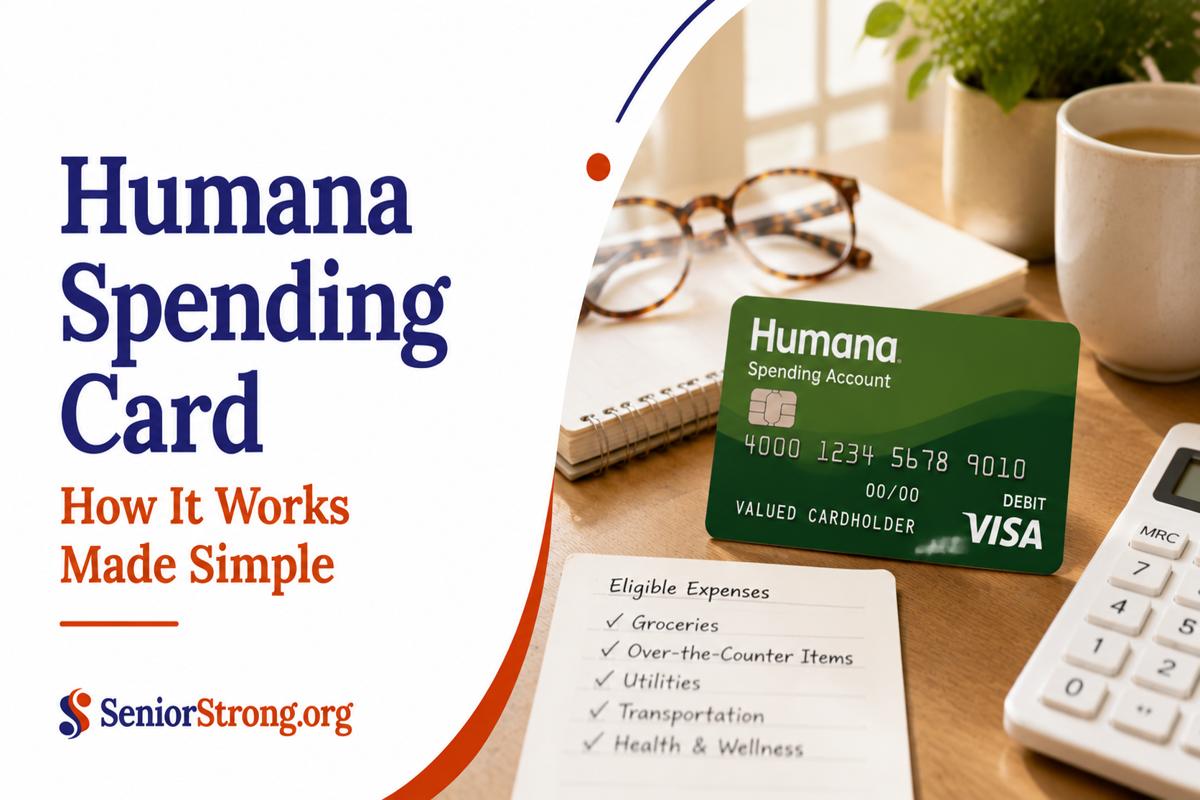
The Humana Spending Account Card is a preloaded debit card that holds monthly or quarterly allowances for eligible Humana MedicareA federal health insurance program for people who are 65 or older, certain younger people with disab... Advantage members. Depending on your plan, the card can carry up to three separate allowances: a Healthy Options Allowance for groceries and household essentials, an over-the-counter (OTC) allowance for non-prescription health items, and a Flex allowance for covered dental, vision, or hearing costs. Monthly allowances begin at $25 and reach $260 or more on certain Dual-Eligible Special Needs Plans. Roughly 34 million Medicare beneficiaries were enrolled in Medicare Advantage plans in 2025, according to KFF's 2026 Medicare Advantage analysis, and many of them have access to some version of these supplemental benefits.
This guide explains exactly who qualifies, what you can buy, how to activate your card, and how to avoid the scams that target seniors searching for these benefits online.
The Humana Spending Account Card is a preloaded prepaid card issued to eligible Humana Medicare Advantage members so they can access one or more plan allowances. It looks and functions like a debit card, but it only works for the specific items and categories your plan approves. According to Humana's official Spending Account Card page, a single card can hold up to three separate allowances at once, depending on the plan you are enrolled in and where you live.
The card is not free money. It is a structured supplemental benefit funded by your Medicare Advantage planA type of Medicare health plan offered by a private company that contracts with Medicare to provide ..., paid for with the rebate dollars insurers receive when their bids come in below the Medicare benchmark. KFF reports that these rebate dollars are the primary mechanism behind flex cards, grocery benefits, and OTC allowances in Part C plans.
You cannot get cash out of an ATM with the card. You cannot use leftover funds on unrelated purchases. The card tracks what you spend against each category's limit, and unused balances either roll over to the next month or expire at the end of each benefit period, depending on your plan.
Not every Humana Medicare Advantage member receives a Spending Account Card, and eligibility varies significantly by plan and by location. Three main groups of Humana members are most likely to have access to one or more allowances on the card.
Dual-Eligible Special Needs Plan (D-SNP) members. If you have both Medicare and MedicaidA state and federal program that provides health coverage to eligible low-income adults, children, p..., most Humana D-SNPs include a Healthy Options Allowance on the Spending Account Card. These plans serve members who qualify for full or partial Medicaid benefits alongside their Medicare coverage, and the allowances tend to be larger than what general Medicare Advantage plans offer.
Chronic Condition Special Needs Plan (C-SNP) members. Most Humana C-SNPs also include a Healthy Options Allowance. C-SNPs are available to seniors diagnosed with specific conditions, including diabetesA chronic condition that affects the way the body processes blood sugar (glucose), requiring ongoing... mellitus, cardiovascular disorders, chronic and disabling mental health conditions, chronic lung disorders, chronic heart failure, and end-stage renal disease. Some plans require at least two qualifying conditions.
General Medicare Advantage members with an OTC benefit. Many standard Humana Medicare Advantage plans offer a smaller over-the-counter allowance on the Spending Account Card, separate from the Healthy Options Allowance. According to KFF's 2026 analysis, 66% of individual Medicare Advantage plans offer an OTC allowance, while 94% of Special Needs Plans include one.
The Humana Healthy Options Allowance starts at $25 per month and reaches $260 per month or more on select D-SNPs in certain markets. The exact amount on your card depends on your plan, your qualifying conditions, and your location. The only way to confirm your allowance is to review your plan's Evidence of Coverage or Summary of Benefits.
The Humana Spending Account Card can carry up to three different allowance types. Each allowance has its own rules, eligible categories, and expiration terms. The table below summarizes the key differences.
| Allowance Type | Who Qualifies | What It Covers | Typical Amount | Rollover Rules |
|---|---|---|---|---|
| Healthy Options Allowance | D-SNP and C-SNP members with qualifying chronic conditions | Groceries, OTC items, utilities, rent, phone service, household goods | $25 to $260+ monthly | Rolls over month to month until plan year-end |
| OTC Allowance | Most Medicare Advantage plan members | Non-prescription medications, vitamins, first aid, dental care, personal care items | Varies; monthly or quarterly | Varies by plan; many expire at end of month or quarter |
| Flex Allowance | Select Medicare Advantage plans | Out-of-pocket costs for covered dental, vision, and hearing services | Varies by plan | Requires claim submission; does not roll into new plan year |
The most generous allowance is almost always the Healthy Options Allowance on D-SNPs. Some Humana Dual Integrated plans load $260 per month onto the card, and a handful of D-SNP members in certain markets qualify for an additional $25 or $50 per month when they engage with a designated High Value Provider as their primary care physician.
Keep in mind that allowance amounts cannot be combined across categories. If your card has both a Healthy Options Allowance and an OTC Allowance, each is tracked separately and must be spent within its own approved categories.
Approved humana items vary by allowance type, but Humana publishes broad categories that give you a practical sense of what the card covers.
Under the Healthy Options Allowance, approved purchases include fresh produce, beverages, dairy, meat and seafood, frozen and prepared foods, bakery items, and other eligible groceries. The allowance also covers toilet paper, paper towels, soap, shampoo, toothpaste, cleaning supplies, furnace filters, fans, space heaters, and air conditioners. Assistive devices such as grab barsSafety devices installed in bathrooms and other areas to help seniors maintain balance and prevent f..., raised toilet seatsToilet accessories designed to increase the height of toilet seats, making it easier for seniors to ..., reaching aids, and low-vision tools are typically covered. Qualifying members can also use the Healthy Options Allowance for utilities, phone service, and rent in certain plans, though Housing and Urban Development requires that rent and utility payments through this program be reported as income if you seek housing assistance.
Under the OTC Allowance, approved purchases include non-prescription medications like allergy, cold, and flu remedies, pain relievers, digestive health products, vitamins, supplements, first aid supplies, and dental care items such as toothpaste and denture care products.
Under the Flex Allowance, covered uses include copays and coinsurance for dental services, routine eye exams, prescription eyewear, hearing aid copays, and similar out-of-pocket costs tied to plan-covered benefits. Unlike the other two allowances, Flex benefits usually require you to submit a claim to Humana before you can use the card.
What you cannot buy with any allowance: alcohol, tobacco, firearms, gift cards, lottery tickets, and general merchandise that is not on your plan's approved list. Pet food is covered on a limited set of plans only.
New and renewing members with an allowance benefit for 2026 receive a Humana Spending Account Card in the mail. Before the card works, you must activate it and confirm your account. Here is the step-by-step process.
The Humana Spending Account Card is accepted at a network of participating retailers that is specific to each allowance type. The card runs on the Visa network, so the merchant must accept Visa, but eligibility is filtered by product category at the register, not by store.
For the OTC Allowance, Humana's partner is CenterWell Pharmacy, and the card is also accepted at major retailers, including Walmart, CVS, Walgreens, Dollar General, and Family Dollar. You can also shop for OTC items online through CenterWell Pharmacy.
For the Healthy Options Allowance, participating grocery retailers typically include large chains like Walmart, Publix, Kroger, Albertsons, Safeway, and regional supermarkets. Humana's Store Finder tool, accessible through the Healthy Benefits Plus app or your MyHumana account, lets you search for participating stores by ZIP code.
For the Flex Allowance, the card is used at in-network dental, vision, or hearing providers only, and most plans require you to submit a claim to Humana before the funds can be applied.
When you arrive at checkout, scan the card or present it as a debit card. If an item is not eligible, the register will decline that portion of the purchase, and you can pay for it separately with another method.
The Humana Spending Account Card is a legitimate benefit, but the category as a whole is heavily targeted by scammers. The AARP has documented multiple fraud tactics tied to advertisements that misrepresent Medicare flex cards.
The most common red flag is advertising that promises $2,880 or similar amounts as a "government-issued" benefit for all seniors. According to the Center for Medicare Advocacy, no such universal benefit exists. The largest legitimate flex-style cards in 2026 are tied to specific D-SNPs in specific markets, and they do not reach the amounts shown in these ads.
Watch for these specific scam patterns:
If you receive an unsolicited call, text, or ad promising a Medicare flex card, do not provide any information. Contact your State Health Insurance Assistance Program (SHIP) for free, unbiased counseling from a trained counselor in your state, or call Humana directly at 800-457-4708 to verify what benefits your current plan includes. You can also report Medicare fraud at 1-800-MEDICARE or through ReportFraud.FTC.gov.
Understanding a few specific terms makes reviewing your plan documents much easier.
Medicare Advantage (Part C): A type of Medicare plan offered by private insurers that bundles Part A, Part B, and usually Part D drug coverage into one plan. Supplemental benefits like the Spending Account Card are only available through Medicare Advantage plans, not through original Medicare.
Dual-Eligible Special Needs Plan (D-SNP): A Medicare Advantage plan for people who qualify for both Medicare and Medicaid. D-SNPs generally offer the most generous Healthy Options Allowances.
Chronic Condition Special Needs Plan (C-SNP): A Medicare Advantage plan for people diagnosed with specific chronic conditions. C-SNPs often include a Healthy Options Allowance for members with qualifying diagnoses.
Special Supplemental Benefits for the Chronically Ill (SSBCI): A category of benefits expanded by the Bipartisan Budget Act of 2018 that allows Medicare Advantage plans to cover items beyond traditional medical care, such as groceries, transportation, and utilities. The Healthy Options Allowance falls under this category.
Evidence of Coverage (EOC): The official legal document that spells out what your Humana plan covers, your allowance amounts, your eligibility rules, and your rights as a member. Every benefit claim should be checked against the EOC.
Summary of Benefits (SB): A shorter plan summary that lists allowance amounts, copays, premiums, and key benefits. Useful for quick comparisons during open enrollment.
In our experience helping seniors review Humana plans, the biggest barrier to using the Spending Account Card is not fraud or confusion about eligibility. It is the simple fact that many members never open their activation packet. A member who does not activate the card loses the full monthly allowance every month until they do.
If you are the adult child helping a parent review a new Medicare Advantage plan, make activation a first-week priority. Sit down together, open MyHumana, and walk through the activation screen. Then download the Healthy Benefits Plus app on the parent's phone if possible, and practice checking the balance once so the process is familiar. A $260 monthly Healthy Options Allowance adds up to $3,120 per year when used fully, which for many fixed-income seniors is the difference between comfortable household management and skipped essentials.
For Medicare Advantage members who want help comparing plans, every state offers free counseling through SHIP, the State Health Insurance Assistance Program. SHIP counselors are trained, unbiased, and cannot sell you a plan. They can review whether your current Humana plan's Spending Account Card allowance is the best fit, or whether a different plan would serve your needs better during open enrollment.
No. The Humana Spending Account Card is a supplemental benefit funded by your Medicare Advantage plan, not by the federal Medicare program itself. Original Medicare does not offer a flex card or Spending Account Card. The card only works for members enrolled in a Humana Medicare Advantage plan that includes one or more approved allowances.
Allowance amounts vary by plan, location, and eligibility. The Humana Healthy Options Allowance starts at $25 per month and reaches $260 per month or more on select D-SNPs in certain markets. OTC allowances on general Medicare Advantage plans are often smaller and may be paid quarterly instead of monthly. Your Evidence of Coverage lists your exact amount.
Yes. Walmart is a participating retailer for both the Healthy Options Allowance and the OTC Allowance on most Humana plans. Use the Healthy Benefits Plus app or MyHumana Store Finder to confirm that a specific Walmart location near you accepts the card.
It depends on the allowance type. The Healthy Options Allowance on D-SNP plans rolls over from month to month until the end of the plan year. OTC allowance rollover rules vary by plan. Flex Allowances generally do not roll over between years. Check your plan documents for your specific rollover terms.
No. Humana confirms that members cannot withdraw cash from an ATM using the Spending Account Card. The card only works for approved purchases at participating retailers.
If you disenroll from your Humana plan or switch to a non-Humana Medicare Advantage plan, any unused balance expires on your disenrollment date. Use your full allowance before changing plans if possible.
Almost always, no. AARP and the Center for Medicare Advocacy have repeatedly flagged these advertisements as misleading. The highest legitimate Humana Healthy Options Allowances are tied to specific D-SNPs in specific markets and do not reach the dollar amounts shown in most of these ads. Always verify any flex card offer by calling the insurance company directly or checking Medicare.gov.
As of 2026, the Humana Spending Account Card is one of the most flexible supplemental benefits available through Humana Medicare Advantage plans, but eligibility and allowance amounts vary significantly. The card is most valuable for D-SNP and C-SNP members, who often receive the generous Healthy Options Allowance, though general Medicare Advantage members can also benefit from smaller OTC allowances for everyday health items.
Before you enroll in a plan based on the Spending Account Card alone, confirm three things in writing. First, the exact allowance amount and schedule. Second, the list of participating retailers in your area. Third, the rollover and expiration rules for each allowance type. Your plan's Summary of Benefits and Evidence of Coverage are the only authoritative sources for this information, and you should be skeptical of any advertisement or phone call that promises a specific dollar amount without pointing you to these documents.
Ready to reduce your healthcare costs and get the most out of your benefits?
Explore our in‑depth resource on navigating Medicare Savings Programs and Medicaid eligibility to help you stretch your dollars further, especially if you qualify for supplemental allowances like the Humana Spending Account Card.