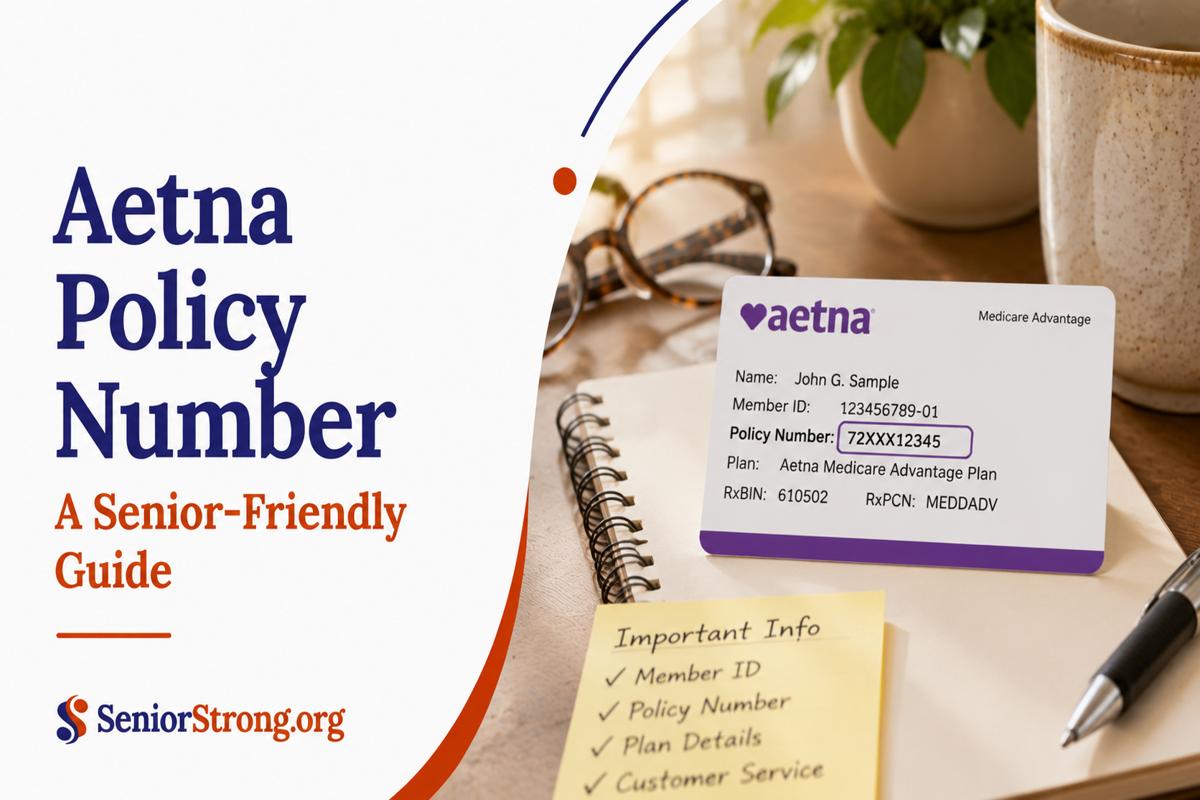
On an Aetna insurance card, the policy number is what Aetna calls the Member ID, and you'll find it on the front of the card, on the left side, labeled "ID" or "ID #." That single number identifies your specific coverage and is the first thing every doctor, pharmacist, and Aetna representative willA legal document that states how a person's property should be managed and distributed after death. ask for at check-in. Aetna confirms this directly in its official Find My Member ID guidance.
With more than 35 million Americans enrolled in MedicareA federal health insurance program for people who are 65 or older, certain younger people with disab... Advantage as of February 2026, according to KFF, and Aetna offering Medicare Advantage Prescription Drug plans across 43 states plus Washington, D.C., for 2026 (CVS Health press release), millions of seniors are looking at an Aetna card and trying to figure out which number on it is the "policy number."
This guide walks through what the policy number actually is, where it sits on different Aetna cards, how the format varies by plan type, what other numbers on the card mean, and what to do if you've lost the card. If you're researching this for an aging parent, the practical retrieval steps are near the bottom.
In U.S. health insurance, "policy number" and "member ID" usually mean the same thing: the unique alphanumeric code assigned to identify a specific person's coverage. Aetna uses the term Member ID on its cards and member documents, but providers and billing offices may still ask you for your "policy number," your "subscriber ID," or your "insurance ID." All four phrases point to the same string of characters labeled "ID" on the front-left of the Aetna card.
This number identifies the primary subscriber and any covered dependents. Aetna and every healthcare provider use it to verify eligibility, pull up coverage details, and submit claims. It is not your Social Security number. Older Aetna cards used SSN-linked formats years ago, but modern Aetna Member IDs are assigned independently to keep personal information out of the billing chain, as LegalClarity notes in its field-by-field card breakdown.
If you're helping a parent or spouse, the language used by their doctor's office may shift between calls. A receptionist might ask for "your insurance ID." A hospital admissions desk might ask for "the policy number on the Aetna card." Both are asking for the same number labeled "ID" on the front of the card, and both will accept that number written down or read aloud over the phone.
Your Aetna policy number sits on the front of the card, on the left side, with a clear "ID" or "ID #" label next to it. Aetna's own member welcome materials state this directly: the Member ID is on the front of the card. Healthcare partner support pages, such as Tava Health's Aetna walk-through, confirm the same placement: left side of the card, labeled ID or ID #.
Aetna card layouts vary across employer plans, Medicare Advantage cards, Aetna Better Health (Medicaid) cards, and student health plans, but the general structure is consistent. The front of the card carries the member's name, the Member ID, the Group Number (if the plan has one), the plan type (HMO, PPO, POS II, and so on), and key copay information for in-network services. The back carries the customer service phone numbers, the claims mailing address, and legal fine print.
A few card layouts place the Member ID near the top, under the Aetna logo, rather than strictly on the left. The "ID" label is always present, always on the front, and always next to the number itself. If you cannot find a label that says "ID" or "ID #" anywhere on the front of the card, the card may be from a discontinued plan. Members who received a new card after a 2026 plan change should retire the old card and use only the most recent one when checking in for care.
Aetna does not use a single Member ID format across every plan. The format depends on whether the plan is commercial, Medicare Advantage, Medicaid, state-sponsored, or international. Two seniors with Aetna coverage can hold cards with very different ID structures, and both are correct. The table below summarizes the formats most commonly seen on Aetna cards in 2026.
| Plan Type | Common ID Format | Notes |
|---|---|---|
| Commercial / Employer | Letter prefix + alphanumeric (e.g., W123456789) | Most common format on employer-sponsored cards |
| Aetna Medicare Advantage | Alphanumeric, plan-specific prefix | Format set by the contract issuing your MA plan |
| Aetna Better Health (Medicaid) | 10-digit numeric | Recently transitioned from older 9-digit numbers in some states |
| 8-character "ME" plans | "ME" + 6 alphanumeric characters | Used by certain plan types in Aetna's documentation |
| 12-digit numeric plans | Twelve-digit numeric string | Found on some commercial and group plans |
| State-specific plans (e.g., NC State Health Plan) | State letter prefix + 11 alphanumeric characters | Used for state employee health plans contracted with Aetna |
| Aetna International | Nine-digit numeric Member ID | Issued for global coverage; format differs from U.S. domestic plans |
Some Aetna Better Health plans transitioned to a 10-digit numeric format, replacing earlier 9-digit IDs, according to Aetna Better Health Pennsylvania's member notice. State employee plans like the North Carolina State Health Plan use a state letter prefix plus 11 alphanumeric characters on the card, as outlined in Aetna's NC SHP provider materials. If your card looks unusual, the format is most likely tied to your specific plan type, not a printing error.
An Aetna card can carry four or five different numbers, and it is easy to confuse them. The Member ID is your policy number. The other numbers serve different purposes and go to different places in the healthcare billing system. Mixing them up is one of the most common reasons claims come back rejected.
Member ID (your policy number).
Unique to you and your covered dependents. Used by every doctor, hospital, and pharmacy to verify your specific coverage. Front of the card, labeled ID or ID #.
Group Number (or GRP).
Identifies the specific employer plan or organization plan that you and your coworkers are enrolled in. Two coworkers at the same company will share a Group Number but each have a different Member ID. The Group Number tells Aetna which benefit package applies to the whole group; the Member ID tells Aetna which person inside that group is using the benefit.
RxBIN (Bank Identification Number).
A six-digit number that routes pharmacy claims to the correct prescription drug benefit manager. Without it, the pharmacy's computer cannot send your prescription claim to the right place. Used only at the pharmacy counter, never at a medical visit.
RxPCN (Processor Control Number).
A secondary routing number that tells the pharmacy benefit manager which specific plan within its system to use. Like RxBIN, this is for pharmacy use, not for medical claims.
RxGRP (Pharmacy Group).
A pharmacy-specific group identifier, separate from the medical Group Number on the front of the card. Some Aetna cards include this as part of the prescription block. If you have an Aetna card showing only the Aetna logo on the front along with BIN, PCN, and GRP numbers, it most likely includes pharmacy benefits, per Aetna's New Member Welcome Guide.
Your Aetna Member ID is required for nearly every interaction with the U.S. healthcare system once you are enrolled in an Aetna plan. The list below covers the most common moments when a doctor's office, pharmacy, or Aetna representative will need it.
If you are enrolled in an Aetna Medicare Advantage plan, your Aetna card is the one you should hand to providers, not your red, white, and blue Original Medicare card. The Member ID printed on your Aetna Medicare Advantage card is the policy number that controls your coverage. The Aetna MA card replaces the Medicare card for billing once you enroll in a Medicare Advantage plan.
2026 was a year of significant Aetna plan changes. Aetna confirmed it would close nearly 90 Medicare Advantage plans across 34 states for the 2026 plan year, according to a CVS Health and Aetna 2026 announcement. Members affected by those closures received notice before September 30, 2025, and either chose a new plan during the Annual Enrollment Period (October 15 to December 7, 2025) or returned to Original Medicare on January 1, 2026. Anyone who switched plans for 2026 received a new Aetna card with a new Member ID and should now use only that new card.
Aetna also announced that 81% of its Medicare Advantage members are in 2026 MAPD plans rated 4 stars or higher by the Centers for Medicare and Medicaid Services. The Star Rating does not affect your Member ID or where it sits on the card, but it does tell you something about the quality and customer service performance of the plan attached to that ID. CMS publishes Star Ratings annually at Medicare.gov, and you can compare plans there during open enrollment.
One more 2026 note that matters for cardholders: Aetna CVS Health no longer offers individual or family medical plans through the Health Insurance Marketplace as of January 1, 2026. If you are over 65 and previously held an Aetna Marketplace plan, your coverage transitioned, and you should be looking at the Aetna card from your current plan, not an older Marketplace card.
If you have lost your physical Aetna insurance card, or have not yet received it, you still have options to access your Member ID and your benefits. The fastest options live online; the most reliable backup is the customer service number on file.
In our editorial work helping families navigate senior health coverage, the Aetna Member ID question comes up most often in two situations: a parent has lost the card, or a parent has multiple cards and is not sure which one is current. Both situations have practical fixes, and neither requires a difficult conversation about taking over a parent's paperwork.
If your parent has lost the card, the Aetna Health app on a smartphone or tablet is the fastest path. With the parent present and consenting, you can register the account using the Member ID from any prior welcome letter or EOB, then save the digital card to the phone. Even if your parent does not use the app regularly, the digital card is there for the next medical visit. If your parent does not have a smartphone, calling Aetna Member Services together (with the parent on the line to authorize the call) is the most direct way to get a replacement card mailed.
If your parent has multiple Aetna cards because of a 2026 plan change, the rule is simple: the most recently dated card is the active one. Older cards from discontinued Medicare Advantage plans should be kept in a folder for reference, but never handed to a provider. Mixing up a discontinued card with the active one is a common cause of denied claims, and resolving the denial after the fact is harder than verifying the right card before the visit.
If a parent's situation involves Medicaid in addition to Medicare, the picture has more cards: a state Medicaid card and a Medicare card or an Aetna Medicare Advantage card.
Yes. Aetna uses "Member ID" on its cards and documents, but providers, pharmacies, and billing offices may ask for your "policy number," "subscriber ID," or "insurance ID." All four phrases refer to the same alphanumeric number on the front-left of the Aetna card, labeled ID or ID #.
On the front of the card, on the left side, is labeled "ID" or "ID #." Aetna Medicare Advantage cards may use a different alphanumeric format than commercial Aetna cards, but the location is the same. If you also have a red, white, and blue Original Medicare card, do not hand that one to providers; use the Aetna MA card while you are enrolled in the plan.
Some Aetna cards, particularly individual plans and certain Medicare Advantage plans, do not include a Group Number. The Member ID is still the policy number and is still on the front-left of the card. Providers will simply enter the Member ID without a Group Number when verifying coverage.
Yes. Aetna's member website and the Aetna Health app give you a digital ID card that providers will accept as proof of coverage. You can show it on a phone screen, print it, or email it to a doctor's office in advance of an appointment. Most providers can also verify eligibility electronically with your name, date of birth, and Member ID.
Log in to the Aetna member website or the Aetna Health app and request a new card, or call the Member Services number on any prior card or welcome letter. Replacement cards typically arrive within 7 to 10 business days. If you need proof of coverage immediately, the digital card is available the same day you register.
Generally, no. Your Member ID stays the same as long as you remain in the same plan. If you switched Aetna plans during the October 15 to December 7, 2025 Annual Enrollment Period (including the seniors who moved off discontinued 2026 plans), you received a new card with a new Member ID. Use only the new card going forward, and discard or file away the old one.
The policy number (Member ID) is unique to you. The Group Number identifies the specific employer or organization plan you are enrolled in and is shared by everyone on that plan. Providers usually need both to verify coverage on employer-sponsored cards, but the Member ID is the one tied specifically to your benefits.
On an Aetna insurance card, the policy number is the Member ID, located on the front of the card, on the left side, labeled "ID" or "ID #." Every doctor, pharmacy, and Aetna representative needs that number to verify your coverage and process claims. The format varies by plan type (commercial, Medicare Advantage, Medicaid, state-sponsored, international), but the location and label do not.
As of 2026, with Aetna offering Medicare Advantage in 43 states plus Washington, D.C., and with millions of seniors holding new cards after the closure of about 90 Aetna MA plans, the most important habit is simple: use only the most recent card you received, keep a digital copy on your phone or in the Aetna Health app, and store the customer service number from the back of the card somewhere you can find it on a stressful day.
If you’re navigating Medicare Advantage, MedigapPrivate health insurance that supplements Medicare by covering co-pays, deductibles, and other expen..., or other senior health benefits and want clear, compassionate guidance, learn more about supplemental and Medicare Advantage plan choices.