The best chair lift for stairs is the one matched to three things: the shape of your staircase, the weight and mobility of the person using it, and a warranty and cancellation policy you have actually read before signing. For straight stairs, Bruno's Elan is a repeat top pick on ride quality and reliability. For curved stairs, a custom-built rail from Bruno, Stannah, or Handicare fits best. Stairs are one of the highest-risk spots in any home for older adults: about 1 in 4 adults age 65 and older fall each year, and falls are the leading cause of injury in that age group, according to the CDC.
This guide walks you, and the family member helping you, through the types, the top brands, real 2026 pricing, funding options, and the safety features that matter.
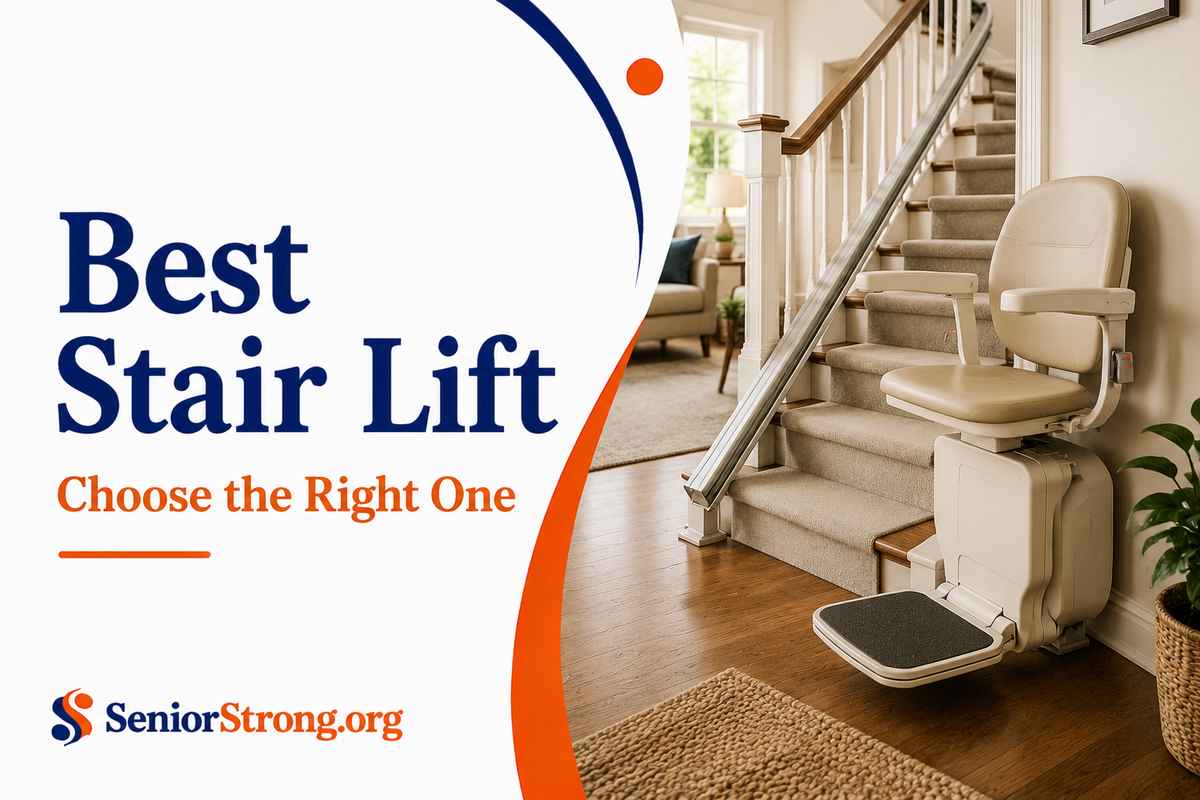
A chair lift for stairs, also called a stair lift, is a motorized chair that travels along a rail bolted to your stair treads, carrying one person up and down a staircase. It suits someone who can sit, stand, and pivot with little help but can no longer climb stairs safely on their own.
The need is often medical. Conditions such as severe arthritisAn inflammation of the joints that causes pain and stiffness and is more common in older adults., multiple sclerosis, and heart or lung disease can make climbing stairs painful, exhausting, or dangerous, and a stair lift lets a person conserve energy and avoid falls. In 2024, 43,020 Americans age 65 and older died from preventable falls, and fall-related deaths in this age group have risen 51% over the past decade, according to the National Safety Council. That is the risk a stair lift is built to reduce.
For families, a stair lift also answers a quieter question: how does a parent stay in the home they love? An AARP survey found that about 90% of older adults prefer to age in place rather than move to a facility. A well-chosen lift can be the difference between staying put and moving out, which is why this decision matters to both the senior and the adult child researching it.
The stair lift type is decided by your staircase, not your preference. Straight staircases with no turns take the cheapest, fastest option. Any staircase with a bend, landing, or spiral needs a curved lift with a custom rail. Outdoor steps need a weather-resistant model. The table below shows how the three types compare on the 2026 cost and installation time.
| Stair Lift Type | Typical Cost (Installed) | Install Time | Best For |
|---|---|---|---|
| Straight | $2,000 to $8,000 | 2 to 5 hours | Staircases with no turns or landings |
| Curved | $10,000 to $15,000+ | A full day or more | Staircases with bends, landings, or spirals |
| Outdoor | $4,000 to $10,000 | Varies, often custom | Porch steps and exterior stairs in any weather |
Straight rails are mass-produced and cut to length, which keeps both price and install time down, per the National Council on Aging stair lift buying guide. Curved rails are custom-manufactured to your exact measurements, so they cost more and take longer. Outdoor lifts add weatherproof materials and UV-protected upholstery to handle rain, snow, and heat.
One structural point reassures most homeowners: stair lifts are usually tread-mounted, meaning the rail bolts to the stair treads rather than the wall. This protects your walls and works on most staircases without major remodeling.
No single brand is best for everyone. Judged on the criteria that matter, ride quality, weight capacity, warranty, and rail design, Bruno leads for straight-stair reliability, Harmar leads on weight capacity, and Access BDD and Handicare stand out for difficult curved layouts. The table sums up the top brands, then the notes below add the honest details.
| Brand | Origin | Notable Model | Weight Capacity | Stands Out For |
|---|---|---|---|---|
| Bruno | USA (Wisconsin) | Elan SRE-3050 (straight) | 300 lbs (400 on Elite) | Quiet enclosed gears, slim 5-inch rail, limited lifetime warranty |
| Stannah | UK | Starla, Siena | Varies by model | One-hand seatbelt, wide customization |
| Access BDD | UK (TK Elevator) | Flow X (curved) | 275 lbs (Flow X) | Keeps seat level on steep inclines, fits 24-inch stairs |
| Harmar | USA | SL600HD (straight) | Up to 600 lbs | Highest bariatric capacity of the major brands |
| Handicare | Sweden | Freecurve (curved) | Varies by model | Space-saving single rail on curved stairs |
Bruno is a family-owned American maker with ISO 9001 certification. Its Elan SRE-3050 is a best-selling straight lift with a slim rail that sits about 5 inches from the wall, and its enclosed rack-and-pinion gears give the quietest, smoothest ride in most head-to-head tests. The Elite models raise the capacity to 400 pounds. Bruno usually requires professional installation to keep its limited lifetime warranty valid, so factor that in.
Stannah is a long-established UK maker known for user-friendly design: a seatbelt you can fasten with one hand, easy armrest controls, and supportive seats, plus broad customization. Some Stannah models use exposed gears, which can run slightly louder than Bruno's enclosed system.
Access BDD (backed by TK Elevator) is the pick for hard staircases. Its Flow X curved lift uses patented technology to keep the seat level on inclines up to 70 degrees and fits stairs as narrow as 24 inches, and it won a Red Dot Design Award. The tradeoff is a 275-pound weight limit on the Flow X, lower than several competitors.
Harmar is the answer for heavier users. Its SL600HD carries up to 600 pounds, the highest bariatric capacity among major brands, and its patented continuous-motion folding rail is a nice touch. As a private-equity-backed company, service experiences can vary more than with family-owned makers, so ask about local service before you buy.
A brand to approach with caution: Acorn is heavily advertised, but it has drawn repeated criticism for aggressive sales tactics, slow service response, and proprietary parts that make independent repairs harder, according to a 2026 brand comparison from Mobility123. That does not make every Acorn lift a poor product, but it is a strong reason to read the service and cancellation terms closely before signing.
One credibility note on rankings: the nonprofit National Council on Aging physically rode each major brand for its 2025 stair lift rankings, a level of hands-on testing most commission-driven review sites skip. When you compare "best of" lists, check whether anyone actually tested the product.
Expect to pay $2,000 to $8,000 for a straight stair lift installed, and $10,000 to $15,000 or more for a curved model, because each curved rail is custom-built. Installation alone runs $300 to $1,000 for a simple job and can reach $2,500 for a complex curved staircase. The length of the staircase, upgraded features like a power swivel seat, and rail complexity drive the final number.
Buying is not the only route. Renting can make sense for a short-term need, such as recovery after surgery, and using lifts lowers the cost for mid-term use. The table shows the tradeoffs.
| Option | Pros | Cons |
|---|---|---|
| Buy new | Full warranty, latest features, best for long-term daily use | Highest upfront cost |
| Buy used | Lower cost, fine for mid-term use | Limited warranty, possible wear, fewer customization options |
| Rent | Low upfront cost, maintenance included, ideal for short-term use | Costs more over the long run, limited model choice, and no resale value |
Original Medicare does not pay for a stair lift. It classifies stair lifts as home modifications rather than durable medical equipment, so Medicare Parts A and B exclude them. Funding usually comes from Medicaid waivers, certain Medicare Advantage plans, or Veterans Affairs programs instead. Here is how each path works.
Medicaid: Many states cover stair lifts through Home and Community-Based Services (HCBS) waivers, which fund home modifications that help a person stay out of a nursing facility. This is the most common funding path, though rules and waiting lists vary by state.
Medicare Advantage: Some Medicare Advantage (Part C) plans cover stair lifts as a supplemental benefit when a doctor documents medical necessity. You will typically need a prescription and paperwork showing that the lift is essential. Check your specific plan.
Veterans Affairs, read this carefully: Many mobility companies advertise that the VA's Home Improvements and Structural Alterations (HISA) grant pays up to $6,800 for a stair lift. Before you count on that, read the VA's own program page: the official HISA list excludes "porch lifts and stair glides" from covered structural alterations. Whether a specific lift qualifies can depend on classification and your local VA facility.
The VA programs used more consistently for stair access are the Specially Adapted Housing (SAH) grant, worth up to $126,526 in fiscal year 2026, the Special Home Adaptation (SHA) grant, up to $25,350, and Veteran-Directed Care, per a 2026 VA funding guide from Lifeway Mobility. If you are a veteran, contact your local VA medical center's prosthetics department and ask which grant applies to your situation before you order equipment.
The safety features below are the ones that prevent real injuries, not upsells. A stair lift built to the North American ASME A18.1 safety standard will include most of them, but confirm each one is present before you buy.
Rack-and-pinion drive. The gear system that moves the chair. Enclosed racks (Bruno) run quieter and need less cleaning; exposed racks can be louder and collect debris.
Tread-mounted. The rail bolts to the stair treads rather than the wall, so it does not damage walls and supports most staircase types.
Durable medical equipment (DME)Medical equipment that provides therapeutic benefits to a patient in need because of certain conditi.... Medicare's category for covered devices. Stair lifts fall outside it, which is the exact reason Original Medicare denies them.
HCBS waiver. A Medicaid Home and Community-Based Services program that some states use to fund home modifications like stair lifts.
Swivel seat. A seat that rotates at the top of the stairs so the user can exit safely onto the landing.
In our product evaluations, the attributes that decide whether a stair lift was a good buy are rarely the ones printed at the top of the spec sheet. The monthly price and top speed get the attention. Cancellation terms, warranty exclusions, false-start reliability, and whether the gears are enclosed or exposed are what you notice two years in.
We weigh a lift against the real conditions of the person using it: Can someone with arthritic hands fasten the seatbelt one-handed? Does the swivel seat lock clearly enough that a user with low vision can trustA fiduciary arrangement that allows a third party, or trustee, to hold assets on behalf of a benefic... it? Will the battery still carry them upstairs during a storm outage? A lift that scores well on price but poorly on these points is the kind of purchase families regret. When a brand hides its cancellation policy or ranks itself first without testing, treat that as information, not a detail.
A well-maintained stair lift lasts 10 to 15 years. Most of that upkeep is simple and takes minutes a week, plus one professional service a year. These habits also keep your warranty valid.
As of 2026, the smartest way to choose a chair lift for stairs is to start with your staircase and the user's needs, then compare brands on ride quality, weight capacity, warranty, and cancellation terms, rather than trusting whichever site ranks a lift first. Book an in-home consultation so a technician can measure your stairs and quote an accurate installed price, and if you are a veteran or on Medicaid, confirm which funding program applies before you order.
A stair lift is one piece of staying safe at home. For added protection after a fall or medical emergency, compare Senior Strong’s guide to the best medical alert systems for seniors, including options with fall detection, mobile coverage, GPS, and 24-hour monitoring.
No. Original Medicare treats stair lifts as home modifications, not durable medical equipment, so Parts A and B do not cover them. Some Medicare Advantage plans, state Medicaid HCBS waivers, and VA programs may help pay instead, usually with a doctor's documentation of medical necessity.
For users above standard limits, Harmar's SL600HD carries up to 600 pounds, the highest bariatric capacity among major brands. Bruno's Elite models support 400 pounds. Whatever you choose, pick a lift rated safely above the user's actual weight rather than right at the limit.
A straight stair lift typically costs $2,000 to $8,000 installed. Curved models commonly run $10,000 to $15,000 or more because each rail is custom-built. Outdoor lifts fall between roughly $4,000 and $10,000. Installation adds $300 to $1,000 for simple jobs and up to $2,500 for complex curves.
Yes. Curved staircases need a custom-manufactured rail that follows the exact bends and landings. Bruno, Stannah, Handicare, and Access BDD all build curved rails. They cost more than straight lifts and usually take a full day or more to install because of the custom fit.
Renting suits short-term needs like recovery after surgery and includes maintenance. Buying used lowers cost for mid-term use but limits warranty and customization. Buying new makes the most sense for long-term daily use, since you get the full warranty and current safety features.
Yes. Stair lifts run on rechargeable batteries, so they keep working when the power goes out, as long as the lift has been parked on its charger. Access BDD's HomeGlide, for example, can complete up to 60 trips on battery backup during an outage.