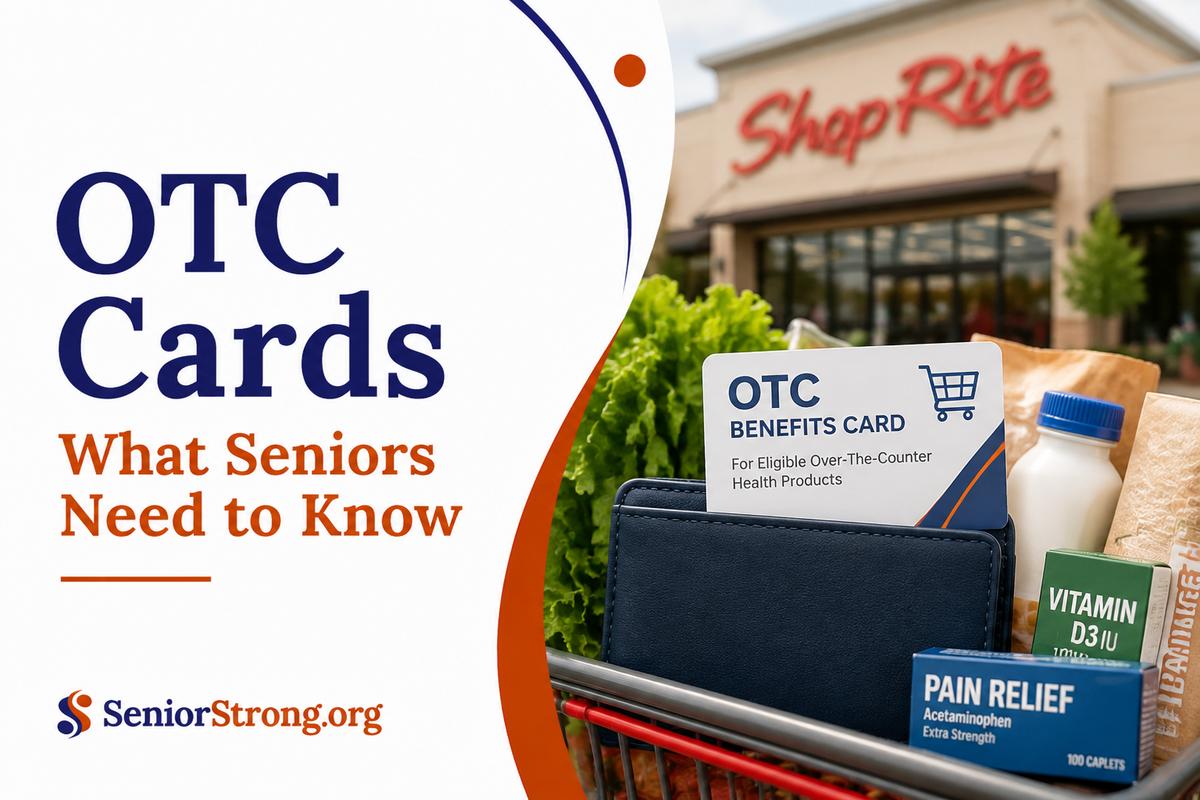
Yes, ShopRite accepts OTC card payments at the register in its stores. Since September 2025, ShopRite and its sister supermarkets have processed over-the-counter benefit cards from three networks: OTC Network (InComm Healthcare), NationsBenefits, and S3 Health Benefit. Acceptance applies to in-store purchases only, and your health plan, not the store, decides which items your card willA legal document that states how a person's property should be managed and distributed after death. cover.
That distinction costs seniors real money. About 70% of over-the-counter allowance dollars go unused every year, leaving close to $5 billion unspent, according to the Consumer Healthcare Products Association.
This guide covers which cards ShopRite takes, how checkout works, what you can buy, why cards get declined, and what changed in 2026.
ShopRite accepts OTC benefit cards at checkout in its store locations nationwide. The program launched across Wakefern Food Corp. banners in September 2025 and covers ShopRite, along with Price Rite Marketplace, The Fresh Grocer, Dearborn Market, Gourmet Garage, and Fairway Market. Acceptance is tied to your card network rather than to an individual store's discretion.
Wakefern Food Corp. is the retailer-owned cooperative behind the ShopRite banner. In its September 2025 announcement, Wakefern chief sales officer Darren Caudill said members of participating health plans can now "shop confidently in-store" with their benefit cards. The rollout brought supermarket aisles into a benefit that had been concentrated in drugstores and mail-order catalogs.
One caution that most articles skip: two separate lists have to line up before your card works. ShopRite's registers must support your card network, which they do for the three networks above. Your health plan must also list ShopRite as a participating retailer in its own network. If your plan's retailer locator does not show ShopRite, the card can decline at a register that otherwise supports it. Check the locator in your plan's member portal, or call the number printed on the back of your OTC card before you shop.
ShopRite accepts cards from three over-the-counter benefit networks: OTC Network, operated by InComm Healthcare, NationsBenefits, and S3 Health Benefit. Look at the front of your card. The network logo printed there tells you whether ShopRite can process it, and the customer service number on the back confirms your eligible item list.
| Card Network | Administrator | What Shoppers Should Know |
|---|---|---|
| OTC Network | InComm Healthcare | The largest benefit-card network in the category, with more than 68,000 participating retail locations and 8.5 million cardholders across 320-plus health plans. |
| NationsBenefits | NationsBenefits | Issues a Flex Card and verifies item eligibility at the register in real time, so covered and non-covered products separate automatically at checkout. |
| S3 Health Benefit | S3 | Used by health plans to cover approved over-the-counter products and, on some plans, qualifying healthy food items. |
If your card carries a different logo, such as a plan-branded card administered outside these three networks, ShopRite may not be able to process it. Some plans route members to their own mail-order catalog or an online portal instead.
No. ShopRite states that OTC benefit cards are accepted only in retail store locations. Cards cannot be used for online grocery orders, delivery, or curbside pickup through ShopRite's website or app. The company says it is working to accommodate online purchases with OTC cards, but no launch date has been announced.
For a senior who no longer drives, or a caregiverAn individual who provides care to someone who needs help with daily tasks and activities due to chr... managing a parent's shopping from another state, an in-store-only rule is a real obstacle. Three workarounds exist. First, most Medicare Advantage plans run their own online catalog or mail-order service, which ships eligible items to the door at no cost. Second, Instacart accepts OTC Network cards at participating retailers; eligible products carry an OTC Network tag at checkout, and a backup payment method covers everything else. Third, a family member can shop in person with the cardholder present, which is the simplest option when a store visit is possible.
Instacart availability is not automatic. Whether your plan permits Instacart and whether a specific ShopRite store is on the platform both depend on your plan's network rules. Confirm through your plan's member portal before assuming delivery will work.
Using an OTC card at ShopRite works much like using a debit card, with one difference: the register sorts your basket by eligibility before it applies your funds. Follow these five steps to avoid a surprise at the front of the line.
ShopRite's checkout system also handles multiple benefit types in one transaction. A shopper can combine an OTC card with eWIC or SNAP benefits at the same register. The cashier processes the eWIC and SNAP items first, then applies the OTC card to the remaining eligible health products.
One practical tip worth the extra minute: ShopRite limits refunds to an OTC card to transactions that contain only OTC-eligible items. If you ring up bandages and vitamins alongside a birthday card and a gallon of milk, a later return of those bandages may not be credited back to the card. Ringing your OTC items as a separate transaction protects your ability to return them cleanly.
ShopRite stocks thousands of items that qualify under a typical over-the-counter benefit, but the store does not write the eligibility rules. Your health plan publishes a catalog, sometimes called a formulary, and that catalog is the only list that matters at the register. The categories below reflect what most Medicare Advantage plans cover.
| Category | Usually Covered | Usually Excluded |
|---|---|---|
| Medications | Pain relievers such as acetaminophen and ibuprofen, cough and cold remedies, allergy relief, antacids, laxatives | All prescription medications |
| First aid | Bandages, antiseptics, medical tape, thermometers, and first aid kits | Durable medical equipment, such as wheelchairs |
| Personal care | Denture care, toothpaste, incontinenceThe loss of bladder or bowel control, a common issue in the elderly that can impact quality of life ... supplies, and foot care products | Cosmetics, shampoo, deodorant, ordinary soap |
| Vitamins and supplements | Multivitamins, vitamin DA fat-soluble vitamin that is essential in promoting calcium absorption in the gut and maintaining a..., calciumA mineral essential for life. It is necessary for the proper development and maintenance of healthy ..., and common mineral supplements | Dual-purpose supplements without a doctor's recommendation |
| Home health devices | Blood pressure monitors, compression hosiery, orthotic braces | Medical services, office visit copays |
| Groceries | Fresh produce, meat, seafood, dairy, eggs, beans, whole grains (flex or OTC Plus plans only) | Any food purchase on a standard OTC-only allowance |
Two 2026 wrinkles are worth flagging. Grocery coverage is not part of a standard OTC allowance. It appears on flex cards and OTC Plus cards, most commonly in Special Needs Plans, and it draws from a separate pool of funds even when both sit on one piece of plastic. Separately, several large carriers trimmed their eligible-item lists for 2026, removing high-demand categories from some plans. The card that bought toothpaste last December may not buy it this July.
An OTC card comes from a Medicare Advantage (Part C) plan or certain MedicaidA state and federal program that provides health coverage to eligible low-income adults, children, p... plans that include an over-the-counter allowance as a supplemental benefit. People enrolled only in Original Medicare (Parts A and B), or in a standalone Part D drug plan, do not receive one. There is no way to apply for an OTC card separately from a plan.
Medicare eligibility generally begins at age 65. Younger adults qualify if they have end-stage renal disease, amyotrophic lateral sclerosis, or a qualifying disability, according to Medicare.gov. Enrollment in Medicare Advantage passed a milestone in 2026: more than half of eligible Medicare beneficiaries, 55%, are now in a Medicare Advantage plan, KFF reports.
Having Medicare Advantage does not guarantee the benefit. KFF's 2026 analysis of CMS data found that 66% of individual Medicare Advantage plans offer an over-the-counter allowance this year, down from the prior year, while 94% of Special Needs Plans still include one. The average allowance across plans runs about $400 per year. For a beneficiaryA person who derives advantage from something, especially a trust, will, or life insurance policy. already paying the standard $202.90 monthly Part B premium in 2026, that $400 is not a rounding error.
The vocabulary around these cards is inconsistent across plans, which is part of why they confuse people. Here is what each term actually means.
The Consumer Healthcare Products Association estimates that roughly 30% of over-the-counter allowances are actually used, leaving close to $5 billion unclaimed each year out of $7.1 billion in total allowances. The reason is rarely indifference. Most beneficiaries either do not know the benefit exists or cannot work out where and how to spend it.
"Using the Medicare Advantage OTC benefit is crucial," says Caitlin Donovan, senior director at the National Patient Advocate Foundation, in guidance published by CVS Health. Dr. Mark Fendrick, a professor of health management and policy at the University of Michigan, told Newsweek that beneficiaries "are often unaware of the benefits" and that expiring allowances compound the problem.
Federal regulators tried to close that gap and then reversed course. The Contract Year 2025 Medicare Advantage final rule required plans to mail each enrollee a personalized Mid-Year Enrollee Notification of Unused Supplemental Benefits between June 30 and July 31, starting in 2026. CMS later rescinded that requirement. No letter is coming this summer. Tracking your own balance is now entirely your responsibility.
One change does favor shoppers. Beginning in 2027, Medicare Advantage plans that use debit cards for supplemental benefits must issue cards electronically linked to covered benefits, with real-time verification at the point of sale. In plain terms, the register should tell you what is covered before you pay rather than after your card declines.
A declined card at a busy register is embarrassing, and it drives people to stop using the benefit altogether. Three causes account for nearly every decline at a ShopRite checkout, and each has a specific fix.
ShopRite cashiers cannot override any of these. They cannot change your plan's eligible item list, and they cannot look up your card balance. The only party that can resolve a decline is your health insurance provider, reachable at the number on the back of your insurance card or your OTC benefit card.
The answer to the question at the top of this page is a qualified yes. ShopRite accepts OTC cards at the register from three major networks, handles the eligibility split automatically, and lets you stack the card with SNAP or eWIC. What ShopRite cannot do is tell you what your plan covers, check your balance, or process the card online. Those gaps belong to your insurer, and closing them takes one phone call.
As of 2026, with fewer plans offering the benefit and no federal reminder letter arriving in July, the burden of tracking an allowance sits entirely with the cardholder and the family members helping them. Call the number on the back of your card this week. Ask three questions: what is my balance, when does it reset, and is ShopRite in my plan's retailer network? Then take the answers to the store.
If you shop at more than one chain, start with our breakdown of whether Food Lion takes OTC cards explains how retailer-level and plan-level rules interact elsewhere.
No. ShopRite accepts OTC benefit cards for in-store purchases only. The card will not work on ShopRite's website, its delivery service, or curbside pickup orders. ShopRite has said it is working toward online acceptance, but no date has been confirmed. Until then, use your plan's mail-order catalog or shop in person.
Yes. ShopRite's checkout system supports combining benefit types. The cashier processes eWIC and SNAP items first, then applies your OTC card to the remaining eligible health products. Any items that neither benefit covers are paid with cash, credit, or debit at the end of the transaction.
Only if your plan includes a healthy food or flex allowance, which is most common in Special Needs Plans. A standard over-the-counter allowance covers health products, not food. Plans with a grocery benefit typically cover produce, meat, seafood, dairy, eggs, beans, and whole grains, and draw those purchases from a separate pool of funds.
The register applies your OTC funds to eligible items first, then asks for a second form of payment. You cover the remainder, including ineligible products and applicable tax, with cash, credit, or debit. Nothing is removed from your basket automatically, so bring a backup payment method to every trip.
Yes, with the original paper or digital receipt. One limitation applies: refunds back to an OTC card are restricted to transactions that contained only OTC-eligible items. If your purchase includes mixed eligible and ineligible products, the refund to your card may not process. Ring OTC items separately to preserve your return options.
Almost never. Most Medicare Advantage plans reload the allowance monthly or quarterly, and any unspent balance is forfeited when the period ends. That structure is why roughly 70% of allowance dollars go unused. Set a calendar reminder for the last week of each benefit period.