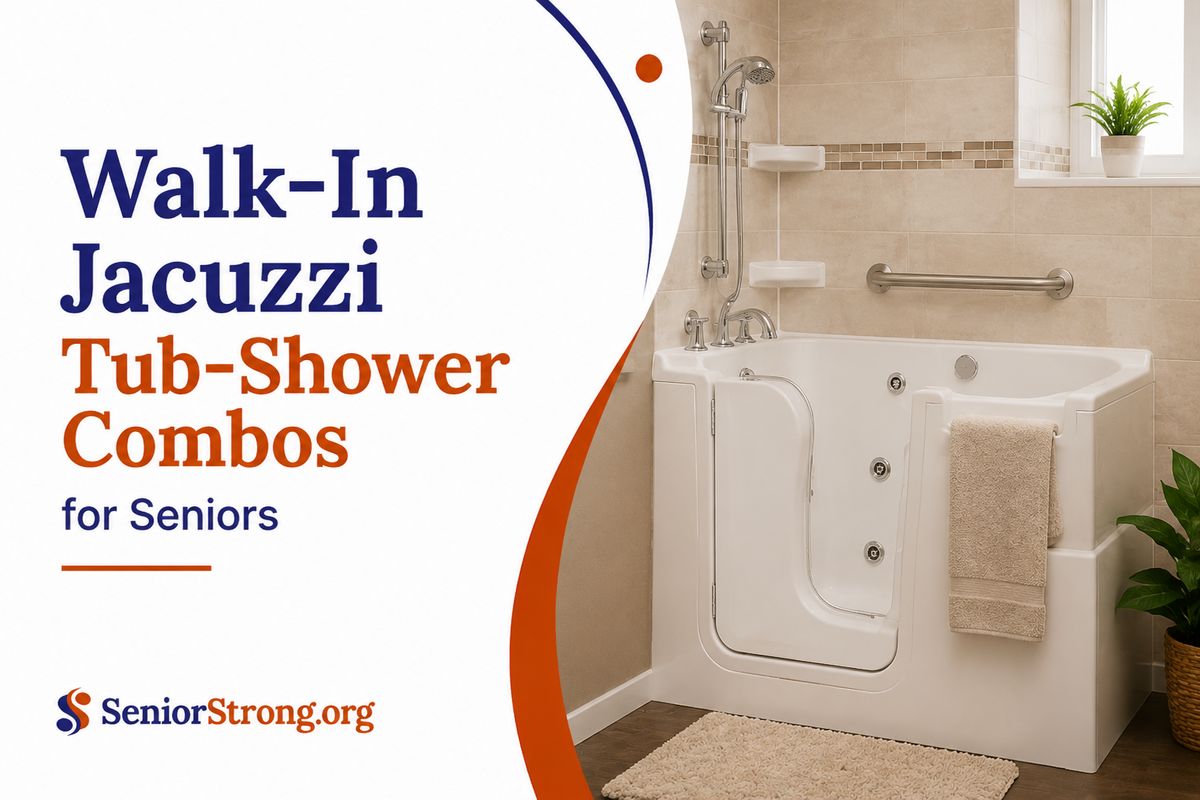
A walk-in Jacuzzi tub-shower combo for seniors is a hybrid bathing unit with a watertight side door, a step-in threshold of roughly 3 to 7 inches, a built-in seat, and a showerhead, and it typically costs between $3,000 and $17,000 once installation is counted. The safety case behind it is real. CDC mortality data released in 2026 show the age-adjusted fall death rate among adults 65 and older rose 21%, from 64.7 per 100,000 in 2018 to 78.4 per 100,000 in 2024.
What most product pages willA legal document that states how a person's property should be managed and distributed after death. not tell you is which safety features matter most, why Original MedicareA federal health insurance program for people who are 65 or older, certain younger people with disab... almost never pays, and which funding programs are worth the paperwork. This guide covers all three.
A walk-in Jacuzzi tub-shower combo is a walk-in bathtub with a sealed side door, a built-in seat, and a showerhead, so the same fixture supports a seated soak or a standing shower. The word Jacuzzi in these listings usually signals water jets rather than a specific manufacturer, and that distinction matters more than it sounds.
Jacuzzi is a real company with its own walk-in bath line, but the name has drifted into everyday speech the way Kleenex did. When a salesperson uses it, ask a direct question: Are you selling me a Jacuzzi-brand tub, or a jetted tub from another manufacturer? The answer changes the warranty, the service network, and, as covered below, whether a VA grant will reimburse it.
Here are the terms you will see on every spec sheet, defined plainly:
The step-in threshold is the feature every walk-in tub advertisement leads with, and CDC injury data suggest it is not where most bathroom injuries begin. Getting into the tub or shower accounted for only 2.2% of bathroom injuries. Bathing, showering, or getting out of the tub or shower accounted for 37.3%. The exit, not the entrance, is the dangerous moment.
The CDC's national analysis of nonfatal bathroom injuries estimated 234,094 emergency department visits in a single year among people aged 15 and older, with roughly 81% caused by falls. Among injured adults 65 and older, 30% were diagnosed with fractures. Among injured adults 85 and older, 38% were admitted to the hospital. Injury rates rose steadily with age, and the highest rates of all occurred in or around the tub or shower.
That same CDC report contains a number worth sitting with. About 63% of American homes used bathtub mats or non-skid strips, but only 19% had grab barsSafety devices installed in bathrooms and other areas to help seniors maintain balance and prevent f.... Mats address the surface. Grab bars address the body. The cheaper fix is the one most households have already made, and it is the less effective one.
Read the injury pattern back onto the product, and the ranking of features changes. Threshold height still helps, particularly for someone with hip or knee limitations who cannot lift a foot 14 inches. But the features that address the exit deserve equal weight: a seat deep enough to push up from, built-in grab bars positioned where a wet hand actually lands, a textured floor, a hand-held sprayer so you are not standing to rinse, an anti-scald valve, and a drain that empties in under two minutes rather than five.
The National Council on Aging notes that of all falls that happen inside the home, bathroom falls are the ones most likely to cause an injury. A tub that makes entry easy but leaves you sitting in a draining basin for five minutes has solved the smaller half of the problem.
Warm water immersion has measurable effects on pain, fatigue, and sleep quality in people with inflammatory joint disease. The jets themselves are comfort features layered on top of that effect. No clinical trial has shown that hydro jets or air jets reduce falls, and no reputable manufacturer claims otherwise in writing.
The most recent controlled evidence comes from a 2025 randomized trial published in BMC Complementary Medicine and Therapies. Researchers at Hacettepe University in Ankara randomized 54 patients with rheumatoid arthritis into three groups of 18: warm saltwater baths, plain warm water baths, and a control group. Both bathing groups improved on pain, fatigue, and sleep quality against validated scales. The warm saltwater group also improved on functional capacity.
Now, the honest caveats, because they change how you should read that result. The trial involved 54 people, which is small. The baths were applied to hands and feet, not to a full-body walk-in tub. And nothing in the study tested jets. The active ingredients were heat and immersion, both of which a $3,000 soaker model delivers as well as a $12,000 model with 14 jets and colored lights.
There is also a medical caution that walk-in tub marketing tends to skip. Hot water immersion raises core body temperature and dilates blood vessels, which can lower blood pressure. If you have congestive heart failure, orthostatic hypotension, poorly controlled diabetesA chronic condition that affects the way the body processes blood sugar (glucose), requiring ongoing..., or peripheral neuropathyDamage to the peripheral nerves often causing weakness, numbness, and pain, typically in the hands a..., talk to your physician about safe water temperature and soak duration before you buy. Anyone with reduced sensation in the feet should treat the anti-scald valve as a requirement rather than an upgrade.
Three brands dominate independent testing of tub-shower combinations: Ella's Bubbles, Safe Step, and Kohler. The National Council on Aging's 2026 review, updated in June 2026, mystery-shopped five brands, surveyed more than 500 older adults, and ranked Ella's Bubbles first. The table below pulls the attributes that determine what you actually live with.
| Brand | Starting price (tub only) | Lowest threshold | Manufacturer installs it? | Warranty | Best suited for |
|---|---|---|---|---|---|
| Ella's Bubbles | $3,950 | 3 inches | No, you hire a contractor | Limited lifetime, tub only | Bariatric and wheelchair needs, most size and model choice |
| Safe Step | $3,000 | 4 inches | Yes | Lifetime, tub and installation | Tight budgets and buyers who want one company accountable |
| Kohler | $4,000 | 3 inches | Yes | Limited lifetime, tub and installation | Fitting a standard tub footprint with luxury finishes |
Read the warranty column twice. Ella's Bubbles scored highest on the product and does not install it, which means a defect in the tub and a defect in the installation are two different phone calls to two different companies. Safe Step scored slightly lower on the product and warranties, both of which means one company owns the problem. For an 80-year-old homeowner without a contractor relationship, that difference can outweigh a two-tenths scoring gap.
Also, read the disclosure line at the top of any walk-in tub ranking, including NCOA's. NCOA states plainly that it earns commissions on purchases made through its links. That does not invalidate its testing, which is more rigorous than most, but it is the reason we say the same thing on every product review page: check who gets paid when you click, then check whether the review names anything negative. NCOAs do. It dropped one brand, Independent Home, from its recommendations after a tester's in-home consultation appointment was scheduled, confirmed multiple times, and then missed with no follow-up.
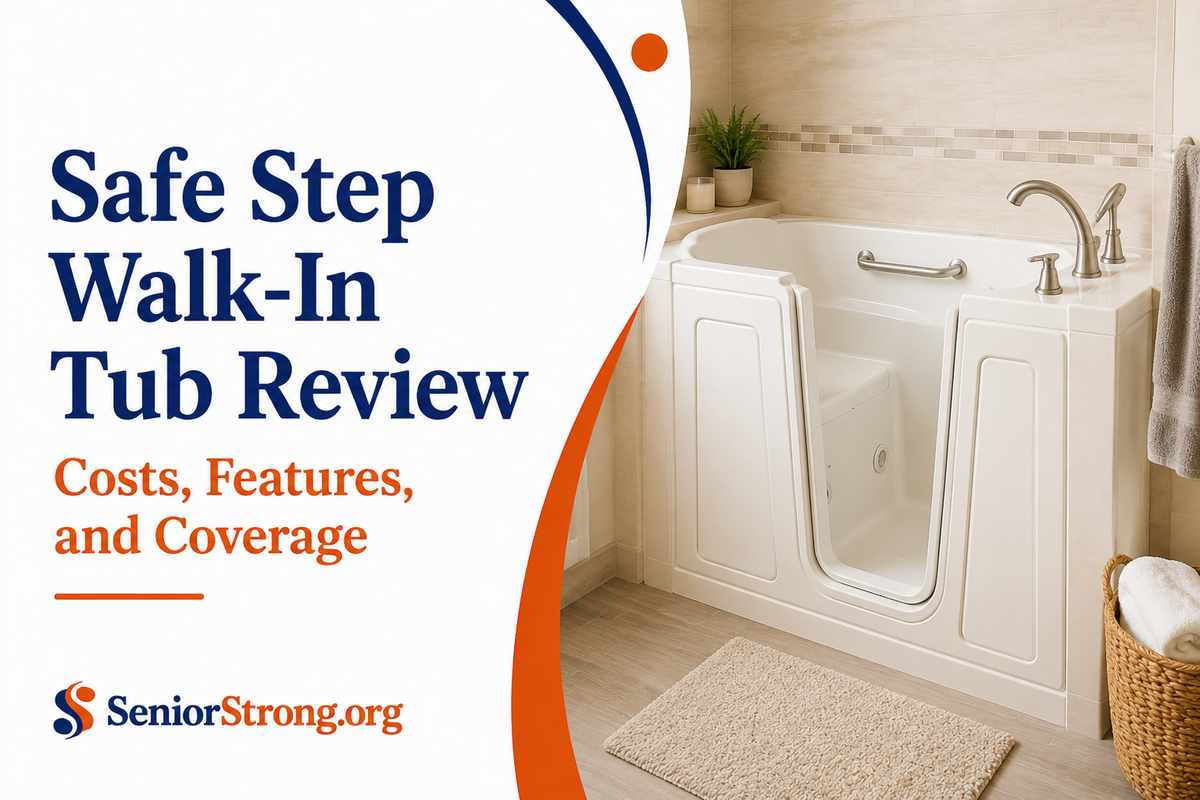
For a closer look at the brand with the strongest warranty terms, see our Safe Step walk-in tub review, including where its pricing runs high relative to its competitors.
Expect $3,000 to $17,000 fully installed. The tub itself starts around $3,000 and rarely exceeds $10,000. Installation adds $1,000 to $5,000 in most homes, and more when floor joists, water heaters, or electrical panels have to be changed. NCOA's walk-in tub cost guide tracks these ranges annually.
| Line item | Typical 2026 range | What drives the number |
|---|---|---|
| Soaker model, no jets | $3,000 to $5,000 | Shell size, door type, seat width, material |
| Hydro or air jet model | $5,000 to $8,000 | Number of jets, inline heater, pump quality |
| Multi-feature luxury model | $12,000 and up | Chromotherapy, aromatherapyThe practice of using the natural oils extracted from flowers, bark, stems, leaves, roots or other p..., heated seat, stone or marble panels |
| Professional installation | $1,000 to $5,000 | Plumbing reroutes, joist reinforcement, tile and drywall repair |
| Electrical work for jets | Varies by home | Dedicated 15-amp or 20-amp GFCI circuits |
| Water heater upgrade | Varies by home | Jetted tubs can need 40 to 80 gallons per fill |
| Fully installed total | $3,000 to $17,000+ | Brand, features, and how much your bathroom has to change |
The line item that surprises people is the water heater. A jetted walk-in tub can require 40 to 80 gallons to fill above the jet line. A standard 40-gallon residential tank cannot do that and still leave hot water for the rest of the house, so a 60-gallon tank or a tankless unit often gets added mid-project. Ask for that assessment before you sign, not after the tub arrives.
Financing is offered by all three manufacturers. Treat it the way you would treat any consumer loan: ask for the annual percentage rate in writing, ask for the total amount paid over the full term, and ask whether the promotional rate converts to a higher rate after a fixed period. A tub priced at $8,000 can cost $11,000 by the end of a 60-month contract.
No, in nearly every case. Original Medicare (Parts A and B) does not classify a walk-in tub as durable medical equipment, so it does not pay for the tub or the installation. Medicare Advantage plans, MedicaidA state and federal program that provides health coverage to eligible low-income adults, children, p... waivers, VA grants, and USDA rural programs are the four realistic paths to help, and each has a different door to knock on.
Under Medicare's durable medical equipment rules, covered equipment must serve a medical purpose, withstand repeated use, and be appropriate for use in the home. A walk-in tub fails that test on the second criterion. It is permanently plumbed into the house and cannot be returned and reissued to another beneficiaryA person who derives advantage from something, especially a trust, will, or life insurance policy., the way a wheelchair or hospital bed can. Medicare, therefore, treats it as a home modification or comfort item. Reimbursement under Original Medicare exists on paper, requires a physician's prescription and a Medicare-enrolled supplier, and is denied far more often than it is granted.
Here is where to look instead, in the order most seniors should work through them:
A walk-in tub-shower combo is a structural project, not a fixture swap. Four physical constraints decide whether your bathroom can take one, and a competent installer will measure all four before quoting a price.
Residential bathrooms are not legally required to meet ADA standards, but the U.S. Access Board's guidance on bathing rooms is the best free reference for what safe actually looks like. It specifies grab bar placement, length, and a minimum 250-pound load rating, and it calls for controls that can be operated with one hand without tight grasping, pinching, or twisting of the wrist. That last requirement rules out several attractive jet dials sold as premium upgrades. Ask to turn every control yourself, in the showroom, with a wet hand.
Brandy Archie, OTD/L, is an occupational therapist and the chief executive and co-founder of AskSAMIE, a home accessibility company in Kansas City, Missouri. Speaking to the National Council on Aging for its 2026 review, she raised three points that rarely appear in a sales consultation.
First, grab bars have to be built into the tub. Archie explains that you cannot securely add them afterward, and the width of the tub shell puts wall-mounted bars out of safe reach for a seated person. Second, many people with mobility limitations struggle to step over any interior ledge, even a 3-inch one, so the threshold number on the brochure is not a guarantee of easy entry. Third, if wheelchair transfers are likely now or within a few years, an outward-swinging door is not optional.
Her summary framing is the one to carry into a showroom: "Choose features that help reduce long-term risk as mobility changes," Archie said. That is a different question from which tub feels best today, and it is the question an adult child and a parent can answer together without either one feeling managed.
Archie also names the alternatives most salespeople will not mention. A low-threshold or curbless walk-in shower paired with a shower chair adapts across a wider range of ability levels than any tub does. For someone who genuinely loves a long soak, an automatic bath lift lowers and raises a person in the tub they already own, at a small fraction of the cost of a new fixture. Neither option earns anyone a commission on an $8,000 installation.
Walk-in tub sales run on in-home consultations, same-day discounts, and pressure. The process below is designed to slow that down and keep the decision with the person who will use the tub.
A walk-in Jacuzzi tub-shower combo solves a specific problem well: it lets someone bathe seated, without help, in their own home. As of July 2026, the honest version of the value proposition is narrower than the advertising. The low threshold addresses 2.2% of bathroom injuries. The seat, the grab bars, the sprayer, the anti-scald valve, and the drain speed address the 37.3% that happen on the way out. The jets address comfort, and comfort is a legitimate reason to spend money as long as nobody tells you it is a medical device.
Price the project fully before you fall in love with a model. Call the four funding programs before you sign anything. Read the warranty column, because it separates a $3,000 tub with one accountable company from a $3,950 tub with two. And if you are the son or daughter running this research at eleven at night, bring the numbers to your parent rather than the salesperson. This decision holds better when it is made together.
When you are ready to compare specific models, start with our walk-in tub buyer's guide and reviews, where every evaluation names its criteria and reports the contract terms alongside the features.
No. Original Medicare classifies walk-in tubs as home modifications rather than durable medical equipment, so Parts A and B do not cover the tub or its installation. A small number of Medicare Advantage plans include home safety modification benefits that may cover part of the cost, but coverage requires prior authorization and a letter of medical necessity, and it varies by plan and county.
Between $3,000 and $17,000 in 2026. The tub alone starts at $3,000 for a Safe Step soaker, $3,950 for Ella's Bubbles, and $4,000 for Kohler. Installation adds $1,000 to $5,000 for most homes. Jetted models, water heater upgrades, dedicated electrical circuits, and floor joist reinforcement push projects toward the top of that range.
Often yes. Kohler and several Ella's Bubbles models are built to drop into a standard alcove tub opening, which avoids moving plumbing or changing the room layout. Standard size still varies by brand, so schedule an in-home measurement before purchase. A few inches determine whether the door swings open with enough clearance for a safe transfer.
The VA HISA grant can pay up to $6,800 toward a medically necessary walk-in bathtub for veterans with service-connected conditions, and up to $2,000 for non-service-connected conditions. However, HISA rules specifically exclude spa, hot tub, and Jacuzzi-type tubs. A jetted hydrotherapy model may be denied even when a plain walk-in tub would be approved. Confirm with your VA prosthetics representative before selecting a model.
No head-to-head trial answers this, but occupational therapists generally favor a curbless shower with a chair and a hand-held sprayer for cognitive impairment. A walk-in tub requires the user to sit in place while it fills and drains, then remember not to open the door while it is full. That sequence is difficult to relearn as memory declines. A curbless shower has no sequence to remember.
Warm water immersion does. A 2025 randomized controlled trial of 54 rheumatoid arthritis patients found that warm water bathing improved pain, fatigue, and sleep quality, and warm saltwater bathing also improved functional capacity. The measured benefit came from heat and immersion, not from jets. A basic soaker model delivers both. Talk with your physician about water temperature and soak length if you have heart or circulation conditions.