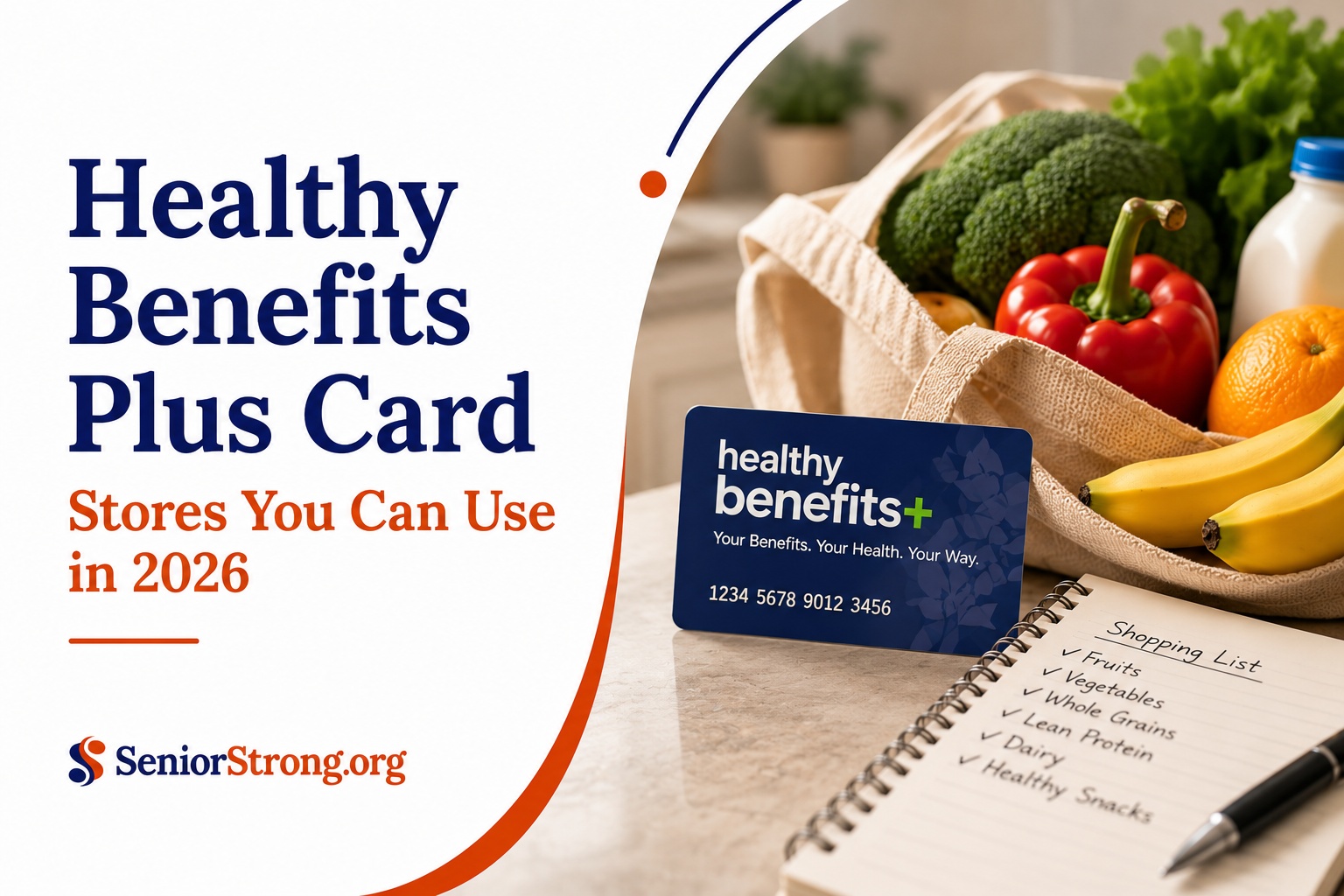
You can use your Healthy Benefits Plus card at more than 55,000 participating retail locations across the United States as of 2026, including Walmart, CVS, Walgreens, Rite Aid, Kroger, Albertsons, Dollar General, Family Dollar, and online platforms like Amazon and Walmart.com. The exact stores that accept your card depend on your specific health plan, since the program is sponsored by individual MedicareA federal health insurance program for people who are 65 or older, certain younger people with disab... Advantage and MedicaidA state and federal program that provides health coverage to eligible low-income adults, children, p... plans rather than a single insurer.
This guide lists every category of participating store, walks through what you can and cannot buy, and shows how to confirm a store accepts your card before you shop. If you also want a fuller view of how supplemental benefits like this one fit into your Medicare coverage, our Medicare and senior benefits guidance can help you make sense of the rest.
The Healthy Benefits Plus card is a prepaid benefit card issued through select Medicare Advantage, Medicaid, and Dual Eligible Special Needs (D-SNP) plans. Your health plan loads a monthly or quarterly allowance onto the card. You spend that allowance on approved over-the-counter (OTC) products and, on some plans, healthy groceries at participating stores.
The program is managed by Solutran (an Optum company) on behalf of carriers including Humana, UnitedHealthcare, CareSource, and Molina Healthcare. The card runs on the S3 payment network, which functions like Visa or Mastercard at checkout. When you swipe or scan it, the system automatically approves eligible items and rejects anything outside your plan's approved list. The official program portal is healthybenefitsplus.com, where you can register your card and access the Store Finder.
Allowance amounts vary widely. Most Humana Medicare Advantage plans, for example, provide between $25 and $200 per quarter for OTC purchases, which works out to $100 to $800 per year depending on the plan and county. The allowance resets every quarter on January 1, April 1, July 1, and October 1, and any unused balance is forfeited at the end of each quarter on roughly 85% of plans. Knowing this rhythm matters: if you are helping a parent manage their card, you want to be aware of the deadline before the funds disappear.
The largest national retailers offer the most convenient one-stop shopping for both groceries and OTC items. If you live near any of the following stores, you almost certainly have a place to spend your allowance.
Walmart is one of the most widely used participating retailers. You can use the card at Walmart Supercenters and Neighborhood Markets nationwide, and Walmart has built the benefit into its online and app checkout flow for in-store pickup or home delivery. For seniors who prefer to shop without leaving home, this is one of the easiest options.
Dollar General and Family Dollar both accept Healthy Benefits Plus cards, which matters in rural areas and small towns where these are often the closest options. Dollar General expanded its acceptance of supplemental health benefits in recent years, allowing shoppers to purchase OTC medicines, food, and produce in the same trip.
A note on Walmart shoppers: a small number of plans restrict in-store use of the card at Walmart and require phone or mail orders through the catalog instead. If your card is declined unexpectedly, call the number on the back of the card to confirm whether your specific plan covers in-store purchases at that retailer.
Pharmacy chains are natural partners for the program because their inventory leans heavily toward OTC medicine, vitamins, and personal care. If you already fill prescriptions at one of these stores, using your benefit card there usually requires no extra trip.
Walgreens accepts the card both in-store and on Walgreens.com. You can save the card as a payment method in your online account. Walgreens also allows you to combine your benefit card with manufacturer coupons, store coupons, and myWalgreens Cash rewards on the same purchase, which stretches your allowance further than a card-only transaction would.
CVS Pharmacy participates in thousands of locations and covers the typical drugstore lineup of eligible OTC items, including aspirin, vitamins, toothpaste, and antihistamines. CVS also operates the OTC Health Solutions program for many Medicare Advantage carriers, which is a related but separate benefit on certain plans.
Rite Aid is the third major national pharmacy in the program. Coverage in your area depends on whether Rite Aid still operates locally after the chain's recent restructuring, so check the Store Finder before assuming a particular Rite Aid is open.
Regional grocery chains matter most for plans that include a healthy food allowance. The largest regional grocers in the program are listed below, organized by family of brands.
Kroger Family of Stores, which includes Kroger, Ralphs, Fred Meyer, King Soopers, Smith's, and Fry's, accepts the Food and OTC Benefit Card in-store. You can buy eligible groceries and OTC items in the same purchase, with a secondary payment method covering anything that is not eligible. Kroger also lets you scan your Shopper's Card to redeem coupons and earn Fuel Points on the same trip.
Albertsons Companies, which includes Albertsons, Safeway, Vons, Acme, Jewel-Osco, and Tom Thumb, accepts the benefit card across its full network. The card covers groceries, OTC medications, and other approved items. Coverage is consistent across the company's brands, which simplifies things for families that move between Safeway and Albertsons stores depending on the neighborhood.
Other regional grocers that participate include Stop & Shop, Giant Eagle, Food Lion, Publix, Sedano's, The Giant Company, The Fresh Grocer, and Super 1 Foods. Coverage varies by ZIP code and by the specific card brand on your plan (S3 network, OTC Network, Nations Benefits, or InComm Healthcare). The Store Finder on your plan's app or website is the only reliable way to confirm that a specific store accepts your specific card.
The table below compares the major participating store types by best use case, what they typically cover, and whether they offer an online option. Use it to choose the right store for the kind of allowance you have and the kind of items you want to buy.
| Store Type | Best For | Typical Coverage | Online Option |
|---|---|---|---|
| National Supercenter (Walmart) | One-stop shopping for OTC and groceries | Both OTC and food (where plan allows) | Yes (Walmart full integration) |
| National Pharmacy (Walgreens, CVS, Rite Aid) | OTC medicine, vitamins, first aid | OTC primarily; limited food | Walgreens and CVS online |
| Discount Retailer (Dollar General, Family Dollar) | Rural and small-town access | OTC and select food items | Limited |
| Regional Grocer (Kroger, Albertsons families) | Healthy food allowance and OTC | Strong food coverage; OTC available | Some chains offer pickup |
| Online Marketplace (Amazon, Walmart.com) | Mobility-limited shoppers, bulk OTC | OTC and select groceries | Yes, full home delivery |
Online options matter most for seniors with mobility limitations and for adult children handling shopping on a parent's behalf from a different city. Several major platforms now accept the card directly.
Amazon is the largest online participant. You can add your Medicare Advantage OTC Benefits card to your Amazon account and shop for eligible products in a dedicated OTC store on the platform. Eligible items are clearly labeled. Standard Amazon shipping rules apply, including Prime delivery for members.
Walmart.com allows you to add your card details during checkout and use them on online orders for store pickup or home delivery. The integration is one of the most complete in the industry. For families coordinating care from a distance, this is often the most reliable option, since you can place the order on a parent's behalf and have it delivered to their door.
Walgreens.com mirrors the in-store experience. You save the card as a payment method, browse the OTC catalog, and check out the way you would for any other order.
Instacart and DoorDash have begun accepting health savings accounts (HSAs) and flexible spending accounts (FSAs) for eligible health items as of 2026. Direct integration of the Healthy Benefits Plus card varies by health plan and is not yet universal. If your plan partners with a specific delivery service, the partnership is listed in your benefits welcome packet or in the Healthy Benefits Plus app.
The mechanics of using the card vary slightly by retailer, but the overall process is consistent. Here is the standard sequence for any first-time use.
Eligibility depends on your specific health plan, but the broad categories below apply to almost every Healthy Benefits Plus program.
Eligible OTC items typically include pain relievers (aspirin, ibuprofen, acetaminophen), cold and allergy medicine (cough drops, antihistamines, nasal sprays), digestive products (antacids, laxatives), first aid supplies (bandages, antibiotic ointments, hydrogen peroxide), oral care (toothpaste, toothbrushes, denture care), vitamins and supplements (multivitamins, calciumA mineral essential for life. It is necessary for the proper development and maintenance of healthy ..., vitamin DA fat-soluble vitamin that is essential in promoting calcium absorption in the gut and maintaining a...), personal care items (sunscreen, incontinenceThe loss of bladder or bowel control, a common issue in the elderly that can impact quality of life ... products, certain skin care), and medical equipment such as blood pressure monitors and thermometers.
Eligible food items, on plans that include a healthy food allowance, generally cover fresh fruits and vegetables, meat, poultry, seafood, eggs, milk, cheese, yogurt, pantry staples like beans and whole grains, and bottled water.
Ineligible items include sugary drinks (soda), candy, chips and other junk foods, alcohol, tobacco products, pet food, household cleaning supplies, paper products (unless your plan has an OTC Plus designation), prepared hot foods, and any fees such as bag fees, bottle deposits, or tips.
A practical note: every plan defines its own approved list. Two seniors standing at the same Walmart with cards from different insurers may have different items approved at checkout. The plan's catalog or app is the only complete reference.
In our work with families managing senior benefits, the single most common moment of frustration is the first checkout. A senior approaches the register with what looks like a clear list of OTC items, the cashier rings them up, and one or two items decline unexpectedly. The card is rarely the problem. The catalog is the problem: a brand or product variant the senior assumed would qualify is not actually on their plan's specific approved list, even though a similar product from a different brand is.
The fix is to use the barcode scanner inside the Healthy Benefits Plus app before adding any item to the cart. Scanning the product tells you in seconds whether your specific plan covers it. For adult children helping a parent, this small habit prevents nearly all of the awkward register surprises that make seniors reluctant to use the card again.
According to a 2026 industry overview from MedicareGuide, quarterly OTC allowances on Medicare Advantage plans most often fall in the $25 to $100 range, with higher amounts on D-SNP and chronic condition plans. The single biggest reason members lose unspent funds is uncertainty about what qualifies and where the card is accepted. The two habits that close that gap are scanning before you buy and confirming the store before you go.
You can use your Healthy Benefits Plus card at most Walmart Supercenters and Neighborhood Markets nationwide for eligible OTC and food items, depending on your plan. A small number of plans restrict in-store use at Walmart and require phone or mail orders through the catalog instead. If your card is declined at the Walmart register, call the member services number on the back of the card to confirm whether your plan covers in-store purchases there.
Costco and Sam's Club acceptance is plan-specific and limited. Costco accepts certain OTC benefit cards on a club-by-club basis, but it is not a default participating retailer for Healthy Benefits Plus. Some Priority Health 2026 plans list Costco as a participating store, but most national plans do not. Use the Store Finder on the Healthy Benefits Plus app to confirm before you visit.
Most plans operate on a use-it-or-lose-it basis. Most standard plans reset your balance to zero on the first day of each new quarter (January 1, April 1, July 1, and October 1). Unspent funds do not roll over. A small number of specialized plans offer carry-over features, but these are the exception. Set a calendar reminder for the 25th of the last month in each quarter so you have time to shop before the reset.
Yes, on plans that include a healthy food allowance and that integrate with online retailers. Walmart.com and Amazon both allow you to save the card to an online account, place orders on a parent's behalf, and have eligible items delivered to their address. This is one of the most useful options for long-distance caregivers and is fully approved on plans that include online benefits.
Multivitamins, calcium, vitamin D, and most general-purpose supplements are covered on the majority of plans. Specialized supplements (joint support, sleep aids, herbal blends) vary plan by plan. Use the barcode scanner in the Healthy Benefits Plus app to confirm whether a specific brand and product is covered before you put it in your cart.
The Store Finder is built into the Healthy Benefits Plus app and the program website. Log in with your card credentials, enter your ZIP code, and filter by store type. The Store Finder is the only reliable way to confirm whether a specific store at a specific location accepts your specific card, since coverage can vary even within the same chain.
The Healthy Benefits Plus card is one of the most useful supplemental benefits in Medicare Advantage and Medicaid coverage. It works at more than 55,000 retail locations as of 2026, including every major national supercenter, all three of the largest pharmacy chains, the Kroger and Albertsons regional grocery families, the major dollar store chains, and the most widely used online retailers. Knowing where you can use the card is half of the battle. Knowing what you can buy and how to confirm coverage before checkout closes the rest of the gap.
If your goal is to use every dollar of your allowance every quarter, the practical steps are simple: download the app, scan items before you buy, use the Store Finder before any new shopping trip, and set a calendar reminder for the 25th of the last month of each quarter so funds do not expire unused.
Looking to understand how supplemental benefits like Healthy Benefits Plus fit into your broader Medicare plan choices? Check out the SeniorStrong guide for seniors and caregivers on evaluating Medicare Advantage plans and maximizing your benefits to help you make informed decisions.