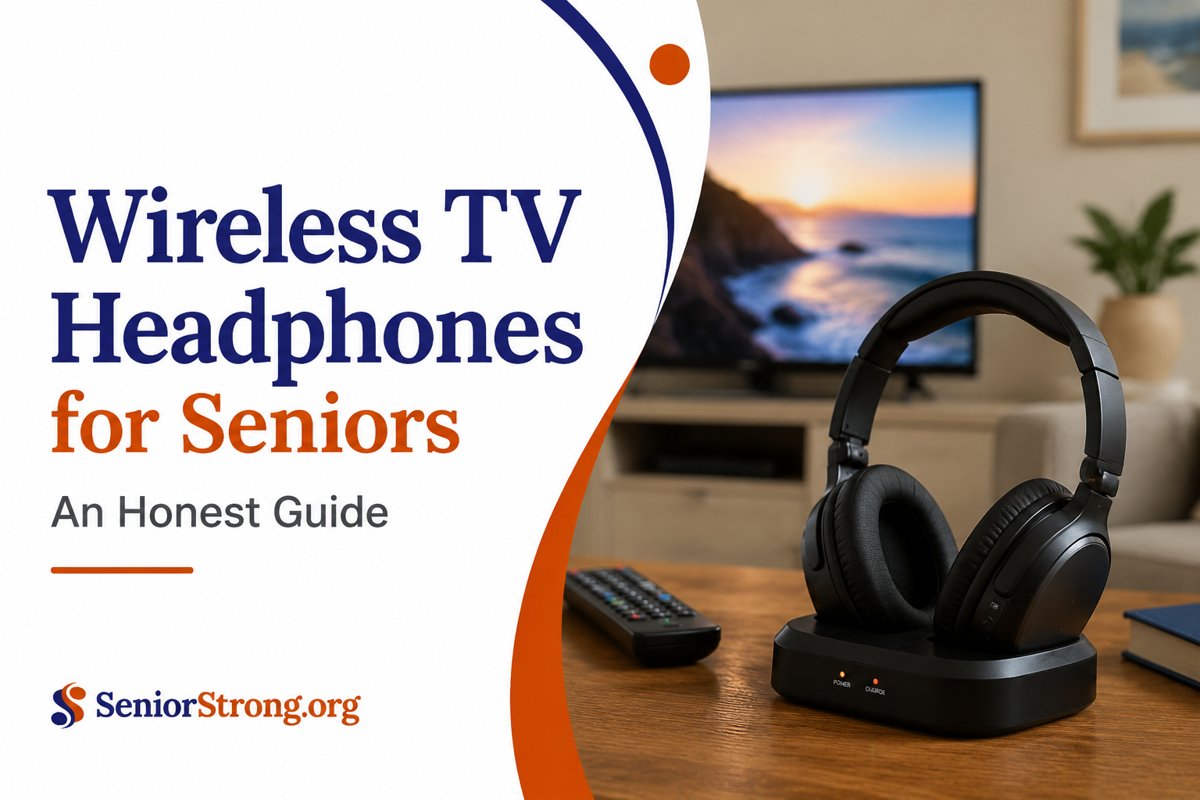
The best wireless TV headphones for seniors use radio frequency instead of Bluetooth, include a speech clarity mode that lifts dialogue out of background music, allow independent left and right volume control, and recharge in a dock so nobody has to manage a cable. Those four features matter more than sound quality scores.
Hearing loss is why this product category exists. The National Institute on Deafness and Other Communication Disorders reports that 22% of adults ages 65 to 74 and 55% of adults 75 and older have disabling hearing lossThe partial or total inability to hear sound in one or both ears, common in the elderly..
This guide explains how RF and Bluetooth differ, which five models earn their price, the seven checks to run before you buy, and whether MedicareA federal health insurance program for people who are 65 or older, certain younger people with disab... pays for any of it.
Age-related hearing loss, known clinically as presbycusis, damages the high-frequency receptors in the inner ear first. Consonant sounds such as s, t, f, and th live in that upper range. Speech then registers as mumbled rather than quiet, which is why turning the television up rarely fixes anything and usually starts an argument instead.
The scale is well documented. Roughly one in three adults ages 65 to 74 has hearing loss, and nearly half of adults older than 75 have difficulty hearing, according to the NIDCD. A broader measurement published in JAMA Network Open put the figure at 65.3% of US adults age 71 and older, about 21.5 million people. The World Health Organization, in a fact sheet updated in March 2026, reports that more than 25% of people older than 60 have disabling hearing loss.
Modern television compounds the problem. Dialogue is mixed alongside score, effects, and ambient noise, and streaming compression leaves less separation between those layers. A senior whose low-frequency hearing is intact still hears the music clearly while losing the words on top of it. Raising the volume raises everything at once, so the dialogue never becomes more distinct. It only becomes louder underneath a louder score.
That is the household argument in one sentence. The person watching cannot make out the words. The person in the next room can hear nothing but the television. A wireless TV headset resolves it by giving one listener their own volume and their own frequency balance, without changing what anyone else in the house hears.
For television, radio frequency wins. RF transmitters send audio to the headset with no delay a viewer can perceive, while standard Bluetooth codecs introduce 40 to 500 milliseconds of lag that pushes voices out of sync with lips. RF also reaches 100 to 300 feet, and most RF headsets pair automatically the moment they are lifted off the dock.
| Factor | RF (radio frequency) | Bluetooth |
|---|---|---|
| Audio delay | Effectively zero; no lip-sync problem | 40 to 500 ms on standard codecs; under 40 ms with aptX Low Latency |
| Typical range | 100 to 300 feet, often through walls | 30 to 50 feet, line of sight preferred |
| Setup | Plug the base into the TV once, then lift and listen | Pairing through TV menus, re-pairing after disconnects |
| Multiple listeners | One base can often feed two or more headsets | Usually one device, dual-link on select models |
| Portability | Tied to the transmitter base | Works with phones, tablets, and computers |
| Best for | Nightly TV viewing, hearing loss, low tech tolerance | Shared use across several devices |
Bluetooth is not disqualified. The aptX Low Latency codec cuts delay below 40 milliseconds, which most viewers cannot detect. The catch is that the transmitter and the headset both have to support that codec, and a television’s built-in Bluetooth almost never does. Buying a headset that ships with its own transmitter avoids the compatibility question entirely.
One tradeoff deserves stating plainly. RF ties the headset to a base station, so a parent who also wants to listen to a tablet in another room gets less value from it. For a headset that lives beside the television and gets worn for four hours a night, the base station is a feature rather than a limitation. It is also the charger, which is the single most useful thing it does.
We evaluate TV headphones against five named criteria: dialogue enhancement, independent left and right balance, weight over a long viewing session, daily handling (docking, button size, pairing behavior), and the terms attached to the purchase, meaning warranty length, return window, and replacement part availability. Price is a tiebreaker, not a ranking factor.
| Model | Wireless type | Standout feature for hearing loss | Battery life | Typical price |
|---|---|---|---|---|
| Sennheiser RS 195 | Digital RF (Kleer) | Seven hearing profiles, speech mode, left/right balance | About 18 hours | $400 to $500 |
| Sennheiser Set 860 | Digital RF | Under-chin design, speech clarity button, per-ear volume | About 18 hours | $300 to $400 |
| Avantree Duet | 2.4 GHz transmitter base | Two headsets, TV speaker pass-through, speech EQ mode | About 20 hours | $200 to $250 |
| TV Ears Digital | 2.3 GHz RF | Sold as an assistive listening device with voice-clarifying circuitry | Rechargeable, all-evening use | $150 to $200 |
| Insignia NS-HAWHP2 | RF | Drop-to-charge dock, latency measured near 17 ms | 50 or more hours | Under $100 |
Prices move constantly in this category, and older Sennheiser model numbers cycle in and out of stock, so treat the figures above as a planning range rather than a quote. Check the current listing before you buy.
The RS 195 comes closest to functioning like a hearing aid for television. Seven sound profiles, a dedicated speech mode that suppresses background layers, and independent left and right balance let the audio be shaped around an asymmetrical loss. Kleer digital RF holds a stable signal out to roughly 328 feet with no perceptible delay. The honest drawbacks: it is the most expensive set on this list, the earcups are heavy for a three-hour movie, and because it is an older model, availability and pricing swing more than they should.
The Set 860 hangs under the chin in a stethoscope style and delivers sound directly into the ear canal, which means nothing presses against eyeglass arms, and nothing traps heat against the head. A prominent speech clarity button and per-ear volume adjustment make it usable without reading a manual. The drawback is the fit itself. Earpieces that sit inside the canal irritate some people within an hour, and there is no way to know which group you are in until you try it. Buy from a retailer with a real return window.
The Duet ships with two pre-paired headsets and a single transmitter base, and it keeps the TV speakers active while the headphones are in use. Each headset carries its own volume control and a speech-boosting EQ mode. For a couple where one partner has hearing loss, and the other does not, this is the product that ends the volume argument without forcing both people into headphones. The drawback is that dialogue processing is lighter than the Sennheiser sets, so a listener with severe loss may still struggle.
TV Ears sells its Digital system as an assistive listening device rather than a consumer headphone, and the company advertises voice-clarifying output up to 120 dB. That figure comes from the manufacturer, not from independent testing, and readers should weigh it accordingly. What we can say is that the under-chin design, the single volume dial, and the tone control aimed squarely at speech frequencies make it the easiest set on this list to hand to someone who has never used headphones with a television.
The Insignia is the least sophisticated set here and, for many households, the correct one. Latency measured near 17 milliseconds, battery life beyond 50 hours, and a transmitter that doubles as a charging cradle mean the headset is always ready and never needs a cable. It has no dedicated speech mode, which is the real limitation, and it is a Best Buy house brand, so warranty service runs through that retailer rather than a manufacturer. If dialogue clarity is the whole problem, spend more. If privacy and freedom of movement are the problem, this is enough.
Running these seven checks in order willA legal document that states how a person's property should be managed and distributed after death. eliminate most of the returns we see readers make in this category. Each takes under five minutes.
Product listings in this category lean on technical shorthand. Here is what the shorthand means.
No. Original Medicare (Parts A and B) does not cover hearing aids or the exams used to fit them, and it does not cover wireless TV headphones at all, because headphones are consumer electronics rather than durable medical equipment. Whatever hearing coverage exists sits inside Medicare Advantage, not inside Original Medicare.
KFF’s 2026 analysis found that 95% of enrollees in individual Medicare Advantage plans are in plans that offer hearing exams, hearing aids, or both. That benefit almost always takes the form of an allowance applied to hearing aids purchased through the plan’s contracted supplier. Very few plans extend the allowance to assistive listening devices, and fewer still to TV headphones. Read the Evidence of Coverage document for your specific plan before assuming a headset qualifies.
Veterans have the strongest coverage available. The Department of Veterans Affairs provides hearing aids and related audiology services to eligible veterans enrolled in VA health care, in some cases, including hearing loss that is not connected to service.
The practical answer for most households is that a wireless TV headset is an out-of-pocket purchase between roughly $60 and $500. That is worth saying directly, because several sites in this category imply that coverage exists in order to capture a phone call. It does not, and a reader who calls a number expecting Medicare help will get a sales pitch instead.
Hearing loss reaches well past the living room. The ACHIEVE trial, published in The Lancet, followed nearly 1,000 adults ages 70 to 84 for three years and found that hearing treatment slowed cognitive decline by 48% among participants at elevated risk. Frank Lin, MD, PhD, professor of otolaryngology and epidemiology at Johns Hopkins and co-principal investigator of the study, recommends that "older adults have their hearing checked regularly and any hearing issues properly addressed."
Wireless TV headphones are not hearing aids and do not carry that evidence behind them. A headset amplifies and shapes one audio source. It does nothing for conversation at the dinner table, in a restaurant, or on the phone. Anyone who is buying TV headphones because they can no longer follow dialogue should schedule a hearing test in the same month, not instead of it.
What TV headphones do accomplish is narrower and still worth the money. Across the senior product categories we evaluate, the pattern that repeats is this: the device a person actually uses every evening delivers more real benefit than the technically superior device that stays in a drawer. A $90 headset worn nightly beats a $500 headset that felt too heavy after the first week.
The person who most needs a TV headset is often the person most resistant to wearing one, because the headset makes the hearing loss visible to everyone in the room. That resistance is about dignity, not about the product, and arguing with it on technical grounds does not work.
Two approaches tend to land. The first is to frame the headset as a solution to a shared household problem rather than an individual deficiency: the television is too loud for the person in the next room, and the headset fixes that for everybody. The second is to buy a model with pass-through audio and use it yourself first, so the device enters the house as a piece of ordinary equipment rather than as a medical intervention aimed at one person.
Seniors reading this on their own behalf are in a stronger position and should use it. Buying a headset before a family member raises the topic keeps the decision, the budget, and the timing entirely in your hands. Order from a retailer with a 30-day return window, try the set for two weeks of normal viewing, and send it back if the earcups get uncomfortable. Nothing about that process requires anyone else’s permission or opinion.
Start with the hearing loss, not the product. If dialogue is the only problem and the loss is mild, an inexpensive RF set with a charging dock solves it for under $100. If speech has become genuinely hard to follow, or if one ear is clearly worse than the other, pay for a model with a named speech mode and independent balance control. If two people share the television, buy a pass-through audio and stop the volume argument permanently. As of 2026, no Medicare plan will reimburse any of these purchases, so buy the set you will actually wear rather than the one with the longest specification sheet.
Want to learn more about protecting your hearing as you age? Explore Senior Strong’s guide on how to help a loved one with hearing loss for practical tips on recognizing hearing changes, starting conversations, and finding the right support.
Not comfortably in most cases. Over-ear headphones press against behind-the-ear hearing aids and often cause feedback whistling. Under-chin models such as the Sennheiser Set 860 and TV Ears sit in the ear canal and cause less conflict. Many hearing aid wearers instead use a TV streamer sold by their hearing aid manufacturer, which sends audio directly to the aids and skips headphones entirely.
Yes, with one caveat. Headphones let a listener hear dialogue at a lower absolute volume than a television speaker across a room requires, which reduces total noise exposure. The caveat is that models built for hearing loss can reach 120 dB, well above the roughly 100 dB ceiling on standard headphones. Set the volume to the lowest level at which speech is clear, and leave it there.
On most RF systems, yes. A single base station can broadcast to multiple headsets, and some manufacturers support well over a dozen on one transmitter. The Avantree Duet ships with two pre-paired headsets for exactly this reason. Bluetooth systems are more limited, generally supporting one headset unless the transmitter specifically advertises dual-link capability.
Almost always, provided you match the transmitter to an available output. Televisions made in the last ten years carry an optical (TOSLINK) port. Older sets carry red and white RCA jacks or a 3.5 mm headphone jack. Most transmitters ship with cables for all three. Check the back of the set before ordering, because a transmitter with the wrong connector is a return.
No. A TV headset amplifies and shapes one audio source in one room. It does nothing for conversation, telephone calls, doorbells, or smoke alarms. It is a reasonable first step for someone whose only complaint is television dialogue, and a reasonable companion device for someone who already wears hearing aids. It is not a replacement for a hearing evaluation.