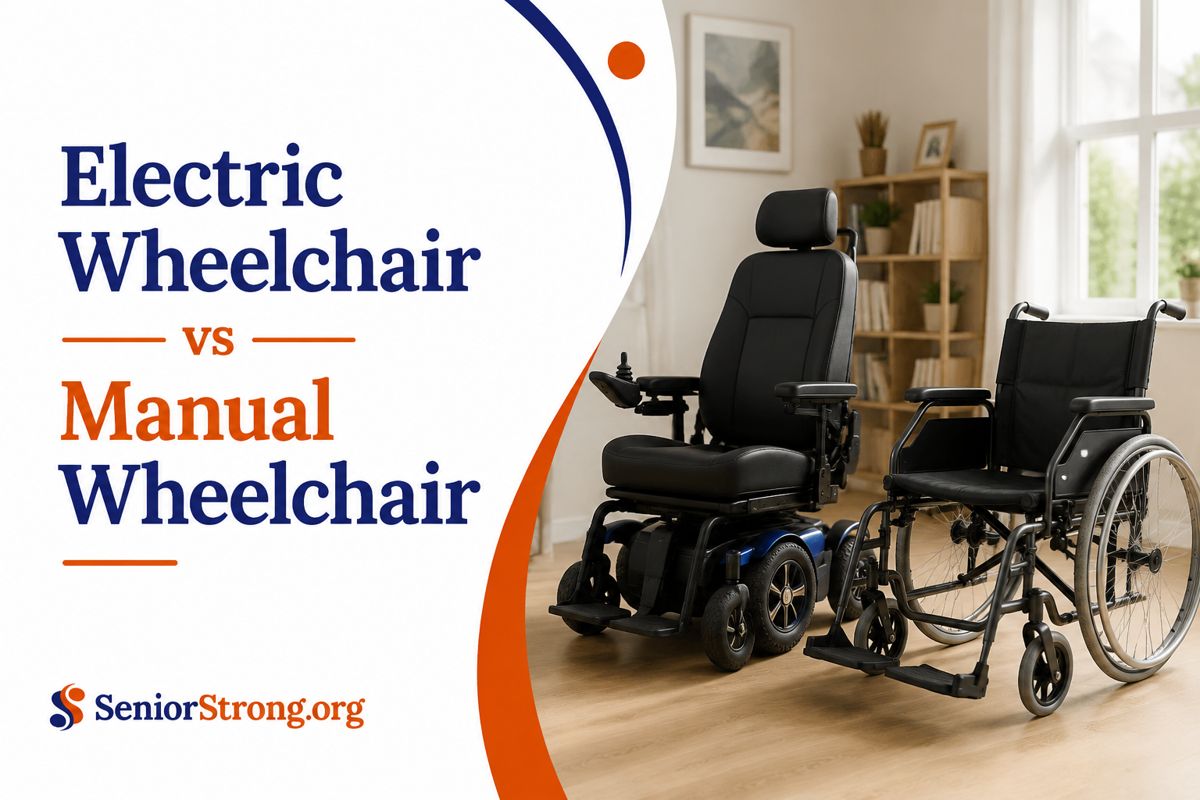
Choose a manual wheelchair if you have dependable upper body strength, travel short distances, and need a chair that folds into a car trunk. Choose an electric wheelchair if fatigue, pain, or progressive weakness makes self-propulsion unsafe or exhausting. The electric wheelchair vs manual wheelchair decision rests on your body, your home layout, and your five-year outlook, not on price alone.
Wheelchair use among adults 65 and older climbed from 4.7 per 100 people in 2011 to 7.1 per 100 in 2019, according to a National Health and Aging Trends Study analysis published in Archives of Physical Medicine and Rehabilitation. Roughly 1 million wheeled mobility device users in the United States are 65 or older, and most of them sit in manual chairs.
This guide covers what each type costs in 2026, what MedicareA federal health insurance program for people who are 65 or older, certain younger people with disab... pays and what it refuses, what years of pushing do to shoulders, and the seven questions that settle the choice.
A manual wheelchair suits a senior with reliable arm and shoulder function who covers short distances, lives in a home with narrow doorways, and travels by car. An electric wheelchair suits a senior whose stamina, grip, or joint pain makes pushing unsafe, or whose condition is expected to progress.
The difference is not really about mobility. Both chairs move a person from one room to the next. The difference is about who supplies the effort. A manual chair borrows energy from the user's arms every single day. An electric chair borrows its power from a battery. That trade determines how much of the day a person can spend upright, out of the house, and doing something other than recovering from the last trip across the parking lot.
Manual chairs still hold roughly half the global market by volume, though motorized wheelchairs led the market by revenue in 2025, according to Fortune Business Insights, which values the global wheelchair market at $6.11 billion in 2026 and projects $13.14 billion by 2034. Volume favors manual. Spending favors power. That split reflects exactly what happens in a seating clinic: manual chairs are the default, and power chairs are what people move to when the default stops working.
One warning about the word independence. Adult children and their parents often use it to mean opposite things. A father hears "manual chair" and thinks of self-reliance. His daughter watches him give up on the grocery store because the slope in the parking lot exhausts him. Both are describing independence. Only one of them is measuring it in places actually visited.
Suppliers, clinicians, and Medicare all use vocabulary that decides what gets covered. Learn these nine terms before the first appointment, because a coverage denial often traces back to a mismatch between the words on the prescription and the words in the policy.
The table below compares the two chair types on the attributes that change a daily routine: propulsion, weight, terrain, transport, and the Medicare pathway. Price appears here for reference, but it is the least predictive attribute on the list.
| Attribute | Manual Wheelchair | Electric Wheelchair |
|---|---|---|
| Propulsion | User pushes hand rims, or a caregiver pushes | Battery and motors, joystick or alternative control |
| Typical chair weight | 25 to 40 lbs, many models fold | 150 to 250 lbs, most do not fold |
| Purchase price | $100 to $5,000 | $2,500 to $15,000 and up for CRT |
| Battery replacement | None | $100 to $600 every one to two years |
| Annual maintenance | $50 to $150 | $100 to $200 and up |
| Common repairs | Tires and casters, $50 to $200 | Joystick $200 to $500, motor $300 to $800 |
| Vehicle transport | Folds into most car trunks | Usually needs a ramp, lift, or accessible van |
| Outdoor terrain | Slopes and rough ground drain the user fast | Handles inclines, grass, and long distances |
| Indoor maneuvering | Narrow frame fits older doorways and bathrooms | Wider turning radius, may require home changes |
| Physical effect | Builds upper body strength, risks overuse injury | Removes strain, raises risk of deconditioning |
| Medicare pathway | Prescription plus face-to-face exam | Face-to-face exam, often prior authorization |
Read the last two rows together. A manual chair keeps a senior's arms working, which is a real health benefit, right up to the moment the arms cannot keep working. An electric chair protects the shoulders and the schedule, but it asks the user to replace that lost activity somewhere else, through seated exercise, physical therapyA branch of rehabilitative health that uses specially designed exercises and equipment to help patie..., or standing time where safe.
A basic manual wheelchair costs $100 to $500 and needs almost nothing beyond tires and cleaning. An electric wheelchair costs $2,500 to $10,000 for standard models and exceeds $15,000 for complex rehab configurations, with batteries, joystick repairs, and motor service added over the life of the chair.
| Cost item | Manual | Electric |
|---|---|---|
| Entry-level purchase | $100 to $500 | $1,200 to $2,500 |
| Mid-range purchase | $500 to $1,500 | $2,500 to $8,000 |
| Custom or ultralight / CRT | Up to $5,000 | $8,000 to $15,000+ |
| Batteries over 5 years | $0 | $300 to $1,800 |
| Maintenance over 5 years | $250 to $750 | $500 to $1,000+ |
| Vehicle modification | $0 to $200 (trunk carrier) | $1,500 to $30,000 (lift or van) |
Vehicle modification is the line item families forget. A power chair that cannot leave the driveway is a very expensive living room chair. Before signing, price the lift, the ramp, or the accessible van, and add that number to the chair.
Medicare Part B covers both manual and power wheelchairs as durable medical equipment when a doctor documents that the chair is medically necessary for mobility inside the home. After the 2026 Part B deductible of $283, Medicare pays 80% of the approved amount, and the beneficiaryA person who derives advantage from something, especially a trust, will, or life insurance policy. pays 20%, provided the supplier accepts assignment.
The 2026 deductible of $283 and the standard Part B premium of $202.90 were confirmed by CMS in November 2025. On a power chair with a $5,000 approved amount, the 20% coinsurance works out to roughly $1,000 out of pocket once the deductible is met. A MedigapPrivate health insurance that supplements Medicare by covering co-pays, deductibles, and other expen... policy typically absorbs that coinsurance. Medicare Advantage plans must cover at least what Original Medicare covers, but they add their own networks and approval rules.
Power wheelchairs carry a heavier documentation burden because Medicare treats them as the option of last resort. The physician has to establish that a cane, a walker, and a manual wheelchair all fail to meet the person's mobility needs at home. Getting through that process is a sequence, and skipping a step restarts it.
If the request is denied, the supplier may resubmit once with stronger documentation. A second denial can still be appealed through the standard Medicare appeals process, starting with the date printed on the Medicare Summary Notice. Medicare also rents most wheelchairs rather than buying them outright: after 13 months of continuous rental payments, ownership transfers to the beneficiary.
Self-propelling a manual wheelchair loads the rotator cuff thousands of times a day. A systematic review and meta-analysis in Pain and Therapy found a pooled shoulder pain prevalence of 44% among wheelchair users, with musculoskeletal pain at any site reaching 50%. Wheelchair users were 5.8 times more likely to report shoulder pain than matched controls.
That number matters more for a 74-year-old than for a 34-year-old. Age-related rotator cuff degeneration is already underway in most seniors before the first push. Adding daily hand-rim propulsion, plus the transfers in and out of the chair, accelerates a joint that was already thinning. Shoulder pain then makes transfers harder, which makes falls more likely, which is the outcome the wheelchair was supposed to prevent.
This is the strongest clinical argument for power assist. A power-assist hub keeps the lightweight manual frame that fits through the bathroom door and folds into the trunk, while cutting the propulsion force each push demands. For a senior who wants to stay in a manual chair but is starting to feel the shoulders complain, power assist is often the honest middle answer that neither the manual chair salesperson nor the power chair salesperson volunteers.
Answer these in order. The first three are usually enough. If the answers point in different directions, an occupational therapist at a seating clinic can resolve the conflict with a trial of both chair types.
Michael L. Boninger, MD, professor of physical medicine and rehabilitation at the University of Pittsburgh, wrote the consumer fact sheet Getting the Right Wheelchair for the Model Systems Knowledge Translation Center. His framing is the one that cuts through the marketing: "Your wheelchair is a tool that enables you to do more of what you want in life."
That standard changes what a good decision looks like. The right chair is not the lightest one, the cheapest one, or the one with the longest battery range. It is the one that produces the most days spent doing things that matter. Measured that way, a $7,000 power chair that gets a senior to church, to the grandchildren's recitals, and to the far end of a grocery store can be the better value than a $300 manual chair that stays folded in a closet because using it is exhausting.
The practical step most families skip is the seating clinic trial. Occupational and physical therapists with ATP or Seating and Mobility Specialist credentials can measure seat width, depth, and cushion pressure, then let the senior drive both chair types across carpet, over a threshold, and up a ramp before anyone signs anything. Insurers will not pay to correct a chair chosen badly. They will pay for the evaluation that prevents it.
The electric wheelchair vs manual wheelchair question resolves cleanly once the framing shifts from what the chair costs to what the chair makes possible. Manual chairs are excellent tools for strong arms, short distances, tight spaces, and stable conditions. Electric wheelchairs are the correct tool when propulsion is the thing standing between a person and their own life.
As of 2026, Medicare covers both types at 80% after the $283 Part B deductible, and the paperwork for a power chair is heavier but entirely navigable with a prepared physician and an ATP-credentialed supplier. Book the seating clinic evaluation, measure the doorways, price the vehicle lift, and answer the seven questions above with the senior in the room rather than about them. Then compare specific models in our evaluation of the best wheelchairs for seniors and bring the shortlist to the appointment.
Choosing mobility equipment is only one part of creating a safer, more independent home. Explore Senior Strong’s guides on senior mobility, fall preventionStrategies and adaptations in caregiving aimed at reducing the risk of falls, a common risk for seni..., and home safety to find more practical ways to support aging in place.
Yes. Medicare Part B covers a power wheelchair as durable medical equipment when a physician documents that the person cannot safely use a cane, walker, or manual wheelchair to move around inside the home. After the $283 deductible in 2026, Medicare pays 80% of the approved amount. Certain power wheelchair codes require prior authorization before delivery.
You can use it anywhere. Medicare simply will not base coverage on outdoor need. The medical necessity standard is mobility inside the home, so a chair prescribed only for grocery trips or community outings gets denied. Many suppliers also note that repairs from outdoor damage may fall outside the coverage terms, which is worth confirming in writing.
A folding manual wheelchair typically weighs 25 to 40 pounds, and ultralight models weigh under 20 pounds without the wheels. A standard electric wheelchair weighs 150 to 250 pounds, including batteries. That difference is the reason transport planning, whether a ramp, a lift, or an accessible van, belongs in the budget conversation from the first day.
The supplier can resubmit the prior authorization request once with additional documentation of medical need. If the second request is denied, the beneficiary can appeal, beginning with a written request to the company that handles the Medicare claim by the deadline printed on the Medicare Summary Notice. Denials most often trace back to incomplete physician documentation rather than genuine ineligibility.
A scooter works for a senior who can walk short distances, transfer independently, sit upright without support, and steer a tiller with both hands. Scooters are lighter, cheaper, and easier to transport than power chairs. They also have a wide turning radius that makes indoor use difficult, and they offer no postural support, which rules them out for pressure relief needs.
Many seniors do exactly that, and Medicare will fund a second chair when a physician documents that the condition has changed. The risk is timing. Shoulder damage from years of propulsion does not reverse. If a progressive diagnosis is already on the chart, a power-assist add-on to the manual frame often preserves both the shoulders and the option to wait.