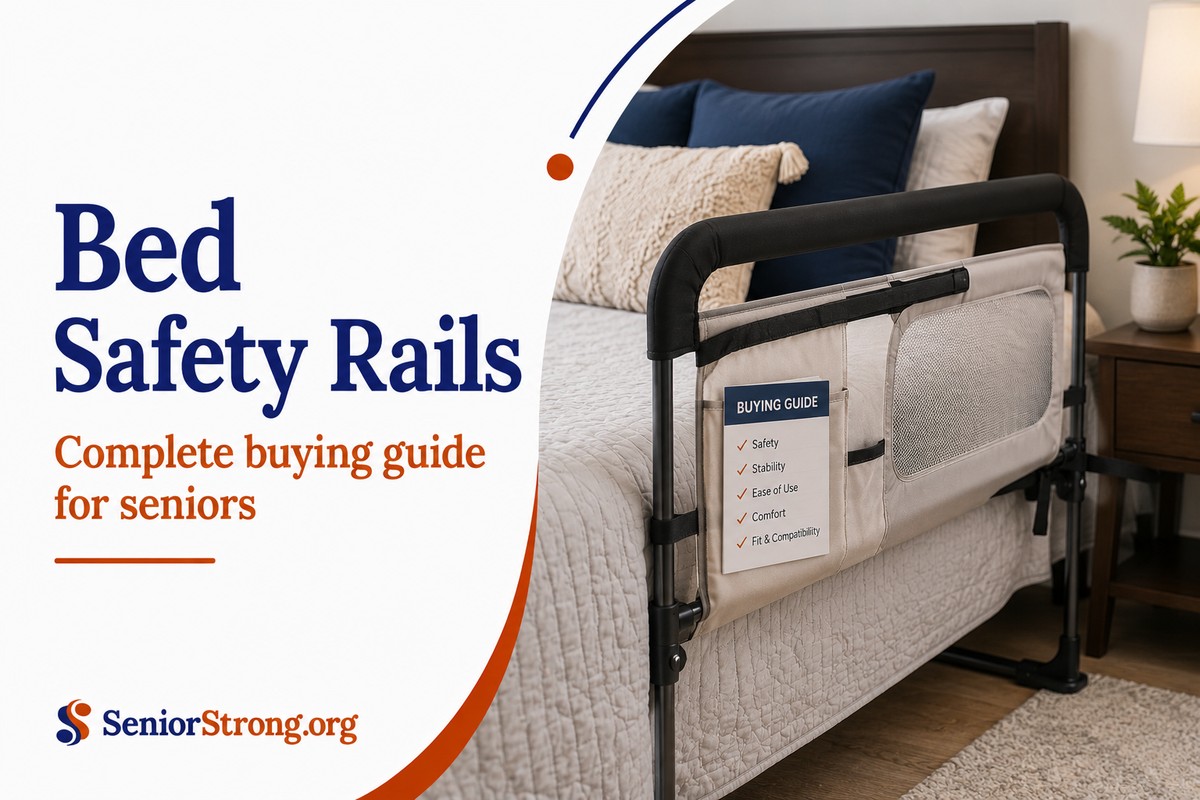
Bed safety rails for elderly adults can reduce nighttime falls and help seniors get in and out of bed safely. They can also cause serious injury or death when they are mismatched to the mattress, used on a senior with dementiaA chronic disorder characterized by a decline in cognitive function beyond what might be expected fr..., or missing the federal safety certification that became mandatory in 2023. Adults 65 and older account for about 14 million reported falls each year and roughly 3 million emergency department visits, and falls remain the leading cause of fatal and nonfatal injuries in this age group. A bed rail can be part of a safer bedroom for the right person. It can also be a problem in the wrong situation.
This guide walks both seniors and family caregivers through what works, what does not, what the law now requires, and what MedicareA federal health insurance program for people who are 65 or older, certain younger people with disab... actually pays for in 2026.
Bed safety rails for elderly adults are safe in some situations and dangerous in others. For an alert senior with limited mobility who needs leverage to sit up or transfer in and out of bed, a properly fitted half-length assist rail can be a useful safety device. For a senior with dementia, restlessness, or a tendency to climb, the same rail can be lethal.
The Consumer Product Safety Commission documented 284 entrapment deaths involving adult portable bed rails between January 2003 and December 2021. The FDA has separately collected reports of patients caught, trapped, entangled, or strangled in hospital bed rails dating back to 1985, with hundreds of deaths included. These deaths are not freak accidents. They follow a predictable pattern: a gap that should not exist, a senior who cannot free themselves, and a fall risk score that should have ruled the rail out in the first place.
The honest read is that bed rails are a useful tool for the right person and a hazard for the wrong one. The decision is not whether bed rails are safe in the abstract. It is whether they are safe for this senior in this bed with this cognitive status. Skip to the contraindications section before you buy.
The FDA defines four areas where a senior's head, neck, or chest can become trapped in or around a bed rail. The 2023 federal safety standard tests each of these zones using a specific probe shape and size. If a bed rail fails any zone test, it should not be sold. Both seniors and caregivers should learn to check these zones on any rail already installed at home.
| Zone | Location of the gap | Primary risk |
|---|---|---|
| Zone 1 | Within the rail itself, between the bars | Head or chest passes between bars and become wedged |
| Zone 2 | Under the rail, between rail supports | Head or neck slips under the rail and gets pinned |
| Zone 3 | Between the rail and the side of the mattress | Most common entrapment zone; senior slides into the gap and cannot escape |
| Zone 4 | At the ends of the rail, where it meets the mattress edge | Neck entrapment between rail end and head or footboard |
Zone 3 is the one to inspect first. The CPSC's testing in 2018, 2019, and 2021 found that most rails on the market at that time did not pass Zone 3 standards. The fix is not complicated: the top of the test probe must sit above the highest point of the uncompressed mattress when the rail is installed correctly. If you can fit a fist between the rail and the mattress, the rail is unsafe at any price.
Not every bed rail is built for the same purpose. Some are full-length barriers that block the senior from rolling out of bed. Others are short assist handles meant to provide leverage for sitting up or standing. The right choice depends on the senior's mobility, cognitive status, and reason for needing a rail in the first place.
| Type | How it works | Best for | Main drawback |
|---|---|---|---|
| Full-length traditional rails | Bolt to bed frame; run most of the bed length with multiple crossbars | Bedridden or very weak seniors at high roll-out risk under caregiverAn individual who provides care to someone who needs help with daily tasks and activities due to chr... supervision | Highest entrapment risk; institutional look; not for seniors with dementia |
| Bed assist rails (with floor legs) | L-shaped; slide between mattress and box spring; vertical legs touch the floor | Ambulatory seniors who need help sitting up and standing | Floor legs block under-bed cleaning and may obstruct a walker or wheelchair |
| Bed assist rails (no floor legs) | Held in place by mattress weight and a strap across the bed frame | Seniors with heavy mattresses who want easy removal or portability | Can tip on light mattresses if leaned on too hard from the outside |
| Single-point bed handles | Compact handle mounted at one spot on the bed for repositioning | Seniors who need minimal leverage to roll over or sit up | Not built to bear standing weight; can wobble if used as a transfer aid |
For most home users, a half-length bed assist rail placed near the pillow is the right starting point. It supports the moment of risk (sitting up and standing) without creating a wall that the senior has to climb over to leave the bed. Full-length rails belong in clinical settings with trained staff, not in most homes.
The FDA's 2003 clinical guidance, still the foundational document for U.S. clinicians, is clear that bed rails should never be the default solution. The decision to use one must be based on the individual senior's condition. Bed rails are contraindicated, meaning they should not be used, for seniors who fall into any of the categories below.
If any of these apply, do not buy a bed rail. Look at the alternatives section below instead. A bed rail used to restrain a senior, rather than to assist them, is treated as a physical restraint under CMS rules and is a documented safety risk.
On August 21, 2023, the CPSC's federal safety standard for adult portable bed rails (16 CFR Part 1270) went into effect. The rule makes the ASTM F3186-17 standard mandatory, with CPSC modifications, for every adult portable bed rail manufactured for sale in the United States after that date.
Before 2023, the same ASTM standard was voluntary. CPSC testing in 2018, 2019, and 2021 found that the bed rail industry was not substantially complying with it. That is why so many rails currently in U.S. homes do not pass the four-zone entrapment test. If a senior is using a bed rail bought before September 2023, it is worth checking the manufacturer's documentation to confirm compliance.
What the standard now requires:
The buyer's takeaway is simple. Look for explicit ASTM F3186-17 (or F3186-24, the updated version) certification on the product listing or packaging. If the certification is not stated, do not buy it. The CPSC has issued five public warnings and multiple recalls for non-compliant rails since 2020.
Even a certified bed rail is dangerous if installed wrong. These are the steps a family caregiverA family member who provides care and assistance to a relative who is aging, chronically ill, or dis... or senior should follow before the first night the rail is in use.
If a near-miss happens (the senior briefly gets wedged but frees themselves), treat it as the warning event. Re-evaluate immediately. Repeat entrapment incidents tend to escalate quickly, and the second event is often fatal when the first one was not.
For seniors who fall into any contraindication category, or for families that simply want to avoid the entrapment risk, several alternatives reduce nighttime fall injury without the trade-offs of a rail.
Many families find that the right combination is a low bed plus a fall mat plus motion lighting, with no rail at all. This stack often outperforms a bed rail in measured injury outcomes and avoids every entrapment scenario.
Medicare's answer in 2026 is narrow and specific. Original Medicare (Part B) does not cover detachable bed rails sold for use on a conventional home bed. Those are out-of-pocket for the senior and family.
What Medicare does cover is a hospital bed with attached, adjustable side rails, when a physician documents that it is medically necessary. The bed is classified as durable medical equipment (DME)Medical equipment that provides therapeutic benefits to a patient in need because of certain conditi.... Medicare pays 80% of the approved amount after the senior meets the Part B annual deductible, which is $283 in 2026. The remaining 20% is owed by the patient, unless a MedigapPrivate health insurance that supplements Medicare by covering co-pays, deductibles, and other expen... supplement plan covers it.
To qualify, the senior needs:
Medicare Advantage plans must offer at least the same coverage as Original Medicare for DME, but copays, networks, and supplier rules vary by plan. Seniors enrolled in Medicare Advantage should call the plan directly before purchasing any equipment. MedicaidA state and federal program that provides health coverage to eligible low-income adults, children, p... coverage for bed rails varies by state. State Home and Community Based Services (HCBS) waivers often cover DME more broadly than Medicare, and may include detachable rails as part of an aging-in-place benefit.
There is one development to watch. The Stand Strong for Medicare Act (S. 2831) is a federal bill that would let Medicare cover a wider set of common safety items, including detachable bed rails, as part of fall preventionStrategies and adaptations in caregiving aimed at reducing the risk of falls, a common risk for seni.... As of May 2026, the bill has not passed. Current coverage rules still apply.
Adult Portable Bed Rail (APBR). The legal category covered by the CPSC's 16 CFR Part 1270. Includes any rail installed by a consumer on or next to an adult bed, including grab barsSafety devices installed in bathrooms and other areas to help seniors maintain balance and prevent f..., assistive bars, and transfer aids. Excludes side rails built into FDA-regulated hospital beds.
ASTM F3186-17. The performance standard that adult portable bed rails must meet. Tests cover entrapment in four zones, structural integrity, retention system reliability, labeling, and warning statements. A 2024 update (F3186-24) refines the same framework.
Entrapment zone. A gap or opening where a person's body part can be captured or restrained. The four zones are inside the rail, under the rail between supports, between the rail and the mattress, and at the ends of the rail.
Retention system. The strap or hardware that anchors the bed rail to the bed frame, preventing it from shifting outward and creating a Zone 3 gap.
Durable Medical Equipment (DME). The Medicare coverage category for medically necessary equipment used in the home, including hospital beds, walkers, and oxygen equipment. Detachable home bed rails are not DME under current Medicare rules.
Physical restraint. Under CMS guidelines, any device that restricts a patient's freedom of movement and that the patient cannot easily remove. A bed rail used to keep a senior in bed against their willA legal document that states how a person's property should be managed and distributed after death. meets this definition and is regulated accordingly.
In our editorial review of bed rail safety, the most consistent theme from clinicians is that the rail is rarely the actual solution to the problem the family is trying to solve. The CPSC's incident review found that falls were the second most common hazard pattern associated with adult portable bed rails. Most of those falls involved seniors falling against or striking the rail itself. A minority involved seniors deliberately climbed over.
Consider a common scenario: an 84-year-old mother with mild cognitive impairment has had two nighttime falls trying to get to the bathroom. Her adult daughter wants to install a full-length bed rail. The rail would not have prevented either fall, because the falls happened on the floor, not in the bed. What would help: a motion-activated nightlight on the path to the bathroom, a low-profile bedside commode within arm's reach, and a bed exit alarm so her daughter (sleeping in the next room) is woken before her mother walks unassisted. The right intervention almost always targets the moment of risk, not the location of the bed.
If the moment of risk is sit-to-stand, the answer is usually a half-length assist rail or a transfer pole. If the moment of risk is the walk to the bathroom, no bed rail will help. If the moment of risk is a senior rolling out of bed during sleep, a low bed plus a fall mat is almost always safer than a rigid rail. The bed rail conversation should always start with a question: What specific moment are we trying to make safer?
Bed safety rails for elderly adults can help the right person in the right situation, but they should never be treated as a simple fall-prevention shortcut. A safe choice starts with the senior’s cognition, mobility, mattress type, and exact moment of risk. For an alert senior who needs leverage to sit up or transfer, a properly installed half-length assist rail that complies with 16 CFR Part 1270 may help. For a senior with dementia, confusion, restlessness, or a history of climbing, safer alternatives such as a low bed, fall mat, bed exit alarm, motion lighting, or transfer pole are usually the better place to start.
Before buying any rail, confirm federal compliance, measure the mattress, use the retention system, and inspect the setup regularly for gaps. If Medicare coverage is part of the decision, remember that Original Medicare generally covers medically necessary hospital beds as DME, not detachable consumer bed rails for a standard home bed.
For more help comparing bedroom safety options, caregivers may also want to compare related bedroom tools such as overbed tables for seniors who spend extended time in bed.
No. Standard bed rails should not be used for seniors with moderate to severe dementia or Alzheimer's. Disoriented seniors are at higher risk of climbing over the rail (causing a fall from a greater height) and at higher risk of becoming wedged in one of the four entrapment zones. The FDA and CPSC have both documented deaths in this population. Safer alternatives for dementia careSpecialized care aimed at meeting the specific needs of individuals with Alzheimer's disease or othe... include low beds, bedside fall mats, bed exit alarms, and in clinical settings, fully enclosed Posey beds.
Original Medicare does not pay for detachable bed rails sold for use on a regular home bed. Medicare Part B does cover a hospital bed with attached side rails as durable medical equipment if a physician prescribes one as medically necessary. Medicare pays 80% of the approved cost after the 2026 Part B deductible of $283. Medicare Advantage plans must offer at least the same coverage, but vary in copays and supplier rules. State Medicaid HCBS waivers may cover detachable rails in some cases.
For most seniors who live at home and have intact cognition, a half-length bed assist rail certified to ASTM F3186-17, installed near the pillow with the manufacturer's retention strap, is the safest type. It supports sit-to-stand transfers without creating a wall that the senior must climb over. Full-length barrier rails carry the highest entrapment risk and belong in clinical settings with trained staff. Always check ASTM F3186-17 (or F3186-24) certification before buying.
Check four things. First, can you fit a fist between the rail and the mattress? If yes, Zone 3 entrapment risk is present. Second, does the rail wobble or shift outward when pressed? If yes, the retention system is inadequate. Third, is the top of the rail at least 4 inches above the mattress? If no, the rail is undersized for the mattress. Fourth, is the rail certified to ASTM F3186-17? If certification is not stated on the product, the rail should be replaced.
Several alternatives often work better than a rail. A low bed reduces the height of any fall. A bedside fall mat absorbs the impact of a roll-out. A bed exit alarm alerts a caregiver before the senior leaves the bed. A floor-to-ceiling transfer pole gives a stable handhold for sit-to-stand transfers without any entrapment gap. Many families use a combination of these instead of a rail, with better-measured safety outcomes. For seniors with severe dementia, alternatives are not optional; they are the standard of care.
Yes, if the bed and mattress fall within the rail manufacturer's tested specifications and the senior does not fall into any contraindication category. The rail must be certified to ASTM F3186-17, the mattress thickness must be inside the rail's rated range, the retention strap must anchor to the opposite side of the bed frame, and the family should commit to weekly inspections to catch mattress compression or hardware loosening before they become a hazard.