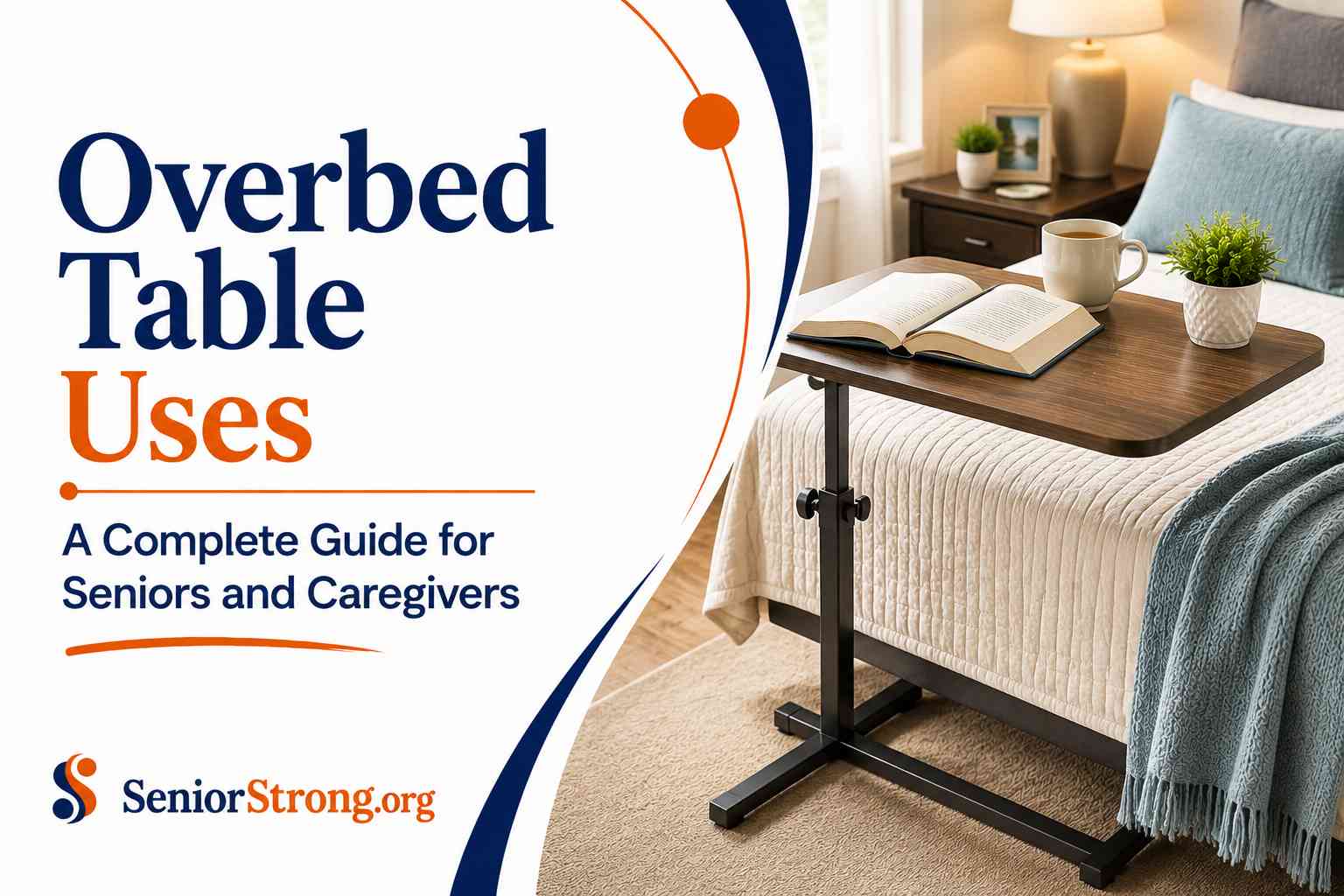
An overbed table can be used for far more than hospital meals. It works as a bedside dining surface, a medication and supply station, a reading or hobby desk, a mobile workstation for remote work, and a stable support for caregiving tasks, all on one height-adjustable rolling surface that fits over a bed or chair.
That flexibility matters more every year. In AARP's 2024 Home and Community Preferences Survey, 75% of adults age 50 and older said they want to stay in their current homes as they age. A well-chosen overbed table is one of the lowest-cost tools that makes staying home safer and more comfortable, whether you are recovering from surgery, managing a chronic condition, or simply tired of balancing a dinner plate on your lap.
Below, we cover every practical use, what to check before you buy, whether it can qualify for Medicare coverage, and how to pick the right model for your situation. The goal is a clear answer you can act on, written for the senior reading it and the family member helping with the decision.
An overbed table is used for any task that benefits from a stable, height-adjustable surface positioned over a bed or chair. The most common uses are eating, holding medications and personal items, reading, writing, hobbies, and using a laptop. In care settings, staff also use it to organize supplies and document care.
The design is what makes it so adaptable. A base slides underneath the bed or chair while the tabletop extends out over the user's lap. Most models roll on locking casters and adjust in height, so the same table can serve a person sitting up in bed in the morning and the same person resting in a recliner that afternoon.
These tables started as hospital furniture more than a century ago. Over the past two decades, manufacturers adapted them for home care, aging in place, and remote work, adding features such as tilting tops, wood-grain finishes, and built-in power outlets and USB ports. The result is a piece of furniture that suits people of all ages and mobility levels, well beyond patients alone.
For older adults at home, an overbed table earns its place by handling four everyday jobs: meals, keeping essentials in reach, reading and hobbies, and light desk work. Each one supports the same goal, which is staying comfortable and independent without constant help.
Eating meals. Dining is the most common use. Bedbound or recovering individuals often struggle with awkward reaching and poor posture at mealtime. Research from Cornell University's Human Factors and Ergonomics Research Group found that height-adjustable overbed tablesAdjustable tables that can be positioned over a bed or chair, providing a stable surface for eating,... improve meal management, reduce spills, support better eating posture, and lower the risk of choking or aspiration. Keeping food and drinks within easy reach also encourages the steady hydrationThe process of causing something to absorb water. In seniors, maintaining hydration is critical for ... and nutrition that recovery depends on.
Keeping essentials within reach. An overbed table holds a phone, glasses, the TV remote, books, and a water bottle right next to the person who needs them. Occupational therapists note that having personal items consistently accessible improves patient confidence and reduces caregiver burden during rehabilitation. Fewer retrieval requests means more dignity for the senior and fewer interruptions for the family member helping out.
Reading, writing, and hobbies. A tilting top turns the table into a reading stand, a writing desk, or a craft station for puzzles, sketching, or card games. Some surfaces include a raised lip so pens and tablets do not slide off. Because the whole table rolls away when it is not in use, a small bedroom does not have to give up floor space to it.
A bedside or chairside workstation. Remote work and online learning pushed overbed tables well past the bedroom. A tilt-top model positions a laptop screen and keyboard at a comfortable angle, which eases neck, shoulder, and eye strain during longer sessions. The audience for this is growing fast: a 2025 U.S. News survey found that 94% of seniors want to age in place, and the U.S. Census Bureau projects the population age 65 and older will climb from about 58 million in 2022 to 82 million by 2050.
For caregivers and people recovering from surgery or illness, an overbed table does two things at once: it lets the person in bed do more for themselves, and it spares the caregiver from bending and lifting. Both effects reduce strain and protect everyone's well-being.
Caregiver relief and ergonomics. In-home caregiving means frequent lifting, bending, and reaching, which is how many caregivers end up with back injuries. An overbed table brings the task up to bed level. During grooming or personal hygiene, it can hold a basin, oral care supplies, a shaving kit, or a hairbrush directly over the bed, so the caregiver does not have to lean awkwardly across the mattress.
Participation in personal care. When supplies sit on a stable surface at the right height, the person in bed can take part in their own grooming to the extent they are able. That participation supports morale and keeps muscles and coordination active during recovery, which therapists view as part of the healing process, not separate from it.
Recovery after surgery or a hospital stay. Recovery often means long hours of rest. A stable overbed table keeps medications, a water glass, a call button, and reading material organized in one spot, which lowers the chance of a risky reach toward a nightstand. Occupational and physical therapists also use these tables during sessions, for fine-motor tasks like puzzles and writing, adjusting the height as the patient gets stronger.
The base shape decides how stable the table is, how easily it moves, and which furniture it fits under. There is no single best base. The right one depends on whether you are using a standard bed, a recliner, or a wheelchair, and how much room you have. Here is how the common base types compare.
| Base Type | Shape | Best Suited For | Main Advantage |
|---|---|---|---|
| H-Base | Symmetric “H” | Standard beds and consistent room layouts | Balanced, predictable stability for daily tasks |
| U-Base (C-Base) | Open “U” or “C” | Recliners, wheelchairs, and multi-position use | Wraps around a chair for close, comfortable reach |
| X-Base | Intersecting “X” | Larger work or charting surfaces | Wide footprint stays balanced under off-center loads |
| I-Base | Centered, linear | Compact rooms and tight spaces | Easy positioning and high maneuverability |
| Specialty Base | Low-profile or offset | Critical-care beds and stretchers | Clears structural obstructions under the bed |
If you plan to use the table mainly with a recliner, a U-base is usually the safest choice because it slides around the chair instead of bumping into it. For a standard bed with plenty of floor clearance, an H-base or X-base gives the most steady, no-fuss support.
Picking the right model comes down to seven checks. Walk through them in order, because the first three (measurements) rule out tables that will not physically fit before you compare features or price.
No. Original Medicare does not cover an overbed table for home use. Medicare classifies it as a convenience item that is “not primarily medical in nature,” so it falls outside durable medical equipment coverage, even though Medicare does pay for related items such as a hospital bed and bed railsSafety rails that can be attached to the side of a bed to prevent falls and provide support when get... when a doctor prescribes them.
Because you will likely pay out of pocket, the price you choose matters. As of 2026, entry-level home models run about $55 to $80, mid-range adjustable tables with tilt-tops and locking casters cost roughly $80 to $130, hospital-grade tables run $140 to $250, and premium clinical models with sanitizable tops and built-in power can reach $300 to $600 or more.
A few routes can still offset the cost. Some Medicare Advantage plans include supplemental over-the-counter or home-support allowances that may apply, so check your plan's benefits. A Health Savings Account or Flexible Spending Account may cover it when a doctor recommends it. State MedicaidA state and federal program that provides health coverage to eligible low-income adults, children, p... home and community-based services waivers vary widely, and veterans may have options through the VA. Rules differ by program and state, so confirm before you buy.
A handful of product terms come up again and again in listings. Knowing them helps you compare models accurately instead of guessing at the differences.
The case for an overbed table is not just convenience. It shows up in clinical research on recovery, independence, and infection control, three areas where the right table measurably helps.
On recovery and nutrition, the Cornell University Human Factors and Ergonomics Research Group found that height-adjustable tables improve meal management, reduce spills, and lower aspiration risk for people eating in bed. On independence, the American Journal of Occupational TherapyTherapy aimed at helping individuals develop, recover, or maintain daily living and work skills. reports that keeping personal items within reach improves confidence and reduces the load on caregivers during rehabilitation.
Infection control is the reason hospitals take these tables seriously. One landmark study identified the overbed table as the third most-touched surface in a patient room, behind only bed linens and bedrails. Some manufacturer-cited testing and infection-control discussions identify overbed tables as high-touch surfaces that can become contaminated, which is why easy-to-clean, nonporous surfaces matter in clinical settings and for high-risk home users. That is why clinical-grade models use joint-free KYDEX or copper-infused tops. For a senior at home with a weakened immune system, the same lesson applies: a non-porous surface you can wipe down easily is worth paying for.
In our product evaluations, the models that earn the highest marks share a pattern. They use pneumatic height adjustment for one-handed operation, locking casters that hold firmly, and a tilt-top with a stable, easy-clean surface. Consider a common scenario: a parent comes home after hip surgery and spends most of the first two weeks in bed. A sturdy overbed table holding water, medications, a phone, and a book turns a dozen small daily requests for help into tasks the person can manage alone, which is exactly the kind of small win that protects both recovery and dignity.
An overbed table can be used for meals, medications, reading, hobbies, grooming, caregiving tasks, and remote work, all from one adjustable surface that keeps life within reach. For anyone recovering at home or aging in place, that simple capability supports independence for the senior and relief for the family member helping out.
As of 2026, you can find a capable home model for under $130, though Medicare will not cover it. Start with the three measurements (mattress height, under-bed clearance, and base-to-chair fit), match the base type to where it will be used, and choose the height mechanism that suits the user's hand strength.
For more ways to make the home safer and easier to navigate, read SeniorStrong’s guide to 10 best safety upgrades for seniors.
No. Original Medicare treats an overbed table as a convenience item that is not primarily medical in nature, so it is not covered as durable medical equipment for home use. Medicare does cover related items like a prescribed hospital bed. Some Medicare Advantage plans, HSAs, FSAs, or state Medicaid waivers may help, so check your specific plan.
Yes. Choose a U-base (also called a C-base), which is open on one side so it wraps around the chair and brings the tabletop close to you. Before buying, measure the chair so the inner width of the base is wide enough to fit around it without bumping the armrests.
It depends on the model. Light-duty home tables hold 20 to 30 pounds, standard-duty models hold 30 to 50 pounds, and heavy-duty clinical tables handle 50 to 100 pounds. Bariatric tables are built to support up to 500 pounds. Match the capacity to what you will actually place on it, with room to spare.
An overbed table has a base that slides under the bed so the top extends over your lap, and it usually adjusts in height and rolls on casters. A bedside table is a fixed stand that sits next to the bed. The overbed design is what lets you eat, read, or work directly over the mattress without reaching to the side.
Set it so the top sits a few inches above your lap when you are seated or propped up, with your forearms resting comfortably and your shoulders relaxed. The table's range must clear the mattress, including when the bed is raised. Adjustable models let you fine-tune the height for eating, reading, or laptop use.
Plenty. It serves as a medication and supply station, a reading or writing surface, a hobby and craft station, a laptop workstation for remote work or video calls, a grooming surface during personal care, and even a mobile activity tray for children. The adjustable height and rolling base make it useful in almost any room.