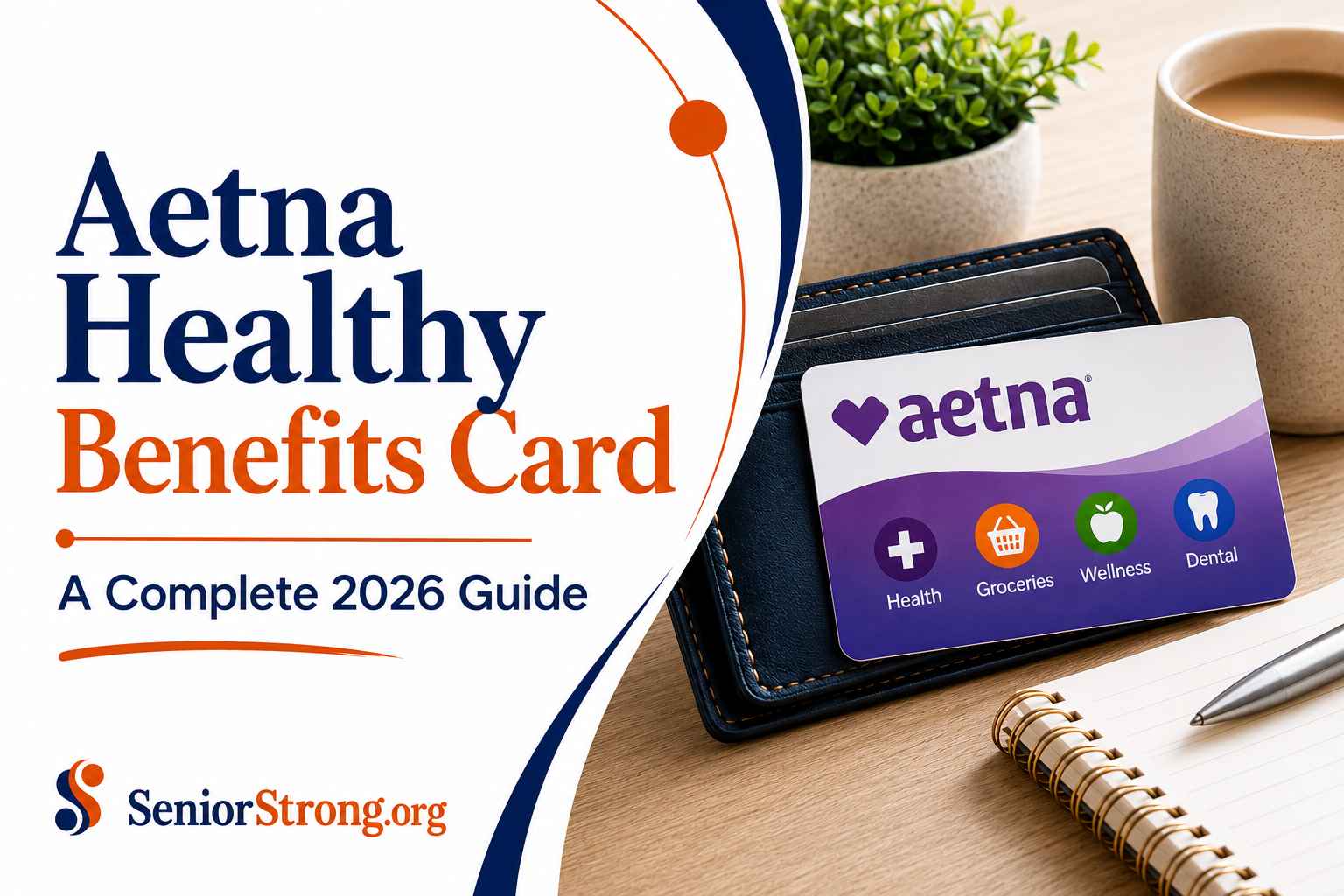
With your Aetna Healthy Benefits Card, you can buy approved over-the-counter health products, and on some plans, healthy groceries, personal care items, and even gas, utility bills, and transportation. What is covered depends entirely on which "wallets" your specific Aetna Medicare plan loads onto the card. The hard part is not the spending. It is knowing what qualifies before you reach the register.
This matters more than most people realize. Only about 30% of Medicare Advantage members who have an over-the-counter benefit actually use it, leaving close to $5 billion in allowances unspent each year, according to the Consumer Healthcare Products Association.
This guide walks through every category you can buy, the stores that accept the card, how to check your balance, and how to make sure none of your allowance expires.
The Aetna Healthy Benefits Card, officially the Aetna Medicare Extra Benefits Card, is not one open balance. Aetna divides it into separate "wallets," and each wallet has its own allowance and its own list of approved purchases. The wallets on your card depend on your plan, so two neighbors with Aetna cards can have completely different spending rules.
Aetna confirms that the card may carry one or more wallets, and that the places you can use it and your allowance depend on your plan. The richest version, the Extra Supports Wallet, is offered mainly on Dual Eligible Special Needs Plans (D-SNP) for people who have both MedicareA federal health insurance program for people who are 65 or older, certain younger people with disab... and MedicaidA state and federal program that provides health coverage to eligible low-income adults, children, p..., and on some Chronic Condition Special Needs Plans (C-SNP).
Here is what each wallet is for and what it typically covers. Check your plan's Evidence of Coverage or your card welcome kit to confirm which ones you have.
| Wallet Type | Primary Purpose | Typical Covered Items |
|---|---|---|
| OTC Wallet | General health and wellness products | Cold and flu remedies, pain relievers, first aid, dental care, eye care |
| CVS OTC Wallet | CVS-specific wellness purchases | Approved OTC items bought only at CVS retail locations |
| Extra Supports Wallet | Comprehensive daily living help | Healthy foods, personal care, OTC products, utility bills, gas, transportation |
| Medical Expense Wallet | Healthcare co-pays and services | Plan-covered medical services billed at a provider's office |
One rule to remember about expiration. Aetna's D-SNP guidance is clear that the food allowance becomes available monthly and allowances do not roll over. A small share of plans do allow rollover, but it is shrinking. Industry data shows OTC cards with rollover dropped from roughly 14% of plans in 2024 to under 10% in 2025, per Milliman's Medicare Advantage benefits analysis. Treat your card as use-it-or-lose-it unless your plan documents say otherwise.
If your card has any OTC wallet, you can buy a wide range of non-prescription health and wellness products at participating stores. These are the everyday items that support preventive care and minor illness, and they are the most consistently covered category across every Aetna plan that offers the card.
Approved OTC categories generally include:
Aetna's own member materials list allergy medicine, pain relievers, first aid supplies, and oral care among the approved OTC health and wellness products. The average OTC allowance across Medicare Advantage plans runs about $400 a year, though Aetna amounts vary by plan and region.
The Extra Supports Wallet is where the card becomes a true cost-of-living tool. If your plan includes it, you can buy approved healthy groceries and personal care products, and you can pay for gas, transportation, and household utility bills directly with the card.
Healthy foods. Aetna confirms the Extra Supports Wallet covers approved healthy foods, personal care products, OTC products, utilities, and transportation. Approved groceries include fresh, frozen, or canned fruits and vegetables, fresh meat, poultry, fish and eggs, milk, cheese and yogurt, whole-grain bread and brown rice, pantry staples like flour and cooking oil, and approved healthy frozen meals.
Personal care and household. Bath soap, body wash, shampoo, conditioner, deodorant, and shaving cream qualify, along with cleaning supplies like disinfectant wipes, laundry detergent, and dish soap on plans that include them.
Gas, transportation, and bills. On Extra Supports plans, you can swipe at the pump for fuel, cover public transit, train, or rideshare fares such as Uber and Lyft, and pay home electricity, gas, water, internet, and cell phone bills. Aetna confirms the card can be used for certain utility bills, public transportation, or a rideshare service.
Here is how the two main spending tiers compare so you can see exactly what your wallet unlocks:
| Spending Category | OTC Wallet (most plans) | Extra Supports Wallet (mainly D-SNP) |
|---|---|---|
| OTC health products | Covered | Covered |
| Healthy groceries | Not covered | Covered |
| Personal care and household | Not covered | Covered |
| Gas at the pump | Not covered | Covered |
| Public transit and rideshare | Not covered | Covered |
| Utility and phone bills | Not covered | Covered |
| Junk food, alcohol, tobacco | Not covered | Not covered |
Knowing the exclusions prevents the most common problem cardholders face: a declined transaction at the register. The card is built for health, nutrition, and essential living costs, so anything outside that purpose is usually blocked, even at a store that otherwise accepts the card.
The Healthy Benefits Card generally cannot be used for:
If an item is not approved, or you have used up your allowance, Aetna notes you simply pay the remainder yourself. The card does not block the whole order; it just covers the eligible portion.
You can use the card in three ways: in store, online, or by phone. Online ordering is often the easiest because the catalog automatically filters out anything your plan willA legal document that states how a person's property should be managed and distributed after death. not cover, so you never guess at the register.
Major participating retailers include:
Aetna's member guidance confirms the card works in store, online at CVS.com/Aetna, or by phone, with the exact stores depending on your wallet. One practical tip from Aetna: at checkout, swipe and select "credit," not debit, and no PIN is required.
To shop online or by phone, follow these steps:
A note on phone numbers and apps. Aetna administers this benefit through more than one vendor depending on your plan. Some members manage the card through CVS OTC Health Solutions, while others use the NationsBenefits app and portal. Always use the number, website, and app printed on your own card and welcome kit rather than a number from a search result.
A few terms come up constantly with this benefit. Here is what each one means in plain language.
Wallet. A spending category on the card with its own allowance and its own approved purchases. The OTC wallet and the Extra Supports wallet have different rules.
D-SNP (Dual Eligible Special Needs Plan). An Aetna Medicare Advantage plan for people who qualify for both Medicare and Medicaid. These plans most often carry the Extra Supports Wallet with groceries and utilities.
Allowance. The dollar amount loaded onto a wallet at the start of each benefit period, monthly or quarterly, set by your specific plan.
Use-it-or-lose-it. The policy on most plans where any unused balance expires at the end of the month or quarter and does not carry forward.
The single biggest mistake is not overspending. It is underspending. Federal data shows benefit cards are widely offered but lightly used, which means real money expires every period for people who could have used it on essentials.
Dr. Mark Fendrick, a professor of internal medicine and health policy at the University of Michigan, told Newsweek that around 87% of Medicare Advantage plans offer some kind of OTC benefit, yet only about a third of eligible members use it. The gap is awareness, not eligibility.
Regulators noticed. Starting in 2025, the Centers for Medicare & Medicaid Services began requiring Medicare Advantage plans to send a Mid-Year Enrollee Notification of Unused Supplemental Benefits between June 30 and July 31 each year, listing benefits a member has not yet touched. If you get one of these notices in 2026, treat it as a reminder to spend downThe process of reducing an individual's assets in order to qualify for Medicaid, as one must meet fi... your card before the funds reset.
In practice, the seniors who get the most value do three simple things: they confirm which wallets are on their card, they keep a running list of shelf-stable essentials to buy near the end of each period, and they check the balance before every shopping trip. Those three habits turn an ignored card into a few hundred dollars of real savings a year.
Because most balances expire, a little planning protects the full allowance. Use these tactics each benefit period.
Your Aetna Healthy Benefits Card can cover far more than cough syrup. Depending on your wallets, it pays for OTC health products and, on Extra Supports plans, groceries, personal care, gas, transit, and utility bills. The key is to confirm which wallets you have, learn the exclusions so nothing gets declined, and spend the allowance before it resets.
As of 2026, with CMS now requiring plans to flag unused benefits mid-year, there is no reason to let this money expire. Confirm your wallets, check your balance before each trip, and build a small end-of-period shopping list.
Want to understand how this card fits into your broader Aetna coverage? Read our guide to the Aetna Medicare Extra Benefits Card to compare card benefits, plan types, and what to check before choosing or changing coverage.
Only if your plan includes the Extra Supports Wallet, which is most common on D-SNP plans. With that wallet, you can buy approved healthy foods like produce, meat, dairy, and whole grains. A standard OTC-only wallet does not cover groceries.
Yes, on participating plans. Walmart accepts the card for approved OTC and food items at many supercenters and on walmart.com for the food benefit. Coverage still depends on your plan's wallets, so confirm Walmart is listed in your member portal store locator.
On most plans, no. Allowances are typically use-it-or-lose-it, resetting each month or quarter. A small and shrinking share of plans allow rollover. Check your plan documents, and assume funds expire unless they clearly state otherwise.
No. The card cannot be used for cash withdrawals, ATM access, or gift cards. It only covers approved products and, on Extra Supports plans, specific services like gas, transit, and utility bills.
Check your balance through the NationsBenefits or CVS OTC Health Solutions app, your online member portal, or by calling the customer service number on the back of your card. Aetna lets you view the balance anytime once the card is activated.
Your card covers the eligible portion, and you pay the rest with another payment method. The transaction is not declined outright as long as the items qualify; you simply owe the difference for anything over your balance or any non-approved item.