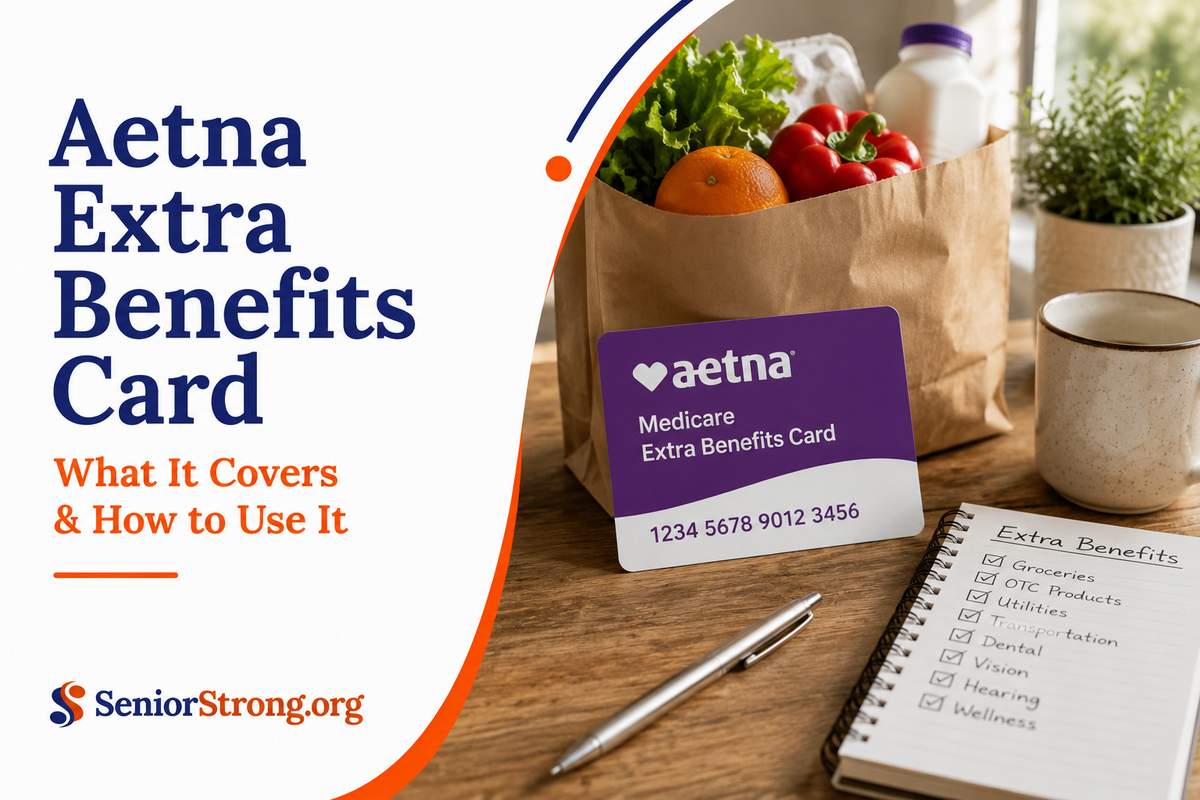
The Aetna MedicareA federal health insurance program for people who are 65 or older, certain younger people with disab... Extra Benefits Card is a prepaid debit card included with select Aetna Medicare Advantage plans that gives members a monthly allowance for things like over-the-counter health products, healthy groceries, utility bills, and transportation. As of February 2026, more than 8 million people are enrolled in Special Needs Plans, the plan category where this card is most commonly offered. If you have an Aetna D-SNP or C-SNP, you may already be eligible for hundreds of dollars a year in benefits you have not yet used.
This guide explains how the card works, which "wallets" your plan includes, and where and how to spend the allowance before it expires.
The Aetna Medicare Extra Benefits Card is a prepaid debit card loaded each month or quarter with an allowance you can spend on approved everyday expenses. Aetna offers it on select Medicare Advantage plans, and the card consolidates multiple supplemental benefits onto a single piece of plastic instead of issuing separate cards for OTC products, groceries, and utilities.
The card is powered by OTC Health Solutions, a CVS Health company, and what you can buy with it depends on which "wallets" your plan includes. Each wallet has its own allowance amount and its own list of approved purchases. If your card has more than one wallet, you cannot mix the allowances. An OTC Wallet allowance can only be spent on OTC products, not groceries.
Aetna is one of several Medicare Advantage carriers offering this kind of supplemental benefit card. You may also see it referred to as a flex card, a benefits card, or a healthy foods card. For a broader look at how flex-style cards work across carriers, our guide to the senior flex card for groceries covers the basics.
Eligibility is determined by plan type, not income or age alone. The Aetna Medicare Extra Benefits Card is most often included on two plan types: Dual Eligible Special Needs Plans (D-SNPs) and Chronic Condition Special Needs Plans (C-SNPs). Some general Medicare Advantage plans also include a limited version of the card, often tied to federal Extra Help eligibility.
According to the Centers for Medicare and Medicaid Services enrollment data published in February 2026, more than 8 million people are enrolled in Special Needs Plans, with 83% of all Medicare Advantage enrollment growth between 2025 and 2026 coming from SNPs. More seniors than ever before are now in plan types that typically include an Extra Benefits Card.
D-SNP eligibility: D-SNPs are for people who qualify for both Medicare and Medicaid. All Aetna D-SNP members receive a monthly OTC Wallet allowance on the Extra Benefits Card. Members with a qualifying chronic condition can have their OTC Wallet upgraded to an Extra Supports Wallet, which adds healthy food, personal care, transportation, and utility spending categories.
C-SNP eligibility: C-SNPs are for people with severe or disabling chronic conditions like diabetesA chronic condition that affects the way the body processes blood sugar (glucose), requiring ongoing..., chronic heart failure, or certain cardiovascular conditions. Aetna expanded C-SNP availability to 18 states in 2026, including 16 new states, and these plans typically include the Extra Benefits Card with similar wallet structures.
General Medicare Advantage eligibility: Some Aetna Medicare Advantage plans outside the SNP categories include a more limited Extra Benefits Card, particularly for members who qualify for the federal Extra Help (Low Income Subsidy) program. To confirm whether your plan includes the card, review your Evidence of Coverage document or log in to your Aetna member portal.
Aetna structures the Extra Benefits Card around three wallet types. Most plans include one or two; some include all three. The wallet type determines where you can shop and what you can buy.
| Wallet Type | What You Can Buy | Where You Can Use It |
|---|---|---|
| OTC Wallet | Approved over-the-counter health and wellness products | CVS retail stores, CVS.com/Aetna, by phone at 1-844-428-8147 |
| CVS OTC Wallet | Approved over-the-counter products only | CVS retail locations only (excluding CVS inside Target stores) |
| Extra Supports Wallet | OTC products, healthy foods, personal care items, utility bills, transportation | 70,000+ participating retail locations, CVS stores, online, phone |
If your plan has a CVS OTC Wallet, that allowance is locked to CVS purchases only. If it has the broader OTC Wallet or an Extra Supports Wallet, you can use the funds in more places. The Extra Supports Wallet is the most flexible of the three because it covers groceries and household bills along with health products. Some plans may include other wallets, such as a Medical Expense Wallet.
The full list of approved items runs into the hundreds, but the categories break down cleanly. The exact products vary by plan, and Aetna provides an OTC catalog at enrollment. Here is what is typically covered.
Approved categories under the Extra Supports Wallet were expanded in 2026 to give members with chronic conditions broader spending flexibility, especially for groceries and household essentials.
Before the first purchase, the card needs to be activated. Aetna offers three options, all free, all available year-round.
Once activated, you can check your balance, view approved products, and place phone or online orders anytime. Many members use the app to scan product barcodes in stores to confirm an item is approved before buying.
Where you can spend depends on your wallet type, but the network has grown substantially in 2026.
In-store shopping is available at CVS Pharmacy retail locations, with one exception: CVS pharmacies located inside Target stores do not accept the card. For members with the Extra Supports Wallet, the card is accepted at over 70,000 participating retail locations nationwide, including major grocery chains, big-box stores, and select transit providers.
Online shopping is supported at CVS.com/Aetna, where you can browse an approved product catalog filtered by your wallet type. Shipping on OTC orders is typically free.
Phone orders are available at 1-844-428-8147, with live representatives from 8 AM to 8 PM local time and an automated system 24 hours a day. This option is especially useful for members who prefer not to shop online or who have trouble getting to a store.
One important note for Arkansas residents: Aetna materials include an Arkansas legal-access disclaimer, but the law has been temporarily blocked; Arkansas members should confirm current CVS/Caremark access with Aetna before relying on the card.
The biggest problem with the Extra Benefits Card is not that members lack access to it. It is that they do not use it. A 2024 Commonwealth Fund survey on Medicare supplemental benefits found that 8 in 10 Medicare Advantage enrollees consider supplemental benefits an important part of their plan, but 3 in 10 reported not using any of them in the past year. The most common mistakes are avoidable.
Mistake 1: Letting the allowance expire. Unused balances do not roll over to the next benefit period. If your plan provides a monthly allowance and you do not spend it by month-end, those funds are gone. Set a reminder to check the balance in the last week of each benefit period.
Mistake 2: Buying ineligible items. Not every product at CVS is approved, and not every grocery item is covered under the Extra Supports Wallet. The CVS OTC Health Solutions app lets you scan a barcode at the shelf to confirm before checkout, which prevents a declined transaction.
Mistake 3: Confusing the wallets. If your plan has both an OTC Wallet and an Extra Supports Wallet, you cannot spend the OTC allowance on groceries or vice versa. The card knows the difference, and a checkout attempt that mixes wallet rules willA legal document that states how a person's property should be managed and distributed after death. be declined for the wrong items.
Mistake 4: Skipping activation. A card that has not been activated will not work, no matter how full the balance shows in your account. Members sometimes report a "broken" card that was simply never turned on.
Mistake 5: Not telling family members. For caregivers helping an aging parent, knowing whether a parent has an Extra Benefits Card and how it works is half the battle. Many seniors receive the card in the mail and never open the envelope, especially if it arrives separately from other Medicare paperwork.
Aetna made several adjustments to the Extra Benefits Card for the 2026 plan year, most of them expansions.
The most significant change: D-SNP coverage expanded into 119 new counties for 2026. C-SNP availability grew from a smaller footprint into 18 states, including 16 states where Aetna's C-SNPs were not previously sold. According to the October 2025 announcement from CVS Health, Aetna's 2026 strategy was specifically designed to expand benefits-card access to more seniors with chronic conditions and dual eligibility.
Aetna also confirmed that for 2026, all D-SNP members receive the Extra Benefits Card with at least an OTC Wallet allowance. Members with a qualifying chronic condition get the card upgraded to an Extra Supports Wallet automatically, with no separate application required.
One countervailing trend is worth noting. According to KFF's January 2026 analysis of Medicare Advantage plan benefits, a smaller share of general Medicare Advantage plans are offering OTC allowances in 2026 compared to 2025, and the rapid expansion of extra benefits across the industry has slowed. For SNP enrollees, the picture is different: 94% of SNPs still offer an OTC allowance in 2026, compared with 66% of individual Medicare Advantage plans. The Extra Benefits Card remains a near-universal feature in the SNP world, which is where it matters most for members who depend on it.
In our experience working with seniors and family caregivers, the single biggest miss is not knowing the card exists in the first place. Adult children often discover, months into a parent's coverage, that the parent has been paying out of pocket for items the card would have covered all along. The 2026 expansion only matters if members and their families know it is there to use.
The Aetna Medicare Extra Benefits Card is one of the most useful supplemental benefits in the Medicare Advantage space, but only for members who actually use it. As of 2026, Aetna D-SNP and C-SNP members receive a monthly allowance that can offset hundreds of dollars a year in OTC, grocery, utility, and transportation costs, and the network of accepted locations grew substantially this year. The card's biggest weakness is not the benefit itself but the awareness gap. Roughly 3 in 10 Medicare Advantage enrollees still go a year without touching their supplemental benefits at all. If you or a parent are enrolled in an Aetna plan that includes the card, the next step is straightforward: activate it, check the balance, and use it before the benefit period resets.
Want to compare Aetna coverage beyond the Extra Benefits Card? Read Senior Strong’s guide to the best Aetna Medicare Advantage plans for seniors to better understand HMO, PPO, and Special Needs Plan options before choosing or changing coverage.
No. Original Medicare (Parts A and B) does not include the Extra Benefits Card or any similar supplemental allowance. The card is provided through specific Medicare Advantage plans offered by private insurers like Aetna, most commonly through D-SNP and C-SNP plans for dual-eligible or chronically ill members. To get the card, you must be enrolled in a plan that offers it.
Only if your plan includes the Extra Supports Wallet. The OTC Wallet and the CVS OTC Wallet are limited to approved over-the-counter health products. The Extra Supports Wallet adds groceries, personal care items, utilities, and transportation as approved spending categories. Check your Evidence of Coverage or your Aetna member portal to confirm which wallets your card has access to.
No. Any unused allowance expires at the end of each benefit period and does not roll forward. If your allowance is monthly, you have one month to spend it. If it is quarterly, you have three months. Aetna's official OTC benefit page states clearly that unused allowance will not carry over to the next benefit period.
The allowance amount varies by plan, state, and whether you qualify for an Extra Supports Wallet through a chronic condition. There is no single national figure. To see your specific amount, log in to your Aetna member portal or call the number on the back of your card. Allowances for D-SNP members with chronic conditions are typically higher than basic OTC-only allowances.
The card will decline the transaction for the ineligible items, but will still process approved items in the same purchase. To avoid checkout problems, scan products with the CVS OTC Health Solutions app or check the approved product catalog at CVS.com/Aetna before shopping. The catalog is searchable by wallet type.
Yes, if the senior member authorizes it. Many adult children help aging parents handle the actual shopping using the parent's card. Aetna treats this as a permitted use as long as purchases stay within the approved categories. Family caregivers should still review the Evidence of Coverage so they understand what is and is not eligible.