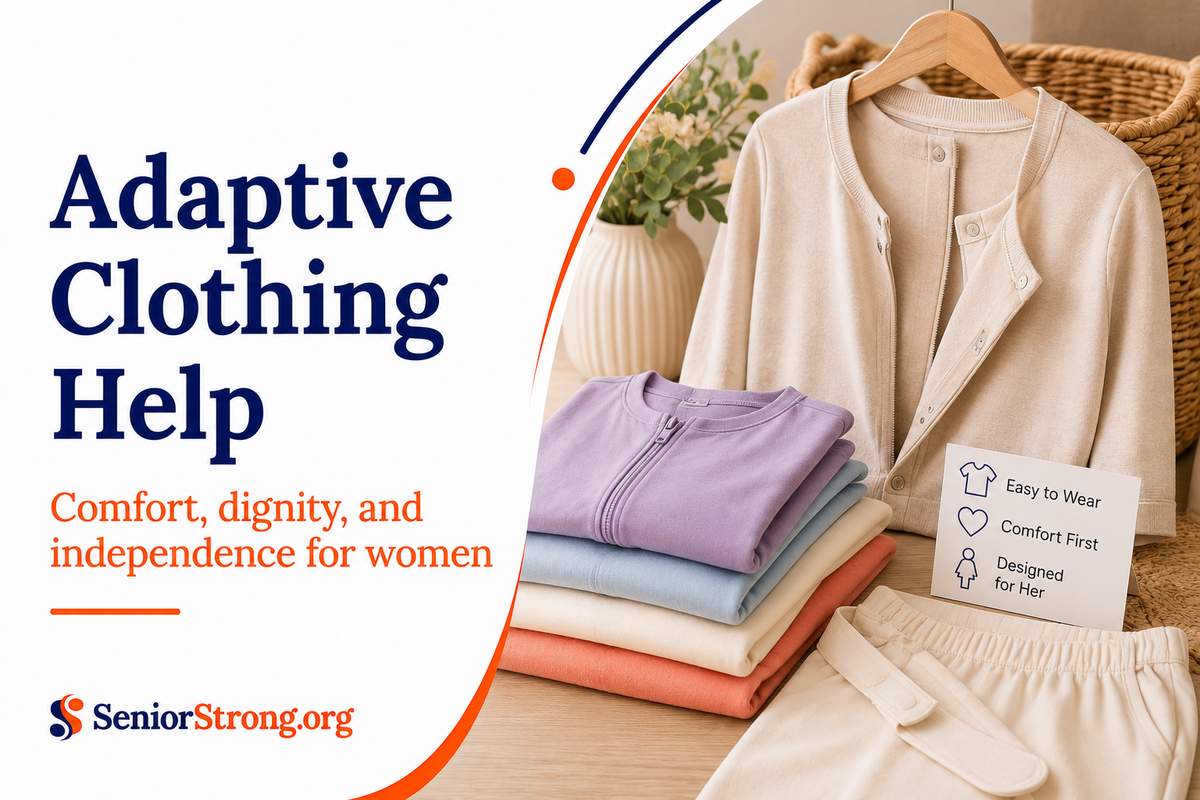
Adaptive clothing for women is regular-looking apparel modified with features like magnetic closures, side zippers, elastic waistbands, and open-back designs that make dressing easier for women with arthritisAn inflammation of the joints that causes pain and stiffness and is more common in older adults., limited mobility, sensory sensitivities, or post-surgical recovery needs. The women's segment now accounts for 48.65% of the global adaptive clothingGarments designed with easy closures, elastic waists, and accommodating fits to assist seniors with ... market and is growing faster than the men's segment, according to industry analysts at Grand View Research.
This guide is written for both the woman shopping for herself and the daughter or spouse helping a mother choose. You willA legal document that states how a person's property should be managed and distributed after death. learn what to look for, which brands actually deliver on style and function, what these garments realistically cost, and how to avoid the common mistakes that send returned packages back to retailers.
Adaptive clothing is apparel modified with closures, cuts, and construction that make dressing easier for someone with reduced dexterity, limited mobility, sensory sensitivities, or medical access needs. The garment looks like a regular blouse, dress, or pair of pants on the outside. The differences are functional, hidden magnets behind a row of decorative buttons, a side zipper that opens the entire pant leg, and a wrap-style top that fastens with one hand.
For senior women, the most relevant categories are: tops and blouses with magnetic or Velcro fastenings, pants with side or back closures and elastic waistbands, open-back nightgowns for caregiver-assisted dressing, dresses with snap or zip openings along one side, and adaptive bras with front magnetic closures that avoid the painful reach behind the back. Adaptive footwear, with stretch panels and grip soles, often gets sold alongside apparel but operates as its own category.
The term gets used loosely. A pair of pants with an elastic waistband is technically adaptive in the sense that it requires no fine motor work to fasten, but it is not engineered for the same use case as a true side-zip pant designed for a wheelchair user. Read the product description carefully. A senior with hand arthritis needs different features than a woman recovering from shoulder surgery, and both need different features than someone with sensory processing differences from autism or dementiaA chronic disorder characterized by a decline in cognitive function beyond what might be expected fr....
Adaptive clothing serves women whose hands, joints, balance, or sensory tolerance no longer cooperate with conventional fasteners and cuts. According to the Centers for Disease Control and Prevention, approximately 2 in 5 adults aged 65 and older live with a disability, and most disability types are more commonly reported by women than men. That intersection of age, gender, and functional limitation defines the core audience.
The clearest beneficiaries fall into a few groups. Women with arthritis, particularly in the hands and wrists, struggle most with the small repetitive grip required by buttons, hooks, and standard zippers. Women with Parkinson's disease lose fine motor control progressively, and the tremor itself makes precise fastening exhausting. Women using wheelchairs or motorized scooters need garments that fit comfortably in a seated position, which means a longer back rise and shorter front rise than standard cuts provide.
There is also a large group rarely discussed in catalog marketing: women recovering from short-term events. A rotator cuff repair, a mastectomy, a hip replacement, or a strokeA medical condition where poor blood flow to the brain results in cell death, leading to potential p... all create temporary windows where conventional clothing becomes nearly impossible. Adaptive garments cover these recoveries well, often as gifts from family members or purchases made the week before a scheduled surgery.
Caregivers benefit too. Buck & Buck, one of the longest-established adaptive retailers, reports that family caregivers and assisted living staff are a significant share of their customer base. Lisa Walke, chief of the Division of Geriatric Medicine at the Hospital of the University of Pennsylvania, told AARP that adaptive clothing gives caregivers "a sense of ease, convenience and comfort" while letting the wearer keep the dignity of dressing herself.
The most useful adaptive features depend on the specific limitation a woman is working around. The table below maps the seven most common adaptive design choices to the conditions and situations they serve best. Use it as a starting filter before reading any product page.
| Feature | What It Does | Best For |
|---|---|---|
| Magnetic closures | Hidden magnets behind decorative buttons or covered placket; no grip strength needed. | Arthritis, Parkinson's, post-stroke, low fine-motor strength. |
| Velcro / hook-and-loop fasteners | Audible, low-precision fastening on shirts, pants, and shoes. | Cognitive impairment, dementia, very limited dexterity. |
| Side or back zippers | Garment opens fully on one side or down the back; can be dressed from a seated or lying position. | Wheelchair users, bedridden patients, and post-surgery recovery. |
| Elastic / wide waistbands with inner pull loops | Pulls on without buttoning; loops give a grip point. | Hand weakness, swollen abdomens, women dressing themselves seated. |
| Open-back designs | Tops and gowns open entirely down the back for caregiver-assisted dressing. | Severe mobility loss, hospice, late-stage dementia. |
| Flat seams and tagless construction | Reduces skin friction and irritation against sensitive areas. | Sensory sensitivities, fragile skin, and post-radiation skin. |
| Higher back / lower front rise on pants | Cut prevents waistband gaping and bunching when seated. | Full-time wheelchair users reduce pressure-sore risk. |
One feature worth singling out is the magnetic closure. The technology was popularized by MagnaReady, a brand founded after the developer's husband was diagnosed with Parkinson's disease, and is now used by Tommy Hilfiger, Yarrow, Joe & Bella, and dozens of smaller labels. The better implementations survive repeated wash cycles. Cheaper magnetic shirts begin to lose closure strength within a year, which is the single most common complaint in customer reviews. Look for brands that disclose the magnet count per closure and that publish wash-test data.
Adaptive garments are sold across hundreds of retailers, mainstream and specialty, with inconsistent sizing and significant price variation. A short, methodical process saves money and prevents the most common returns.
The adaptive women's market splits roughly into two groups: mainstream fashion houses that have launched dedicated adaptive lines, and specialty brands that have built their entire business around the category. Both deserve consideration. Mainstream brands offer better aesthetics and price points; specialty brands offer deeper feature engineering for specific conditions.
| Brand | Type | Best Known For |
|---|---|---|
| Tommy Hilfiger (Tommy Adaptive) | Mainstream | Classic American styling with magnetic buttons, one-handed zippers, and seated-friendly cuts. Often available with sale pricing. |
| Primark Adaptive | Mainstream / Budget | Co-designed with adaptive label Unhidden; affordable adaptive womenswear, sleepwear, and underwear at high-street prices. |
| IZ Adaptive | Specialty | Wheelchair-focused women's wear with patented seamless construction to reduce pressure-sore risk in seated positions. |
| Joe & Bella | Specialty | Stylish modern adaptive basics; signature CareZip pants assist caregivers with toileting and changing routines. |
| MagnaReady | Specialty | The original patented magnetic-button technology; clean, professional blouses and shirts. |
| Silverts | Specialty / Care Setting | Deepest catalog of open-back tops, side-zip pants, and condition-specific clothing for memory careSpecialized care designed specifically for individuals with memory impairments such as Alzheimer's o... and assisted livingResidential living environments for seniors who require assistance with daily activities but do not .... |
| Buck & Buck | Specialty / Care Setting | Long-established care-facility supplier; free hemming, label sewing, and low-cost custom alterations. |
If the wearer wants to keep her existing personal style, mainstream brands are the better starting point. If the wearer needs heavy condition-specific engineering, like an anti-strip jumpsuit for advanced dementia or a hospital-grade open-back gown, the specialty brands carry stock that mainstream lines never will. Many families end up buying from both categories. For more women-specific brand reviews, our team has a separate write-up on fashionable and functional adaptive clothing.
Adaptive clothing for women typically costs $30 for basics like socks and undergarments and $80 to $150 for tops, blouses, and pants. Dresses, jumpsuits, and outerwear can reach $200 or more. The price premium over conventional clothing varies, sometimes 20% higher for mainstream adaptive lines, often 50% or more for small specialty brands. Larger production runs at companies like Tommy Hilfiger and Primark have brought entry-level prices down compared to the catalog-only market of a decade ago.
Medicare does not cover adaptive clothing under Original Medicare. Clothing is not classified as durable medical equipment, which is the Medicare Part B category that covers items like walkers, hospital beds, and oxygen equipment. A few specific medical-grade items, surgical compression garments, certain post-mastectomy bras and prosthetic-fitting garments, may be covered with a prescription, but everyday adaptive apparel is not.
MedicaidA state and federal program that provides health coverage to eligible low-income adults, children, p... coverage is rare and state-specific. Some state Medicaid programs cover a small clothing allowance for nursing homeA facility for the residential care of elderly or disabled people, where nursing care and supervisio... residents, and a handful of long-term care insuranceInsurance designed to cover the costs of long-term care services, including assisted living, home ca... policies reimburse adaptive apparel as part of a personal-care benefit. Veterans receiving the VA Aid and Attendance benefit can apply that monthly stipend to adaptive clothing purchases at their discretion. For seniors on a tight fixed income, the most realistic cost offsets are sales pricing (Tommy Adaptive runs frequent promotions), bulk-buy discounts from Silverts and Buck & Buck, and the medical expense deduction on federal income taxes if total medical costs exceed the 7.5% AGI threshold.
Cost should not be the only filter. A single $90 magnetic-closure blouse worn three times a week for two years works out to less than $0.30 per wear, and it can prevent the daily frustration that makes some seniors stop dressing entirely. The household economics often favor adaptive clothing once it replaces three or four conventional items the wearer can no longer manage.
Clinicians who work with older women routinely describe adaptive clothing as more than a convenience purchase. The medical case rests on three points: preserving independence in activities of daily living, reducing caregiver injury risk, and supporting psychological wellbeing during age-related transitions.
Dr. Lisa Walke, chief of the Division of Geriatric Medicine at the Hospital of the University of Pennsylvania, has been quoted in AARP's caregiving coverage explaining the geriatric care perspective: "One of our main goals in geriatrics is maintaining independence and supporting independence. So having adaptive clothing that allows someone to be able to maintain that ability to dress themselves, without needing assistance or maybe with modified assistance, is an absolute goal and also game-changing for people."
The caregiver side of the equation is increasingly studied. Assisted-dressing tasks are a leading cause of back, shoulder, and wrist injuries among home health aides and family caregivers, particularly when the care recipient resists or stiffens during overhead arm motions. Open-back tops and side-zip pants eliminate the overhead motion entirely, which is why memory-care facilities have moved heavily toward these designs over the past decade. A family caregiverA family member who provides care and assistance to a relative who is aging, chronically ill, or dis... dressing a mother with advanced Parkinson's tremor or dementia-related rigidity is doing the same physical work as a paid aide, with the same injury risk.
There is a softer, less measured argument too. Several caregivers interviewed by senior advocacy publications describe the day a mother stopped fighting the morning dressing routine as a turning point, not because the clothing was a miracle, but because removing one daily struggle freed energy for the things both people wanted to do together. Adaptive clothing does not solve cognitive declineThe gradual loss of cognitive function, which can include memory impairment, difficulty with decisio... or chronic painPersistent pain that can range from mild to severe and lasts for an extended period, often affecting.... It does remove one of the daily reminders of them.
Most of the negative reviews on adaptive retailer sites trace back to the same handful of mistakes. Knowing them in advance saves significant money and frustration.
As of 2026, adaptive clothing for women is no longer a niche corner of the medical supply catalog. Mainstream brands have entered the category, prices have come down at the entry level, and the engineering of closures and cuts has matured considerably. A 73-year-old woman with arthritis, a 58-year-old daughter shopping for her mother in memory care, and a 40-year-old recovering from rotator cuff surgery can all find options that look like regular clothing and work with their bodies instead of against them.
The honest summary: this category is worth the price premium for women who genuinely need it, especially once one adaptive piece replaces three frustrating conventional ones in the daily rotation. It is not a Medicare-covered benefit, and it is not a one-size-fits-all market, so the process matters, identify the limitation, match the features, test one piece, then build the wardrobe.
The right garment will not solve every challenge of aging, but it can take the daily fight out of getting dressed, and that alone is worth getting right. Start with one well-matched piece, test the fit and fabric, then build from there. For more ways to make daily routines safer and easier at home, read Senior Strong’s guide to the best safety upgrades for seniors
No. Original Medicare does not classify clothing as durable medical equipment and does not cover everyday adaptive apparel. A small number of medical-grade items, post-mastectomy compression garments, certain prosthetic-fitting bras, surgical compression stockings prescribed by a physician, may be covered under Medicare Part B. For routine adaptive blouses, pants, and dresses, plan to pay out of pocket.
Comfortable clothing uses soft fabrics and loose cuts but still relies on conventional fasteners. Adaptive clothing engineers the fasteners and construction so the garment can be put on and taken off without fine motor work or overhead motion. A pull-on knit pant with no closure is comfortable. A side-zip pant designed for a wheelchair user, with a higher back rise and Velcro waist tabs, is adaptive.
The magnets used in adaptive clothing are typically rated low enough in gauss strength to pose minimal risk for modern pacemakers and implantable cardioverter-defibrillators (ICDs), but the safe distance varies by device manufacturer. Anyone with a pacemaker or ICD should consult her cardiologist before wearing magnetic-closure garments, particularly bras and chest-area shirts where the magnets sit close to the device.
Look for magnetic-closure blouses and shirts, pants with elastic waistbands and inner pull loops, and slip-on adaptive shoes with stretch panels. Avoid items with small buttons, back zippers, or hooks. Tremor makes precise fastening especially exhausting, so the goal is closures that work even when the hands are shaking. MagnaReady, Joe & Bella, and Tommy Adaptive all carry options well-suited to Parkinson's needs.
Frame the purchase around style first, function second. Mainstream brands like Tommy Hilfiger and Primark make this easier because the adaptive line looks like the regular line. Let her choose colors and patterns. Start with one or two pieces, not a full wardrobe replacement. Many women accept adaptive clothing more readily once they see it does not look medical or institutional, and once they experience how much easier the morning routine becomes.
In-person retail remains limited. Some Target and Kohl's stores stock select adaptive items in the women's section. Specialty adaptive retailers like Silverts and Buck & Buck operate primarily through catalogs and online ordering. A few major medical supply stores stock adaptive clothing alongside walkers and bath safety equipment. For most families, online ordering with a try-and-return approach is the most practical path.