The best lift chair for a senior is the one that fits their weight, body size, health condition, and budget, not the one with the flashiest marketing. A lift chair is a motorized recliner that gently tilts the whole seat forward to help you stand without straining your knees, hips, or back. That matters because falls are the leading cause of injury-related death among adults 65 and older, and more than 14 million older adults report a fall each year, according to CDC data.
This guide compares five strong lift chairs for seniors in 2026 across different budgets and needs, explains the three main chair types, walks through the buying criteria that affect safety, and shows exactly how Medicare coverage works.
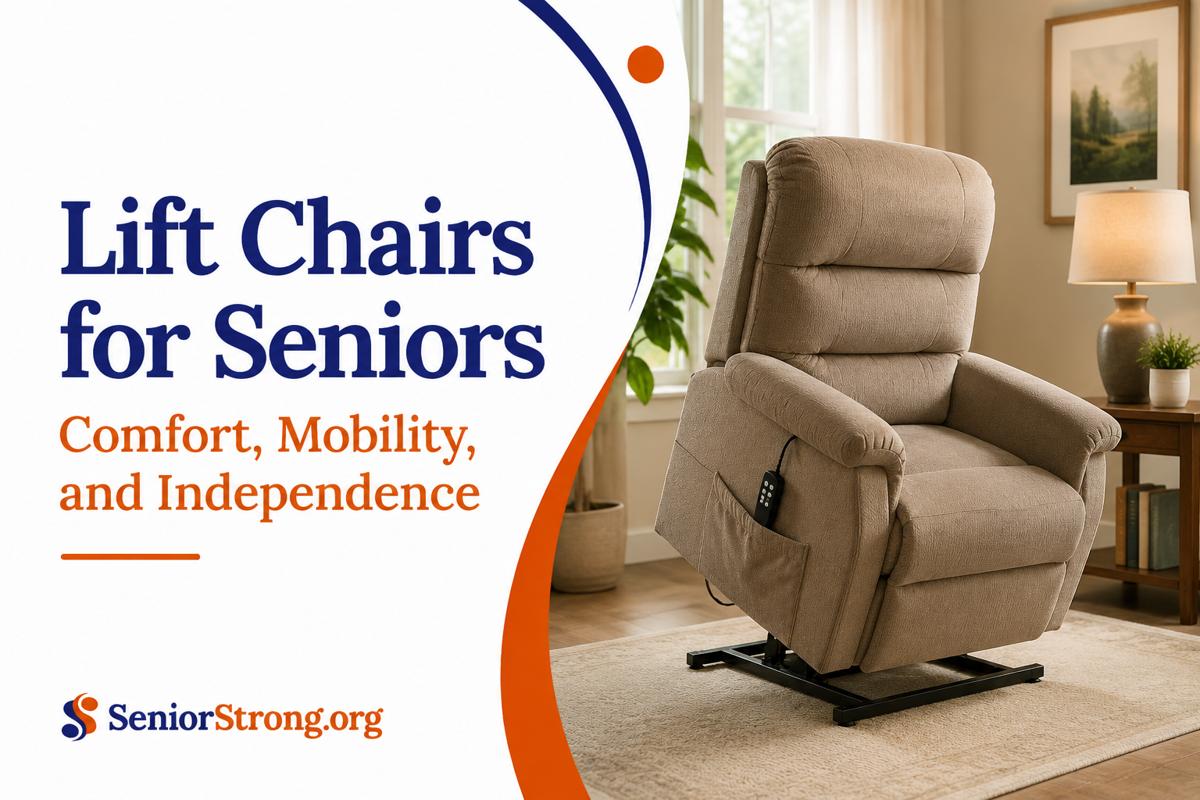
A lift chair is a motorized recliner with a lifting mechanism that tilts the entire chair forward and up, easing you from sitting to standing. It looks like a normal recliner, but the motor under the seat does the hard part, reducing strain on the knees, hips, and lower back. You press a button, and the chair meets you where you are.
A lift chair is different from two devices people often confuse it with. A stairlift carries a person up and down a staircase. A patient lift helps a caregiverAn individual who provides care to someone who needs help with daily tasks and activities due to chr... move someone from a bed to a wheelchair. A lift chair stays in one place like any other piece of living-room furniture. Demand for these chairs is rising with the aging population: the global lift chair market was valued at about $4.19 billion in 2024 and is projected to reach $9.74 billion by 2034.
The chairs help seniors manage severe arthritisAn inflammation of the joints that causes pain and stiffness and is more common in older adults., joint pain, Parkinson's disease, or recovery from hip or knee surgery. For someone with limited grip strength or poor balance, the controlled lift removes the risky moment of pushing up from the armrests. Two terms are worth knowing up front. The seat-lift mechanism is the motorized part that raises the chair, and it is the only part Medicare may cover. Durable medical equipment (DME)Medical equipment that provides therapeutic benefits to a patient in need because of certain conditi... is Medicare's category for reusable home medical equipment, which is how the lift mechanism qualifies for coverage.
Beyond helping you stand, a lift chair can improve circulation, reduce swelling in the legs, support the spine, and lower the risk of a fall during the sit-to-stand moment, when many older adults lose their balance. The benefits are physical and psychological at once.
Falls drive much of the value. Falls are the leading cause of injury-related death among adults 65 and older, and the age-adjusted fall death rate climbed from 64.7 per 100,000 in 2018 to 78.4 per 100,000 in 2024, per CDC falls data. About 37% of older adults who fall report an injury that needs medical care or limits activity. A controlled lift reduces one of the everyday moments where a fall starts.
Infinite-position and zero-gravity chairs add therapeutic positioning. Raising the legs above the level of the heart improves blood circulation and reduces fluid buildup, which helps people manage peripheral artery disease or congestive heart failure. The reclined support also keeps the spine in better alignment, which can ease chronic back pain. For seniors who struggle to lie flat in a traditional bed, a chair that reclines nearly flat can serve as a more comfortable place to sleep.
Lift chairs come in three types, defined by how far they recline and how many motors they use: two-position, three-position, and infinite-position, which includes zero-gravity models. More motors mean more independent control of the back and footrest, and a higher price.
| Type | Motors | Recline range | Best for | Price tier |
|---|---|---|---|---|
| Two-position | Single | Up to about 45 degrees | Reading, TV, small rooms | Most affordable |
| Three-position | Single | Nearly flat | Napping, longer sitting | Mid-range |
| Infinite / zero-gravity | Dual | Full lay-flat, legs above heart | Circulation, sleeping, therapeutic positioning | Premium |
A two-position chair reclines and extends the footrest together on one motor, so the two cannot move independently. A three-position chair uses the same single-motor design but reclines further, almost to horizontal, which suits napping. An infinite-position chair uses two motors so the back and footrest move separately, letting the chair lie fully flat. The dual-motor design also spreads out wear, and many of these models add zero-gravity positioning that distributes weight evenly to reduce spinal pressure.
The five lift chairs below cover different budgets and needs: a strong all-rounder, a premium comfort pick, a splurge dual-motor model, a budget option, and a custom-fit line for petite or tall users. "Best" depends on your body size, weight, and condition, so read each pick against your own situation rather than assuming one universal winner.
A note on honesty: prices change often and vary by retailer, and weight limits differ by model. Confirm current pricing and the specific weight capacity before you buy.
| Model | Best for | Approx. price | Weight capacity | Standout feature |
|---|---|---|---|---|
| MCombo Electric Power Lift Recliner | Overall value | Around $529 | 320 lbs | 8-point massage, lumbar heat, USB port |
| Golden Technologies Cloud PR-515 | Premium comfort | Premium tier | Check model spec | MaxiComfort zero-gravity and sleep mode |
| Restreal Dual Motor Power Lift Recliner | Splurge, full recline | Around $769 | Check model spec | 180-degree lay-flat, wireless phone charging |
| CANMOV Large Power Lift Recliner | Budget | Under $400 | 350 lbs | Backup side controls plus wireless remote |
| Golden Technologies Comforter PR-535 | Custom fit | Premium tier | Six size options | Six sizes for petite to tall, broad users |
The MCombo balances features and price well at around $529. It supports up to 320 pounds, comes in several colors, and adds eight points of vibration massage, lumbar heat, dual cup holders, and a USB port. It reclines to roughly 140 degrees and uses a wired remote, so it is not a full lay-flat chair, but the feature set is strong for the money.
Golden Technologies is a well-known name in medical recliners, and the Cloud PR-515 has been a long-running seller. It uses the MaxiComfort positioning system for zero-gravity and specialized sleeping modes, with an overstuffed back and posture-support seating. Confirm the weight capacity for the specific model you are quoted, since it varies by configuration.
At around $769, the Restreal uses two motors so the back and footrest move independently, allowing a full 180-degree lay-flat position. It adds heat, massage, wireless phone charging, and USB ports. Color options are limited, so this pick suits buyers who value function over finish.
Priced under $400, the CANMOV supports up to 350 pounds and includes lumbar heat, five massage modes, and USB charging. Unusual for the price, it has a wireless remote plus secondary lift controls built into the side of the chair, which is a useful backup if the remote is misplaced.
The Comforter PR-535 comes in six sizes, from petite to tall and broad-framed. It includes MaxiComfort zero-gravity positioning, so the therapeutic benefits fit the user's actual body dimensions. Fit is the point here: a chair that is too big or too small undercuts both comfort and safety.
Choosing the right lift chair comes down to five practical checks: weight capacity, size and fit, upholstery material, extra features, and safety certification. Get the first two right before you think about heat or massage.
Medicare Part B covers the motorized seat-lift mechanism as durable medical equipment, but not the chair furniture itself. After the 2026 Part B deductible of $283, Medicare pays 80% of the approved amount for the lift mechanism, and you pay the remaining 20% plus the full cost of the chair. The $283 deductible figure comes from the CMS 2026 Part B fact sheet.
The covered part is billed under HCPCS code E0627, and Medicare treats the rest of the chair as a comfort item. Per the CMS seat lift mechanism policy, the mechanism must be medically necessary. To qualify, you generally need severe arthritis of the hip or knee, or a severe neuromuscular disease. You must be unable to stand from a regular chair without help, yet able to walk once standing, even with a cane or walker.
Here is the path to coverage, step by step:
A few honest cautions. Medicare does not cover a stairlift, which counts as a home modification. The approved amount for the mechanism is modest, often around $300, so the reimbursement typically knocks a few hundred dollars off the total rather than covering most of the chair. If you have a MedigapPrivate health insurance that supplements Medicare by covering co-pays, deductibles, and other expen... policy, it can cover your 20% coinsurance. MedicaidA state and federal program that provides health coverage to eligible low-income adults, children, p... rules vary by state, but many programs cover the mechanism, and veterans may qualify for help through the VA.
In the homes we visit, the lift chair decision usually starts after a specific event: a fall while standing, a knee or hip that gives out, or a hospital discharge with new mobility limits. The chair is rarely the first thing on the family's mind, but it is often the piece that lets a parent stay in their own living room.
Two mistakes keep coming up again and again. The first is fit. A chair that is too wide or too tall for a petite user leaves them perched and unstable, which defeats the safety purpose. The second is the assumption that Medicare pays for the whole chair. It does not, and families who learn that at checkout often feel misled. Knowing both facts ahead of time changes the shopping list and the budget conversation.
Consider a common situation. An adult daughter is helping her 78-year-old father after a knee replacement. He can walk with a walker once he is up, but he cannot rise from his old recliner on his own. He qualifies for Medicare coverage of the seat-lift mechanism, and a mid-range chair that fits his 6-foot-2 frame keeps him steady. The right answer here was not the most expensive chair. It was the one sized to him, bought from a Medicare-enrolled supplier.
As of 2026, a lift chair remains one of the more practical purchases a senior can make to stay independent and safe at home. The right choice starts with the person's weight, size, and health condition, then works outward to recliner type, features, and cost. Confirm current pricing, verify the weight capacity, and check whether the seat-lift mechanism qualifies for Medicare coverage before you buy.
Choosing the right lift chair is just one step toward safer, more independent livingA living arrangement in residential communities designed for seniors that provide housing with littl.... Learn how to get a free mobility scooter and explore other practical mobility solutions on Senior Strong’s how to get a free mobility scooter guide
No. Medicare Part B covers only the motorized seat-lift mechanism as durable medical equipment, billed under code E0627. You pay the 20% coinsurance after your deductible, plus the full cost of the chair's frame, cushioning, and upholstery, which Medicare treats as a comfort item.
Lift chairs typically run from $400 to $2,000, with basic models near $300 and premium infinite-position or zero-gravity chairs reaching $3,000 or more. Price depends on the number of motors, the size options, and features like heat, massage, and wireless charging.
A regular recliner has no motorized lift. A lift chair adds a seat-lift mechanism that tilts the whole chair forward to raise you toward standing. That motor is what makes it durable medical equipment and what can qualify as part of the cost for Medicare coverage.
Yes. For short-term needs, such as recovery after surgery, renting from a local medical supply company can cost less than buying. Medicare sometimes handles lift equipment as a capped rental, so ask the supplier how rental, ownership, and any maintenance costs work before you commit.
Standard lift chairs support up to about 300 pounds. Heavy-duty and bariatric models are built for up to 500 pounds. Choose a capacity above the user's weight, since exceeding the rated limit is unsafe and shortens the life of the motor.